
Accounts Receivable Automation Demo: What to Expect When Evaluating AI Accounts Receivable Solutions
August 5, 2026Capital Efficiency Playbook: Unlocking Working Capital Without Expensive Lines of Credit
August 7, 2026Executive Summary
Autonomous AI agents for AR are redefining how finance organizations scale Accounts Receivable operations without proportionally increasing costs or headcount. AI agents differ from traditional automation by independently running repetitive AR workflows, making smart, context-aware decisions, and continuously improving from business interactions.
As organizations face mounting pressure to reduce operational expenses and improve working capital, deploying autonomous AI agents offers a practical path to lowering cost per invoice processed automation, improving shared services efficiency, and building a finance organization ready for future growth.
Scaling Finance Operations: Why CFOs Need a New Operating Model
For years, finance leaders have followed a familiar playbook to support business growth, increase transaction volumes, hire more collectors, expand shared services, and absorb higher operating costs.
That model is no longer sustainable.
Today's CFOs are expected to improve cash flow, reduce Days Sales Outstanding (DSO), enhance customer experience, and control operating expenses, all while processing significantly higher invoice volumes. Whether it's a mid-market SaaS company in the United States or a rapidly growing manufacturing enterprise in India, finance teams are being asked to do more with fewer resources.
The challenge isn't simply increasing invoice volumes. It's the explosion of manual activities surrounding every invoice.
Collectors chase overdue payments across emails and spreadsheets. Cash application teams reconcile bank statements manually. Disputes are routed through multiple departments. Finance managers spend valuable time reviewing exceptions instead of driving strategic decisions.
The result is rising Accounts Receivable operating expenditure (AR OPEX), declining productivity, and growing dependence on headcount expansion.
This is where Autonomous AI agents for AR represent the next evolution in finance operations.
The Hidden Cost of Traditional AR Operations
Many organizations measure finance efficiency using Days Sales Outstanding (DSO) or collection percentages.
However, one metric is becoming increasingly important:
Cost per invoice processed.
Every invoice requires several operational steps before receiving payment.
- Invoice delivery
- Payment reminders
- Customer communication
- Email triage
- Cash application
- Payment reconciliation
- Dispute handling
- ERP updates
- Follow-up scheduling
- Reporting
When these activities are performed manually, operational costs increase rapidly as transaction volumes grow. Consider a finance shared services center processing 60,000 invoices annually.
Without automation, scaling often means:
- Hiring additional collectors
- Expanding reconciliation teams
- Increasing supervisory layers
- Growing administrative overhead
- Longer onboarding periods
This creates a direct relationship between revenue growth and finance headcount. For many finance organizations, this is one of the largest hidden contributors to AR OPEX.
Manual processes also introduce bottlenecks:
- Inconsistent follow-ups
- Delayed cash application
- Slow dispute resolution
- Duplicate work
- Human errors
- Limited visibility across teams
Instead of becoming more efficient, finance operations become increasingly expensive.
What Are Autonomous AI Agents?
Many organizations confuse AI agents with robotic process automation (RPA).
The difference is significant.
Traditional RPA follows predefined rules.
Process exceptions trigger a workflow pause until manual intervention occurs.
Autonomous AI agents, on the other hand, understand context, interpret unstructured information, make decisions within defined policies, and continuously improve through learning.
In Accounts Receivable, an AI agent can:
- Read customer emails
- Identify payment intent
- Classify disputes
- Generate personalized payment reminders
- Recommend collection strategies
- Match incoming payments
- Trigger ERP workflows
- Escalate high-risk accounts
- Update dashboards automatically
Instead of simply automating clicks, AI agents automate decision-making.
This distinction fundamentally changes how finance organizations operate.
Rather than becoming faster administrators, finance teams become strategic business partners focused on customer relationships, credit strategy, and working capital optimization.
How Autonomous AI Agents Reduce AR Operating Costs
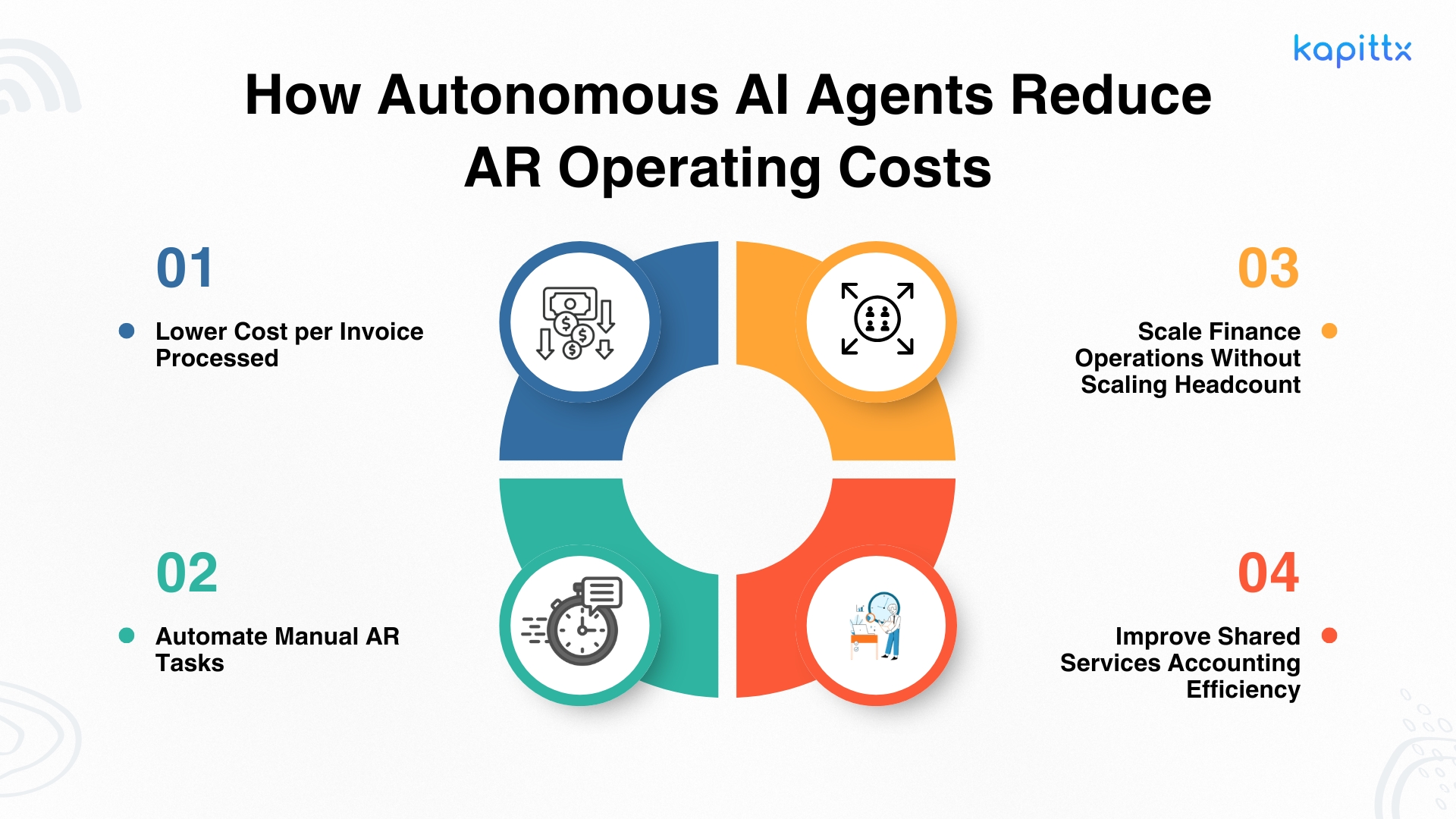
AI agents provide maximum value by eliminating repetitive work throughout the Accounts Receivable process. AI agents provide maximum value by eliminating repetitive work throughout the Accounts Receivable process.
Lower Cost per Invoice Processed
Every automated activity reduces the manual effort required to process an invoice.
As invoice volumes grow, operational expenses increase at a much slower rate than revenue.
This improves one of the most important finance transformation metrics, cost per invoice processed automation.
Automate Manual AR Tasks
AI agents can independently manage numerous repetitive activities, including:
- Payment reminders
- Cash application recommendations
- Invoice matching
- Email triage
- Promise-to-pay tracking
- Collection prioritization
- Dispute routing
- Customer follow-ups
- Reporting
Finance professionals spend less time on administration and more time resolving strategic exceptions.
- Scale Finance Operations Without Scaling Headcount
One of the biggest advantages of AI is enabling finance operations headcount scaling without proportional hiring.
Instead of adding collectors whenever invoice volumes increase, organizations can deploy additional AI agents that work around the clock without fatigue or productivity loss.
This creates a highly scalable finance operating model.
- Improve Shared Services Accounting Efficiency
Shared service centers often struggle with repetitive, high-volume processes.
AI agents standardize execution across locations, reduce manual intervention, improve compliance, and deliver consistent service levels.
The result is significantly higher Shared Services accounting efficiency while maintaining governance and auditability.
A Five-Step Framework for Deploying Autonomous AI Agents
Successful AI adoption isn't about replacing finance teams overnight. It requires a structured transformation approach.
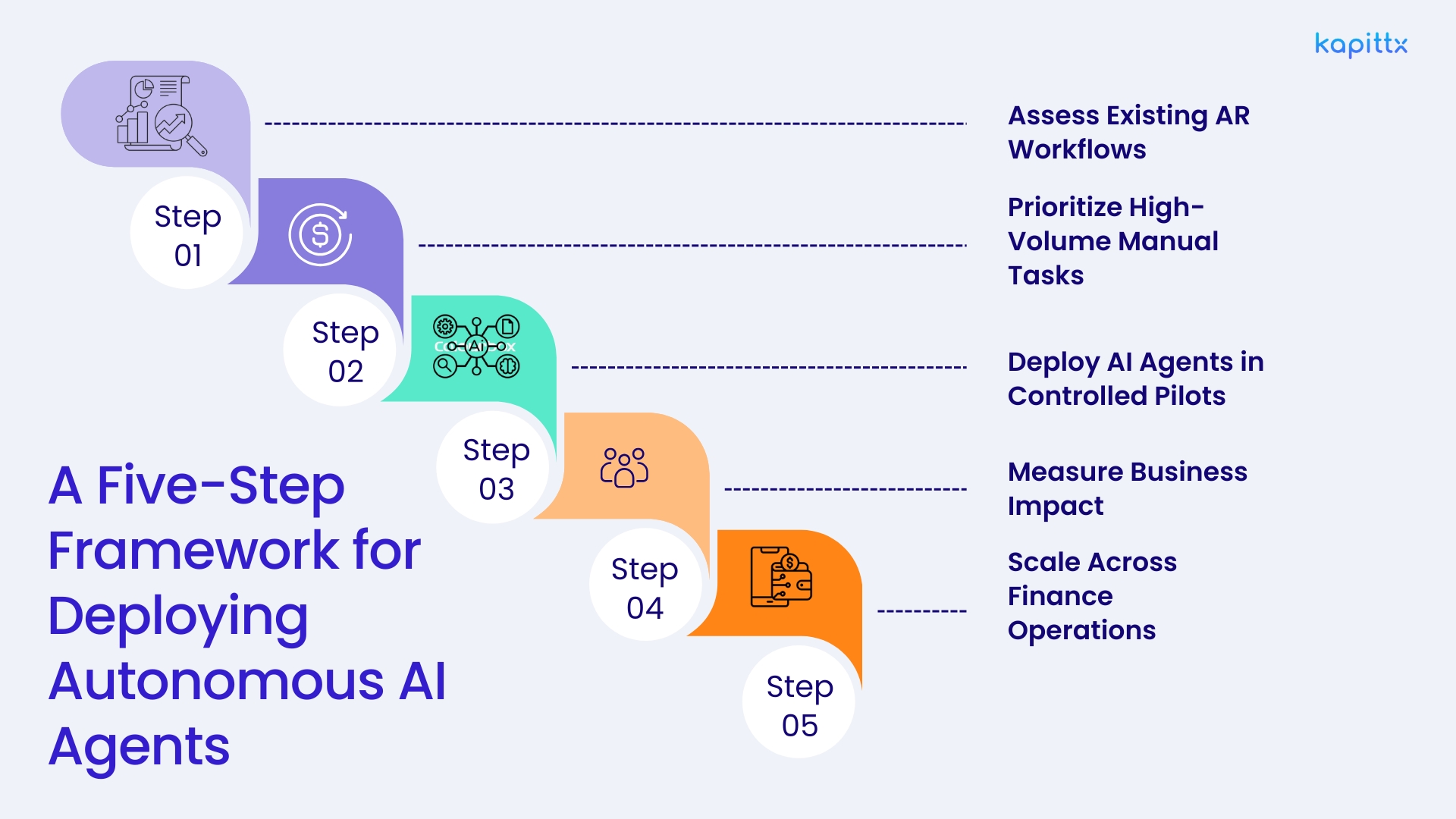
Successful AI adoption isn't about replacing finance teams overnight. It requires a structured transformation approach.
Step 1: Assess Existing AR Workflows
Begin by mapping every activity from invoice generation to payment reconciliation.
Identify bottlenecks, manual handoffs, and exception-heavy processes.
Step 2: Prioritize High-Volume Manual Tasks
Focus first on repetitive activities that consume the most effort, such as payment reminders, email classification, cash application, dispute routing, and reporting. These segments typically deliver the fastest return on investment.
Step 3: Deploy AI Agents in Controlled Pilots
Instead of transforming the entire finance function at once, implement AI agents within one business unit or process.
This allows teams to validate outcomes while building organizational confidence.
Step 4: Measure Business Impact
Monitor KPIs that demonstrate operational improvement, including:
- Cost per invoice processed
- Collection cycle time
- Cash application accuracy
- Manual intervention rate
- Collector productivity
- Exception resolution time
Step 5: Scale Across Finance Operations
Once measurable improvements are achieved, extend AI agents across collections, cash application, deductions management, customer communications, and finance shared services. The result is a connected, intelligent finance organization.
Transforming Shared Services with AI
Shared services have traditionally been designed around labor arbitrage. The next generation of shared services will be built around intelligent automation.
Imagine a finance center where AI agents continuously monitor collector inboxes, reconcile incoming payments, prioritize overdue accounts, identify emerging disputes, and generate executive dashboards, all before employees begin their workday. Instead of hiring more people to manage higher transaction volumes, organizations expand digital capacity through AI.
In one representative scenario, a global finance team reduced manual AR intervention by nearly 70% after deploying autonomous AI agents across collections and cash application. Beyond productivity gains, the organization achieved faster exception resolution, improved audit consistency, and enhanced customer responsiveness. This is no longer simply process automation, it is finance transformation.
Measuring Success: Metrics That Matter
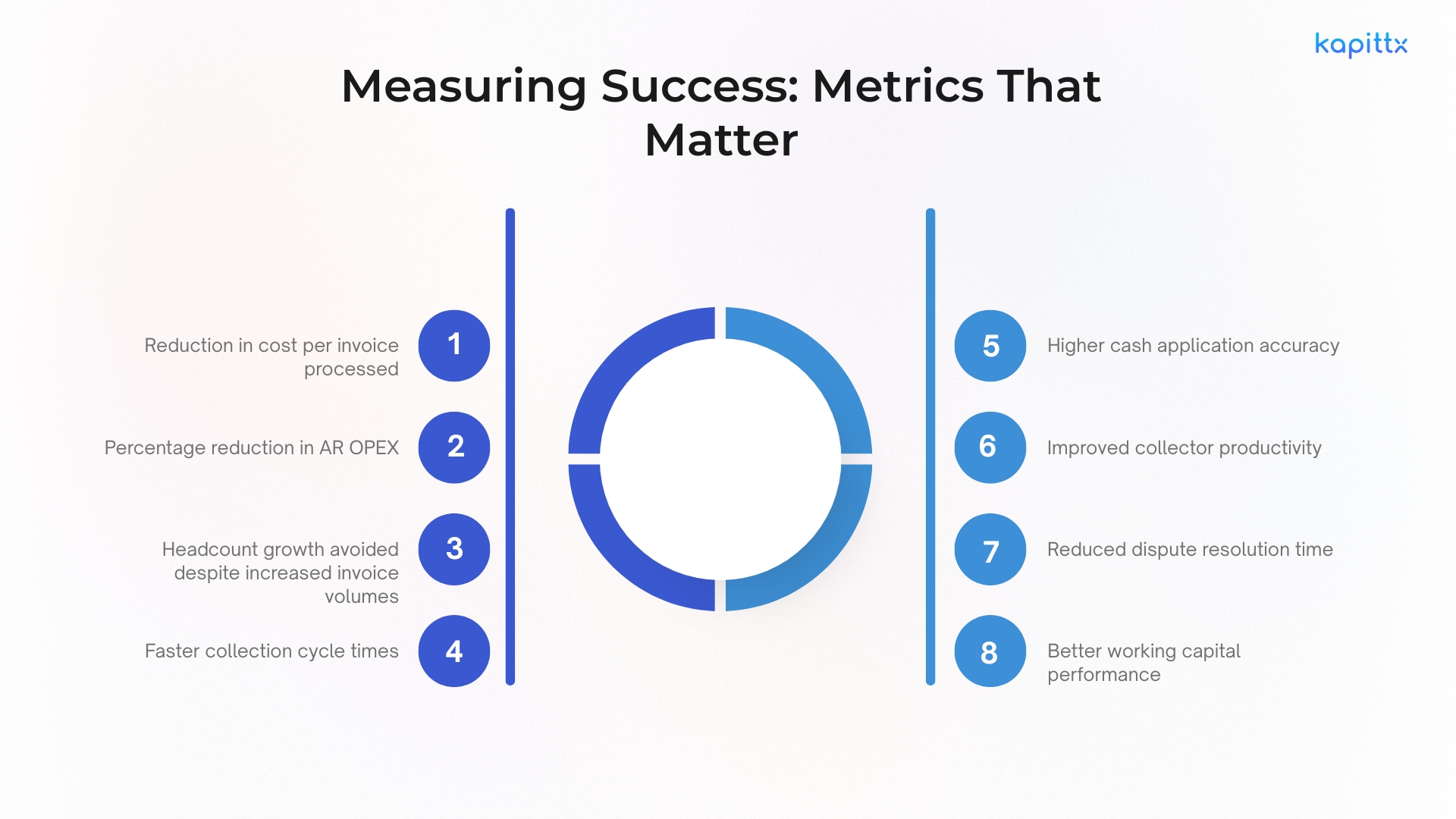
The success of autonomous AI deployment should be evaluated through measurable business outcomes rather than technology adoption alone.
Key metrics include:- Reduction in cost per invoice processed
- Percentage reduction in AR OPEX
- Headcount growth avoided despite increased invoice volumes
- Faster collection cycle times
- Higher cash application accuracy
- Improved collector productivity
- Reduced dispute resolution time
- Better working capital performance
Finance Operations Are Becoming Autonomous
Accounts Receivable is evolving from a labor-intensive function into an intelligent, autonomous operation. The future of finance will not be defined by the size of a shared services team but by the intelligence embedded within its processes. Autonomous AI agents will increasingly predict payment risks, prioritize customer engagement, resolve routine disputes, recommend next-best actions, and continuously optimize workflows without constant human intervention.
Organizations that embrace this shift will build finance functions capable of supporting rapid business growth while maintaining lean operating costs. Those that continue relying on manual processes and headcount expansion will find it increasingly difficult to compete in an environment where speed, efficiency, and cash flow are strategic differentiators.
How Kapittx Helps You Execute This
Kapittx enables finance organizations to move beyond task automation by deploying Autonomous AI agents for AR across the entire invoice-to-cash lifecycle. Its AI-native platform automates manual AR tasks such as collections, payment reminders, cash application, email triage, dispute management, and reconciliation while integrating seamlessly with ERP systems. By reducing the cost per invoice processed, improving Shared Services accounting efficiency, and allowing businesses to scale finance operations without proportional headcount growth, Kapittx helps CFOs build an intelligent, future-ready Accounts Receivable function that delivers measurable reductions in AR OPEX, stronger cash flow, and sustainable operational excellence.
Frequently Asked Questions
