
Scaling Finance Operations: The Executive Guide to Deploying Autonomous AI Agents to Slash AR OPEX
August 6, 2026B2B Payment Solutions: How Payment Automation Helps Buyers Pay Faster and AR Teams Save Time
August 11, 2026Summary
B2B working capital optimization is the cheapest, fastest source of growth funding most finance teams overlook. Instead of drawing down costly credit lines, this playbook shows how to unlock organic corporate liquidity already sitting inside your receivables, payables, and inventory. You'll see how Accounts Receivable automation shrinks Days Sales Outstanding, the cash flow impact of a tighter conversion cycle, and a step-by-step framework CFOs can use to fund growth from the balance sheet they already own.
Introduction: What Capital Efficiency Really Means in B2B
Capital efficiency is the discipline of generating more output, revenue, growth, resilience, from every dollar tied up in operations. In a B2B context, it is less about raising money and more about releasing it. Most mid-market companies are quietly sitting on a second balance sheet: cash trapped in unpaid invoices, mistimed supplier payments, and idle inventory.
The instinct, when growth demands cash, is to call the bank. Yet external credit is the most expensive lever available, and it is rarely the fastest. The alternative is organic liquidity, the working capital your own operations can free up without interest or covenants. This is the heart of B2B working capital optimization, and it is a practical playbook, not a theory. The promise is simple: fund your next stage of growth from cash you already earned.
The True Cost of Capital
Borrowing looks convenient until you price it fully. In 2025–2026, business lines of credit commonly carry rates from roughly 10% to well above 50% APR, while even bank term loans sit near 6% to 11%, before origination, underwriting, and servicing fees. Covenants add a second, hidden cost: they constrain how you operate, what you can spend, and how much scrutiny finance absorbs each quarter.
Organic liquidity carries none of that. Cash pulled forward from receivables, held longer in payables, or released from inventory has an interest rate of zero and no covenant attached. The lowest cost of capital on any CFO's menu is a timely collection: a customer paying on the agreed date converts a receivable into deployable cash at no cost. Seen this way, chasing invoices is not administrative housekeeping, it is treasury.
Accounts Receivable Automation: The Cornerstone
If organic liquidity has a cornerstone, it is Accounts Receivable automation. Receivables typically represent 15–30% of a B2B company's revenue, so the speed at which they convert to cash sets the
tempo of the entire business. Internal inefficiencies drive most collection delays, with Kapittx data showing that approximately 70% of overdue invoices stem from billing mistakes, absent remittance data, and delayed dispute management. Encouragingly, the same research shows about 65% of customers pay on time when they are reminded promptly and correctly.
A Reduce DSO framework built on automation attacks those internal failures directly: accurate invoices issued on time, systematic and segmented follow-ups, structured dispute workflows, real-time aging visibility, and automated cash application. The cash flow impact is immediate and measurable. With market-average DSO having climbed near 59 days against a healthy benchmark closer to 45, many firms carry a 15-day gap. Apply the working-capital formula, (Annual Revenue ÷ 365) × days, and a $30M business that trims 15 days releases about $1.2M in cash it already earned. Finance teams using AI-driven Accounts Receivable automation report 20–30% DSO reductions, translating to 10–20 fewer days and materially stronger, more predictable free cash flow.
Accounts Payable Strategy: Smart Vendor Management
The corresponding process carries equal weight. Days Payable Outstanding (DPO) measures how long you take to pay suppliers, and extending it, within agreed terms, is a legitimate source of internal financing. The goal is not to pay late; it is to pay on time; on the best terms you can negotiate.
Smart vendor management starts with visibility: knowing exactly what is owed, to whom, and when. From there, a simple framework applies. Segment suppliers by strategic importance, negotiate extended terms with high-volume partners in exchange for reliability or volume commitments, and reserve early payment for cases where a discount beats your cost of capital. The discipline is balance. Stretching payables too aggressively damages the supplier trust that keeps your own supply chain moving, so every day of added DPO must be weighed against relationship risk.
Cash Flow Impact & Metrics
Working capital only improves what you measure. Three metrics tell the whole story. Days Sales Outstanding (DSO) tracks how fast you collect; Days Payable Outstanding (DPO) tracks how long you hold cash; and the Cash Conversion Cycle (CCC) ties them together: CCC = DIO + DSO − DPO, where DIO is days inventory outstanding. The shorter the cycle, the less external funding your growth requires, the essence of free cash flow optimization metrics.
|
Metric |
Before |
After |
|
DSO — days to collect |
60 |
45 |
|
DIO — days inventory |
40 |
40 |
|
DPO — days to pay |
30 |
45 |
|
CCC = DIO + DSO − DPO |
70 days |
40 days |
In this illustration, trimming DSO from 60 to 45 and negotiating DPO from 30 to 45 shortens the cycle by 30 days. On $30M in revenue, where roughly every 15 days equals about $1.2M of freed cash, that swing releases well over $2M without a single loan. That is the cash flow impact finance leaders are leaving on the table.
Organic Liquidity Levers Beyond AR and AP
Receivables and payables are the largest levers, but not the only ones. Inventory is cash in disguise: every unit of excess stock is capital that could be working elsewhere, so tightening DIO through demand-based ordering and slow-mover clearance directly frees liquidity. Contract structuring is another underused lever, milestone-based and progress billing pull cash inflows forward instead of waiting for a single end-of-project invoice. Finally, dynamic discounting lets you offer buyers a small, calibrated discount for early payment, trading a modest margin for faster, more certain inflows when your own cost of capital is high. Used together, these levers deepen organic liquidity well beyond the AR ledger.
Building a Capital Efficiency Playbook
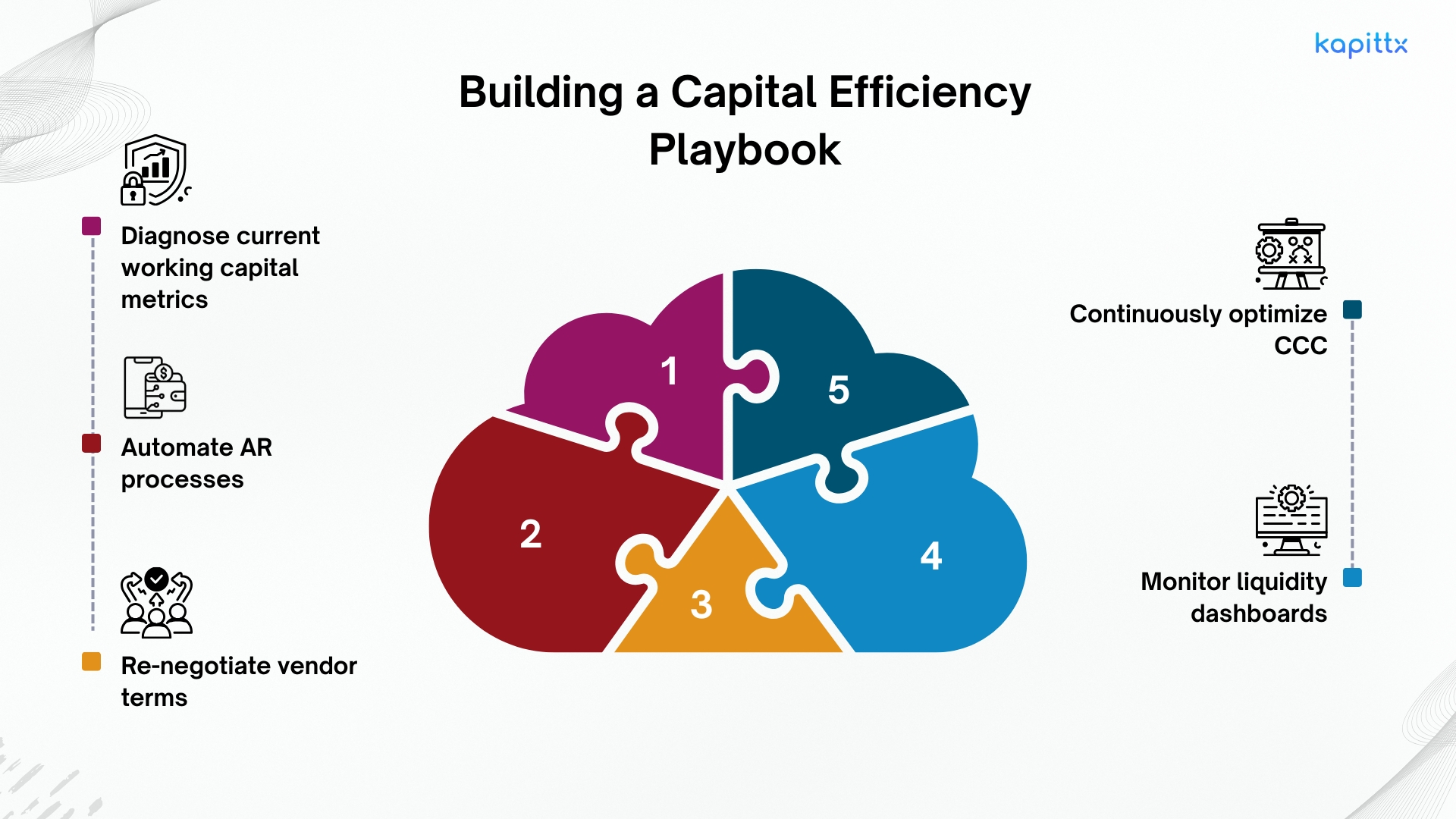
A playbook is only useful if it is repeatable. Five steps turn these ideas into an operating rhythm:
1. Diagnose current working capital metrics. Baseline DSO, DPO, DIO, and CCC, and quantify the cash trapped in each.
2. Automate AR processes. Deploy Accounts Receivable automation to fix the internal 70% of delays, invoicing, dunning, disputes, and cash application.
3. Re-negotiate vendor terms. Extend DPO strategically where relationships and volume allow, without eroding trust.
4. Monitor liquidity dashboards. Track receivables, payables, and the cycle in real time so decisions are proactive, not month-end surprises.
5. Continuously optimize CCC. Treat capital efficiency as a standing discipline, review, adjust, and compound the gains each quarter.
This is iterative, not a one-time project. Each turn of the cycle tightens the next, and the freed cash compounds into a durable funding advantage.
Conclusion
The cheapest capital on any balance sheet is the cash you already own. Before signing for another line of credit, finance leaders should exhaust organic liquidity, the receivables waiting to be collected, the payables that can be timed, and the inventory that can be trimmed. B2B working capital optimization is not a cost-cutting exercise; it is a growth strategy that funds itself. Adopt a capital efficiency mindset, and you build a business that grows on its own cash flow rather than someone else's interest rate.
How Kapittx Adds Value
Kapittx turns this playbook into an operating system for organic liquidity. Its AI-native Accounts Receivable automation attacks the internal causes of late payment head-on: accurate, on-time invoicing; intelligent, segmented dunning with embedded payment links; structured dispute resolution; predictive flagging of high-risk accounts; and touchless cash application that auto-matches up to 95% of payments across invoices, remittance, and bank receipts. Everything syncs in real time with the ERPs finance teams actually run, SAP, Oracle NetSuite, Microsoft Dynamics 365, QuickBooks, Xero, Tally, and Zoho Books, posting reconciled cash straight to your system of record.
The cash flow impact is concrete. Kapittx customers report 20–30% reductions in DSO, often 10–20 fewer days, up to 80% less time spent chasing cash, and 30–40% of finance-team capacity returned to higher-value work, with go-live measured in weeks. That is B2B working capital optimization in practice: lower DSO, a shorter conversion cycle, and millions in organic liquidity unlocked without touching an expensive line of credit.
Frequently Asked Questions
