
Closing the Cash Conversion Loop: Why Siloed AR and AP Software Is Stalling Your Free Cash Flow
August 24, 2026Is Your AR Team Ready for Automation? 10 KPIs That Reveal the Answer
August 26, 2026Executive Summary
TDS reconciliation should not remain a quarterly tax-compliance exercise disconnected from accounts receivable. When expected TDS deductions are not compared with actual customer deductions during collection and cash application, businesses accumulate unidentified short payments, overstated receivables and unreconciled TDS credits. Integrating TDS receivable reconciliation with AR collections helps detect incorrect rates, LDC violations, missing deposits and PAN errors early—before they become aged exceptions, tax-credit losses, write-offs or avoidable cash-flow problems.
TDS Receivables: The Blind Spot Between Collections and Tax
An invoice is raised for ₹11.8 lakh. The customer pays ₹10.8 lakh and describes the ₹1 lakh difference as TDS.
For the collection team, the invoice may appear substantially settled. For the tax team, the TDS will be examined later when the relevant tax statement becomes available. Between those two events, ₹1 lakh sits as a TDS receivable without confirmation that:
- The correct TDS rate was applied
- TDS was calculated on the correct taxable value
- The customer deposited the amount
- The customer reported the correct PAN
- The credit will appear against the correct financial year
- An applicable Lower Deduction Certificate was followed
This gap makes TDS receivables a significant blind spot for Indian AR teams.
Tax Deducted at Source is collected at the point at which specified income originates. The payer deducts the tax and remits it to the Government on behalf of the recipient.
For the supplier, however, the deduction creates more than a tax record. It creates a receivable that must ultimately be supported by a corresponding tax credit.
If the credit is missing or incorrect, the accounting entry does not automatically turn into a recoverable tax asset.
How TDS Works in a B2B Transaction
Consider a simplified professional-services invoice:
- Taxable service value: ₹100
- GST at 18%: ₹18
- Total invoice value: ₹118
- Applicable TDS rate: 10%
- Expected TDS on the taxable value: ₹10
- Expected customer payment: ₹108
- TDS receivable recorded: ₹10
The customer pays ₹108 and deposits the remaining ₹10 with the Government against the supplier’s PAN. The customer subsequently reports the transaction through its TDS statement.
The supplier should then reconcile the ₹10 recorded as a TDS receivable with the tax credit reported against its PAN.
Form 26AS has traditionally provided a consolidated annual tax statement containing TDS and TCS information. The Income Tax Department also provides facilities for identifying mismatches between tax credits claimed and the information reflected in the tax statement.
Finance teams should consult their tax advisers regarding the applicable forms and transition requirements under the current tax framework. Regardless of the reporting form used, the operational reconciliation requirement remains the same: every TDS receivable recorded in the books should be matched with the corresponding credit reported by the deductor.
Why Form 26AS Reconciliation Is Difficult
TDS reconciliation is not a straightforward invoice-to-statement lookup. Several structural and operational differences make matching difficult.
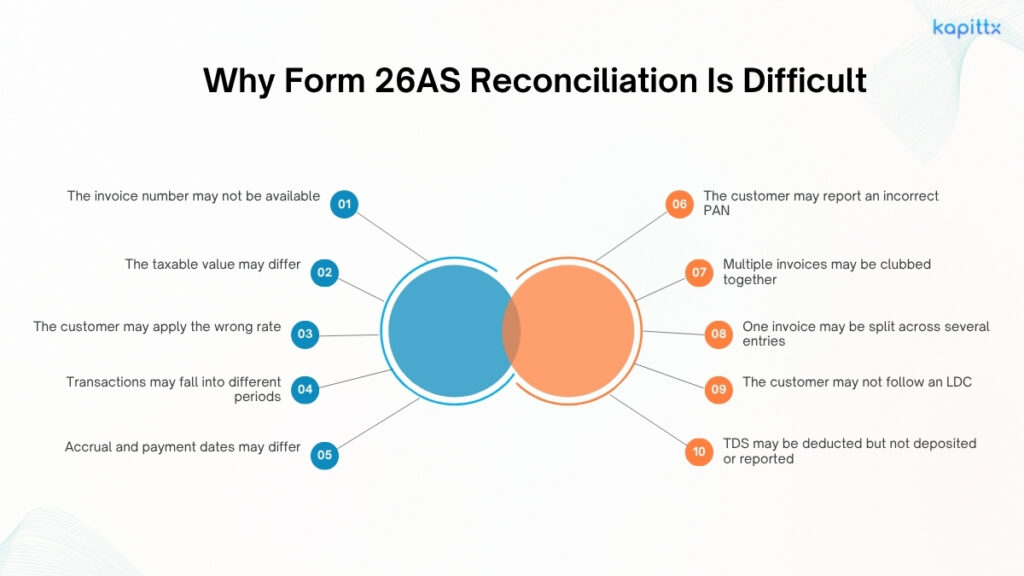
1. The invoice number may not be available
A tax statement generally does not provide the supplier’s invoice number as a universal reconciliation key. Finance teams may have to match using PAN, deductor, transaction date, taxable amount, TDS amount and section or rate.
2. The taxable value may differ
The supplier may expect TDS on the base value, while a customer may deduct it using a different amount. This creates a mismatch between expected and actual TDS.
3. The customer may apply the wrong rate
The supplier may expect a 2% deduction, while the customer deducts 10%. The resulting short payment can easily be classified as “TDS” without validating whether the deduction is correct.
4. Transactions may fall into different periods
The supplier may record the payment in July, while the customer reports the deduction in August. The reconciliation becomes more difficult when the timing difference crosses a quarter or financial year.
5. Accrual and payment dates may differ
TDS is generally triggered at payment or credit, whichever is earlier, subject to the applicable provision. A customer may therefore report the deduction based on the accrual date while the AR team searches using the later payment date.
6. The customer may report an incorrect PAN
The customer may have deducted and deposited the money but attributed it to the wrong PAN. The supplier then receives less cash without receiving the corresponding tax credit.
7. Multiple invoices may be clubbed together
A customer may report one combined TDS transaction for several invoices. A simple one-to-one matching rule will fail even though the overall deduction may be correct.
8. One invoice may be split across several entries
Internal cost-centre allocations may cause a customer to divide one supplier invoice into multiple transactions. Form 26AS reconciliation then requires a many-to-one match.
9. The customer may not follow an LDC
A valid Lower Deduction Certificate may permit tax to be deducted at a lower or nil rate, but the customer may continue applying the standard rate.
10. TDS may be deducted but not deposited or reported
A customer may reduce its payment by the stated TDS amount but delay depositing it or filing the relevant statement. Until reporting is completed correctly, the supplier may not receive usable credit.
The Cost of Irregular TDS Reconciliation
When TDS receivable reconciliation is performed only quarterly or at year-end, the organization loses valuable time.
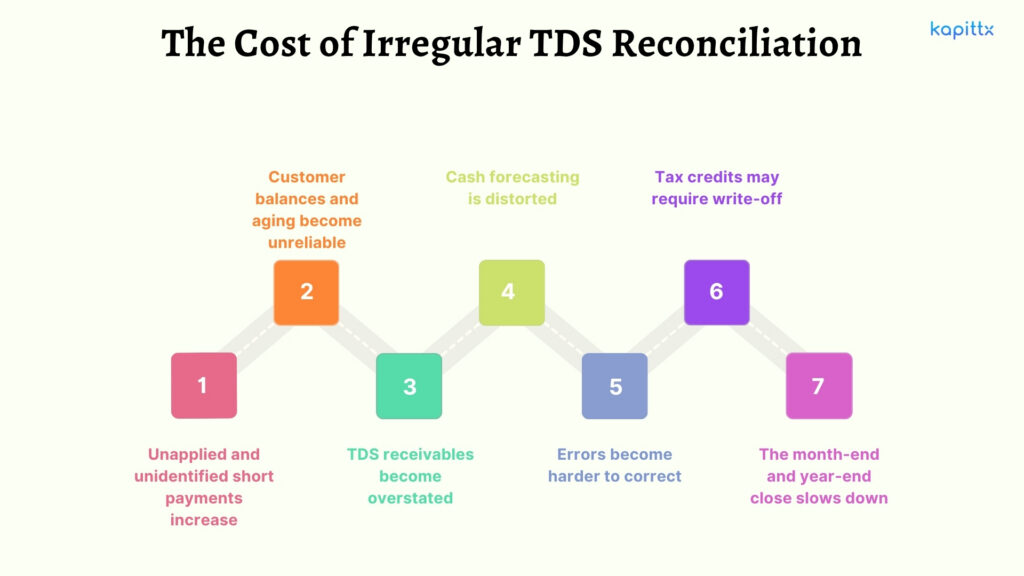
Unapplied and unidentified short payments increase
A payment lower than the invoice value may remain unapplied while AR waits for an explanation. Alternatively, it may be closed using a generic TDS adjustment without validating the deduction.
Both treatments hide the real exception.
Customer balances and aging become unreliable
If the actual deduction is different from the expected TDS, the residual amount may remain on the customer account. Over time, AR aging accumulates small balances that are difficult to explain or recover.
TDS receivables become overstated
The ledger may show that the company is entitled to a tax credit even though the customer has not deposited or correctly reported the deduction.
Cash forecasting is distorted
Expected collections are calculated using the invoice balance, but the amount received is lower because of TDS. If the expected deduction is not built into the collection forecast, cash inflows will repeatedly fall below plan.
Errors become harder to correct
A customer is more likely to investigate a deduction from the current month than one recorded several quarters or financial years earlier. Once customer books are closed or team members change, resolving the mismatch becomes slower.
Tax credits may require write-off
An unreconciled TDS receivable is not automatically lost revenue. It initially represents a tax asset or recoverable amount. However, if the credit cannot be substantiated or recovered, the balance may eventually require a write-off, subject to the company’s accounting policy and tax advice.
The month-end and year-end close slows down
Tax and finance teams must investigate old differences across ERP data, bank receipts, customer communications and tax statements—often without a common transaction reference.
This is working capital leakage caused by delayed exception detection.
Expected TDS Versus Actual TDS: Detect the Difference During Collection
The most important improvement is to stop waiting for the tax statement to discover every TDS discrepancy.
The AR system can calculate the expected TDS deduction when an invoice is raised or when a collection is forecast. During cash application, the expected amount can be compared with the actual deduction indicated by the customer’s payment and remittance advice.
The process should answer four questions:
- What TDS amount was expected?
- What TDS amount did the customer actually deduct?
- Why is there a difference?
- Does the difference require immediate customer action?
For example:
- Invoice value excluding GST: ₹10,00,000
- GST: ₹1,80,000
- Gross invoice: ₹11,80,000
- Expected TDS rate: 2%
- Expected TDS: ₹20,000
- Expected cash receipt: ₹11,60,000
- Actual customer receipt: ₹10,80,000
- Implied TDS deduction: ₹1,00,000
- Excess deduction: ₹80,000
Without an expected-versus-actual comparison, the ₹1,00,000 may be posted entirely as TDS receivable.
With automated validation, the system can identify that only ₹20,000 was expected and immediately flag the additional ₹80,000 as an exception.
The collection team can then contact the customer while the payment, invoice and remittance are still current. This is far more effective than discovering the difference during a quarterly or year-end tax reconciliation.
The LDC Scenario: When a 2% Certificate Becomes a 10% Cash Deduction
A Lower Deduction Certificate, commonly referred to as an LDC, may be issued under Section 197 for lower or nil deduction, subject to the applicable transaction and certificate conditions. Official tax guidance describes a Section 197 certificate as permitting lower or nil deduction.
Suppose a service provider has a valid LDC permitting TDS at 2%.
For a taxable invoice value of ₹10,00,000:
- TDS under the LDC: ₹20,000
- TDS applied by the customer at 10%: ₹1,00,000
- Excess cash deducted: ₹80,000
If the mistake continues across ten similar invoices, ₹8,00,000 of additional cash is withheld.
The company may eventually receive tax credit for the higher amount if it is deposited and reported correctly. But that does not eliminate the immediate liquidity impact. Cash that should have been available for payroll, supplier payments, debt servicing or growth remains outside the business.
An effective LDC reconciliation process should maintain:
- Customer and PAN details
- Certificate number
- Validity period
- Applicable section
- Approved rate
- Approved amount or threshold
- Amount already consumed
- Remaining certificate balance
- Invoices and payments covered by the certificate
During collection and cash application, the system should automatically compare the customer’s actual deduction with the valid LDC rate.
If the customer ignores the certificate, the collection team should receive an immediate exception with the invoice, expected deduction, actual deduction and supporting LDC details.
Why TDS Reconciliation Belongs With AR Collections
Large organizations often divide responsibilities as follows:
- AR handles invoices, customer follow-up and collections.
- Tax handles TDS compliance and Form 26AS reconciliation.
- Treasury monitors cash.
- Accounting manages ERP posting and closing.
This division appears logical, but TDS receivables originate from customer payments. The information needed to resolve them—including payment advice, deduction explanations and customer contacts—usually sits with AR.
The tax team may identify that a credit is missing, but it may not have:
- The relevant remittance advice
- The associated invoice history
- The customer’s payment contact
- The collection correspondence
- The promise or reason provided by the customer
- The operational relationship needed to obtain a correction
TDS reconciliation should therefore remain tax-governed but AR-integrated.
Tax should define the applicable rules and validate compliance. AR should incorporate unresolved TDS exceptions into routine customer follow-up. Accounting should ensure that only supported entries are cleared. Treasury and FP&A should understand how mismatches affect liquidity.
From Quarterly Reconciliation to Continuous TDS Control
A continuous process can operate at three stages.
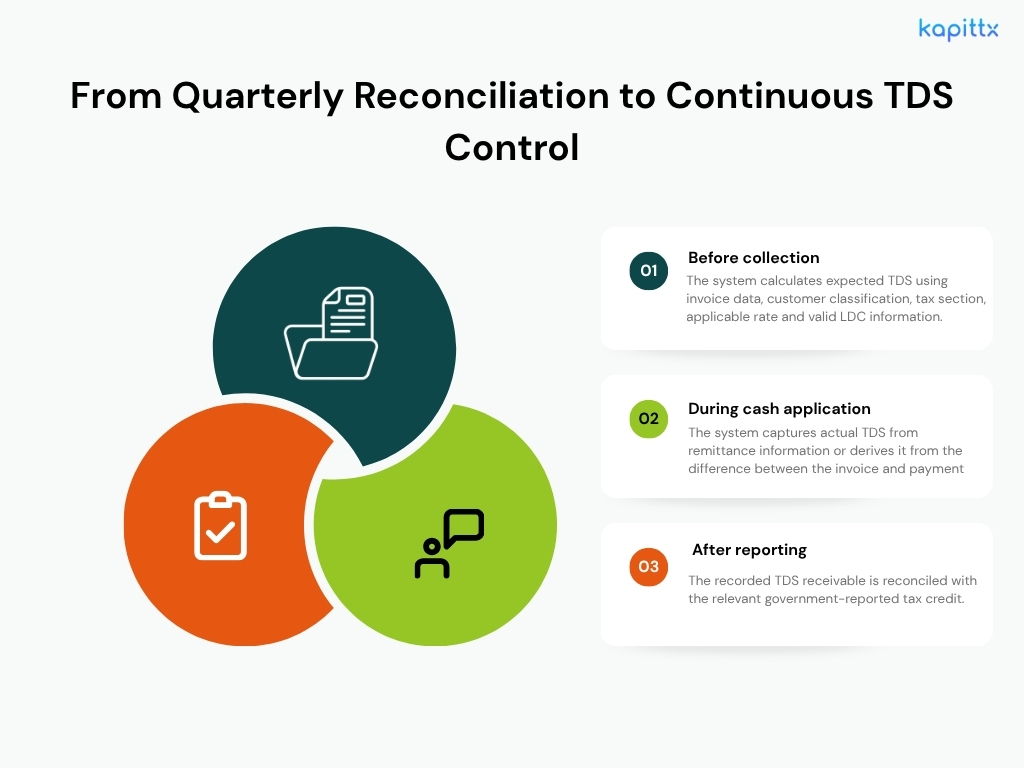
Stage 1: Before collection
The system calculates expected TDS using invoice data, customer classification, tax section, applicable rate and valid LDC information.
Stage 2: During cash application
The system captures actual TDS from remittance information or derives it from the difference between the invoice and payment. It compares expected TDS with actual TDS before closing the invoice.
Stage 3: After reporting
The recorded TDS receivable is reconciled with the relevant government-reported tax credit. Unmatched items are classified by reason and routed for customer follow-up.
This creates three-way TDS reconciliation:
Expected TDS → Actual deduction → Reported tax credit
Most organizations concentrate on the third step. The larger opportunity is to connect all three.
How Kapittx Can Automate TDS Receivable Reconciliation
Kapittx can connect TDS reconciliation with cash application and AR collections instead of treating it as an isolated tax activity.
Calculate expected TDS
Kapittx can use invoice value, customer data, applicable tax rules and LDC details to establish the expected deduction and expected cash receipt.
Capture actual deductions
The AI Cash Application Agent can read remittance advice, payment details and deduction information from emails, spreadsheets, PDFs and other formats.
Compare expected and actual TDS
When the customer deduction differs from the calculated amount, Kapittx can create an exception before the invoice is closed.
Support complex matching
The reconciliation process can accommodate:
- One tax entry covering multiple invoices
- Multiple tax entries relating to one invoice
- Timing differences
- Accrual-versus-payment-date differences
- Rate and taxable-value mismatches
- Customer and PAN discrepancies
- LDC rate deviations
Reconcile tax credits
Book-level TDS receivables can be matched against Form 26AS or the applicable tax-credit statement using customer, PAN, date, amount and other available attributes.
Classify exceptions
Instead of presenting finance teams with one large unmatched list, Kapittx can categorize exceptions as:
- Credit not reported
- Deposit or return pending
- Incorrect PAN
- Rate mismatch
- Taxable-value mismatch
- Timing difference
- LDC not applied
- Invoice clubbing or splitting
- Possible duplicate
- Customer clarification required
Integrate exceptions with collections
Unresolved TDS items can become part of regular customer follow-up. The collection team receives the reason, amount, supporting invoice and required action instead of investigating the issue from the beginning.
Maintain evidence and audit history
Customer responses, supporting certificates, approvals, matching decisions and follow-up actions can be retained in one controlled workflow.
The result is an exception-driven process in which automation clears straightforward matches and finance teams focus on recoveries that genuinely require attention.
Business Impact of Integrated AR and TDS Reconciliation
Integrating TDS receivable reconciliation with collections can help organizations:
- Detect excessive or incorrect deductions earlier
- Prevent valid customer receipts from remaining unapplied
- Reduce old TDS receivable balances
- Improve customer ledger accuracy
- Protect tax-credit recoverability
- Identify customers that deducted but did not report TDS
- Enforce LDC rates before excess deductions multiply
- Improve collection and cash-flow forecasting
- Reduce manual matching across invoices and tax statements
- Accelerate month-end and year-end closing
- Strengthen collaboration between AR, tax and accounting teams
The most important benefit is timing. An exception detected during collection is easier to resolve than the same exception discovered after the financial year has closed.
A Practical TDS Reconciliation Framework
Finance leaders can begin with six steps:
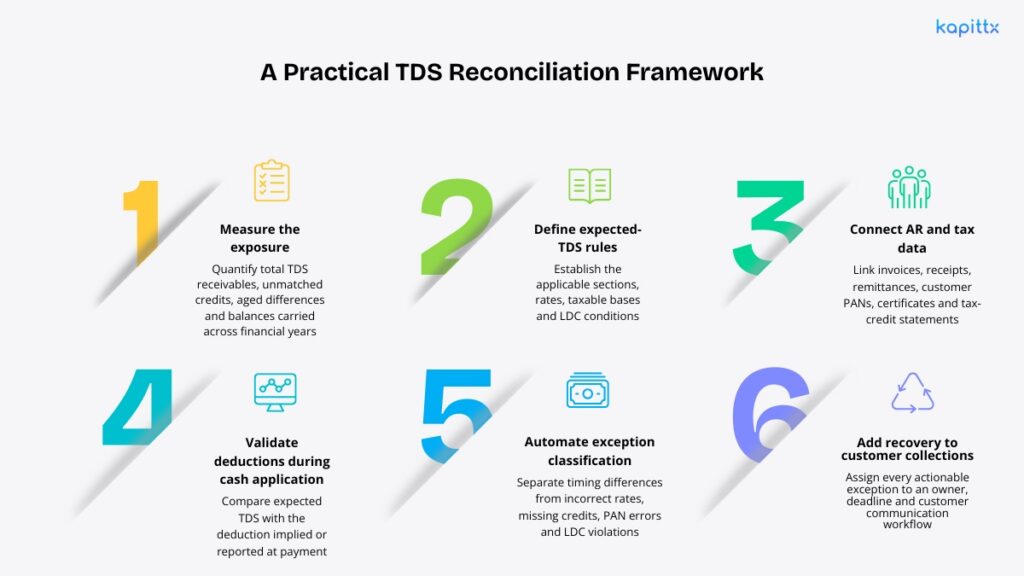
- Measure the exposure: Quantify total TDS receivables, unmatched credits, aged differences and balances carried across financial years.
- Define expected-TDS rules: Establish the applicable sections, rates, taxable bases and LDC conditions.
- Connect AR and tax data: Link invoices, receipts, remittances, customer PANs, certificates and tax-credit statements.
- Validate deductions during cash application: Compare expected TDS with the deduction implied or reported at payment.
- Automate exception classification: Separate timing differences from incorrect rates, missing credits, PAN errors and LDC violations.
- Add recovery to customer collections: Assign every actionable exception to an owner, deadline and customer communication workflow.
Conclusion: TDS Reconciliation Is a Cash-Control Process
TDS may be governed by the tax function, but TDS receivables are created through accounts receivable.
Waiting until the quarter-end or year-end to reconcile them allows errors to age, weakens recovery and hides the real cash-flow impact of customer deductions.
The better approach is continuous reconciliation:
Calculate what the customer should deduct. Capture what the customer actually deducts. Confirm what the customer reports.
By connecting these three stages, finance teams can detect LDC violations, rate mismatches, missing deposits and reporting errors while there is still time to resolve them.
TDS reconciliation should not begin when Form 26AS is downloaded. It should begin when the collection is expected.
FAQs
What is TDS receivable reconciliation?
TDS receivable reconciliation matches the TDS recorded in a company’s books with the amount deducted by customers and the corresponding credit appearing in the applicable government tax statement.
Why is TDS treated as a receivable?
When a customer deducts TDS, the supplier receives less cash but may claim the deducted amount as tax credit, subject to correct deposit, reporting and tax eligibility. The amount is therefore recorded as a TDS receivable until reconciled.
Why does TDS reconciliation create unapplied cash?
If the system does not know the expected TDS amount, a short payment may not match the invoice. The receipt can remain unapplied until the deduction is identified and validated.
What causes a Form 26AS mismatch?
Common causes include incorrect PAN, delayed TDS returns, wrong rates, different taxable values, timing differences, invoice clubbing, invoice splitting and TDS deducted but not correctly reported.
What is expected-versus-actual TDS reconciliation?
It compares the TDS calculated from the invoice and applicable tax rules with the amount the customer actually deducted during payment.
What is an LDC in TDS?
An LDC is a Lower Deduction Certificate permitting a payer to deduct tax at a lower or nil rate for qualifying transactions, subject to the certificate’s validity and conditions.
How does an ignored LDC affect cash flow?
If a customer deducts TDS at the standard rate instead of the LDC rate, the supplier receives less cash than expected. Even if credit is eventually available, the excess deduction reduces immediate liquidity.
How often should businesses perform TDS reconciliation?
Book-level expected-versus-actual TDS validation should occur during each cash-application cycle. Tax-credit statement reconciliation should be performed regularly when updated data becomes available rather than being postponed until year-end.
Should TDS reconciliation be owned by AR or tax?
Tax should govern the rules, while AR should own customer follow-up for payment-related exceptions. The most effective model connects AR, tax, accounting and treasury rather than assigning the process entirely to one department.
How does Kapittx help with TDS reconciliation?
Kapittx connects invoice data, expected deductions, remittances, customer receipts, LDC information and tax-credit data. It automates matching, classifies exceptions and incorporates unresolved TDS items into AR collection workflows.
