
Why Connecting Your AR and AP Is the Secret to Stress-Free Cash Flow Planning
August 18, 2026The TDS Receivable Trap: Why Waiting for Form 26AS Is Costing Your Cash Flow
August 25, 2026Executive Summary
AR and AP software can automate collections and payables independently, but disconnected systems often create working capital drag rather than free cash flow optimization. Separate workflows delay cash application, leave receipts unapplied and prevent DSO and DPO alignment. To improve capital velocity, finance leaders need to eliminate financial data silos across ERP layers and connect receivables, payables, reconciliation, treasury and forecasting through one continuously updated cash intelligence layer.
Introduction: Finance Automation Has a Connectivity Problem
Most companies no longer manage accounts receivable and accounts payable entirely through manual processes. They have invested in collection platforms, invoice automation, payment portals, supplier workflows and ERP integrations.
Yet many CFOs still struggle to answer a seemingly simple question:
How much cash will the business genuinely have available next week, next month or next quarter?
The problem is not necessarily a lack of automation. It is that AR and AP software frequently operates in separate environments.
The AR system focuses on customer invoices, collections and incoming payments. The AP system focuses on supplier invoices, approvals and outgoing payments. Treasury monitors bank balances, while FP&A builds forecasts using data extracted from multiple systems.
Each function may be automated, but the complete cash movement is not.
This creates siloed accounting software applications that perform individual tasks without sharing the context required to optimize liquidity. Finance teams gain departmental productivity but continue to experience unapplied cash, unreliable forecasts, unnecessary borrowing and poorly timed supplier payments.
Closing the cash conversion loop requires a different objective: connecting every operational cash signal to a reconciled position, forecast and working capital decision.
What Is the Cash Conversion Loop?
The traditional cash conversion cycle measures how quickly a business converts its operating investments into cash:
Cash Conversion Cycle = DIO + DSO − DPO
Where:
- DIO is Days Inventory Outstanding
- DSO is Days Sales Outstanding
- DPO is Days Payables Outstanding
The metric helps CFOs measure how long cash remains committed to inventory and receivables after accounting for supplier credit. However, the formula does not explain why cash becomes delayed or where it gets trapped.
The operational cash conversion loop is broader:
Order → Invoice → Collection → Cash Application → Payables → Cash Positioning → Forecast → Working Capital Decision
Every step provides information that changes the company’s actual or expected liquidity.
A customer dispute reduces the probability of collecting an invoice on time. A payment received without remittance creates unapplied cash. A supplier invoice blocked by a missing GRN changes the expected payment date. A marketplace deduction changes the net value of an incoming settlement.
AR and AP are therefore not isolated back-office functions. They are two sides of the same working capital engine.
The Impact of Separate AR and AP Workflows on Working Capital
Separate AR and AP workflows weaken the organization’s ability to coordinate cash inflows with cash outflows.
AR may forecast collections using invoice due dates, promise-to-pay information and customer history. AP may forecast payments using supplier terms, approval status and scheduled payment runs. Treasury then receives two different datasets based on different assumptions and refresh cycles.
The consequences include:
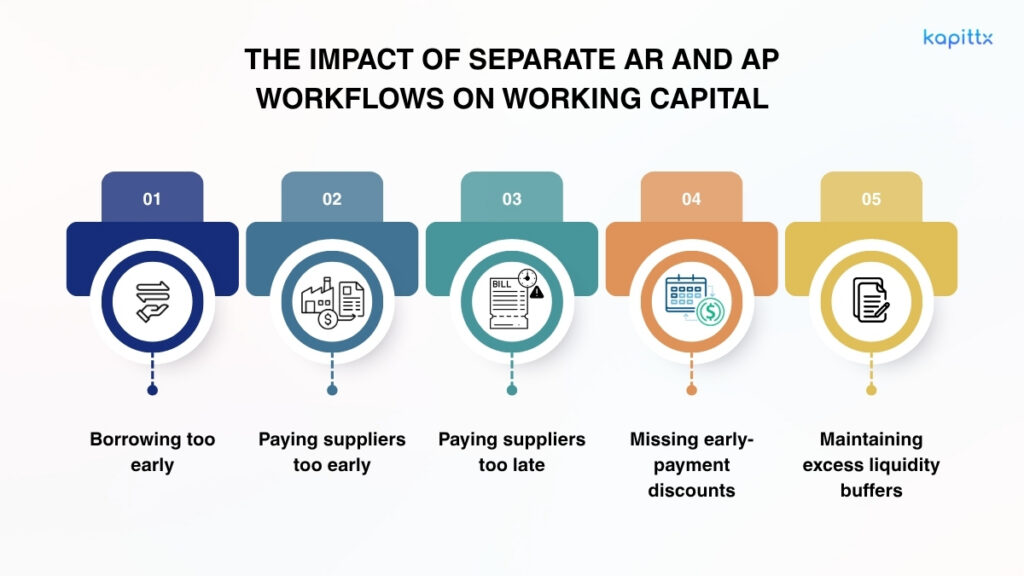
Borrowing too early
Treasury may arrange short-term funding because it cannot see that a large customer payment has been confirmed or received but remains unapplied.
Paying suppliers too early
AP may release payments based on due dates without considering whether incoming cash has been delayed or whether maintaining liquidity would be more valuable.
Paying suppliers too late
In the opposite scenario, poor inflow visibility may cause AP to hold payments unnecessarily, damaging supplier relationships or disrupting supply.
Missing early-payment discounts
Without a unified view of cash availability, finance teams cannot reliably determine whether the return from an early-payment discount is greater than the value of retaining the cash.
Maintaining excess liquidity buffers
Low forecast confidence encourages treasury to hold more cash “just in case.” Although the buffer reduces immediate risk, it also keeps capital from being used for debt reduction, inventory, expansion or strategic investment.
These effects collectively create working capital drag: cash is available somewhere in the operating cycle but cannot be deployed efficiently because its amount, ownership, timing or status is uncertain.
Why DSO and DPO Alignment Matters
DSO and DPO are often managed as separate performance metrics.
AR is encouraged to reduce DSO by collecting customer invoices faster. AP is encouraged to optimize DPO by taking advantage of supplier credit without damaging commercial relationships.
However, independently optimizing the two numbers does not necessarily produce the best cash outcome.
DSO and DPO alignment means coordinating the timing and confidence of customer collections with the timing and economics of supplier payments.
For example, if a customer payment is highly likely to arrive within three days, AP may be able to release a strategically important supplier payment without using external funding. If the collection is disputed or historically unreliable, maintaining liquidity may be more appropriate.
This does not mean that every supplier payment should wait for a corresponding customer receipt. It means payment decisions should reflect:
- Current cash availability
- Probability-weighted customer inflows
- Supplier importance
- Payment terms and discounts
- Financing costs
- Business continuity risks
- Currency and entity restrictions
Effective DSO and DPO alignment turns working capital management from a departmental exercise into an enterprise decision system.
B2B Cash Application and Payables Synchronization
B2B cash application and payables synchronization creates a continuous connection between incoming-payment events and outgoing-payment commitments.
On the AR side, the transaction chain may include:
Customer invoice → Remittance advice → Bank receipt → Deduction → ERP posting
On the AP side, it may include:
Purchase order → GRN → Supplier invoice → Dispute → Payment approval → ERP posting
Both chains ultimately affect the same cash position.
A synchronized model continuously updates liquidity as transactions move through these stages. For example:
- A customer promise-to-pay changes the probability of an inflow.
- A confirmed remittance increases forecast confidence.
- A bank receipt converts expected cash into available cash.
- A deduction reduces the collectible invoice amount.
- A matched supplier invoice establishes a probable outflow.
- A failed three-way match delays or changes that outflow.
- Payment approval converts a probable outflow into a committed outflow.
This produces a more accurate picture than combining static AR and AP reports at the end of the week or month.
Siloed Accounting Software Slows Capital Velocity
Capital velocity describes how effectively a company moves cash through its operating cycle and redeploys it into productive use.
Faster capital velocity does not come only from collecting invoices sooner. It also depends on how quickly the company can:
- Identify a receipt
- Apply it to the correct invoices
- Resolve associated deductions
- Update customer exposure
- Revise the cash forecast
- Determine the best use of the available cash
- Execute the resulting working capital decision
Siloed accounting software slows this sequence because data must be extracted, verified and reconciled before another team can act on it.
A company may therefore report a reasonable cash conversion cycle while still suffering from slow internal capital velocity. Cash may have reached the bank but remain operationally unavailable because the receipt has not been reconciled, its purpose is unknown or downstream decisions still depend on outdated information.
Improving capital velocity requires reducing the time between a cash event and an informed financial action.
Why CFO Dashboards Often Show a Cash Snapshot
Many CFO dashboards rely heavily on posted ERP data. This provides a controlled accounting view, but it may exclude operational events that have not completed the posting cycle.
A dashboard may therefore miss:
- Customer payments received but not applied
- Confirmed remittances awaiting bank validation
- Deductions awaiting classification
- Supplier invoices blocked by missing GRNs
- Approved payment runs awaiting release
- Customer promises that are likely to be missed
- Marketplace settlements reduced by fees or claims
A unified CFO dashboard should distinguish between:
- Recorded cash: Reconciled and posted transactions
- Confirmed cash: Validated cash movements awaiting final posting
- Expected cash: Probability-adjusted future receipts and payments
- At-risk cash: Amounts affected by disputes, deductions or operational delays
This provides a view of “true cash”—not simply the bank balance or general ledger position, but the amount that is available, expected, committed and at risk.
Eliminating Financial Data Silos in ERP Layers
ERPs remain the accounting system of record, but they are not always the only source of information needed for real-time working capital decisions.
Important cash signals may reside in:
- Bank files
- Lockbox data
- Remittance emails
- Customer portals
- Supplier portals
- Payment service providers
- Amazon, Walmart and other marketplace settlements
- Collection communications
- Purchase orders and GRNs
- Dispute-management systems
- Treasury platforms
Eliminating financial data silos in ERP layers does not necessarily require replacing the ERP. It requires an intelligence layer that connects these sources, standardizes the data and continuously updates the financial meaning of each transaction.
That layer should:
- Create consistent identifiers across systems
- Match related financial documents
- Detect missing or duplicate transactions
- Apply approved accounting and reconciliation rules
- Update forecasts when transaction status changes
- Post validated outcomes back to the ERP
- Preserve approval histories and audit trails
- Escalate material exceptions to the correct person
The ERP continues to maintain the official accounting record. The connected intelligence layer ensures that operational cash information reaches the ERP and decision-makers faster.
How Unified AR and AP Software Supports Free Cash Flow Optimization
Free cash flow optimization requires more than increasing collections or postponing payments. It requires improving the timing, certainty and economic value of every cash decision.
Unified AR and AP software supports this by creating:
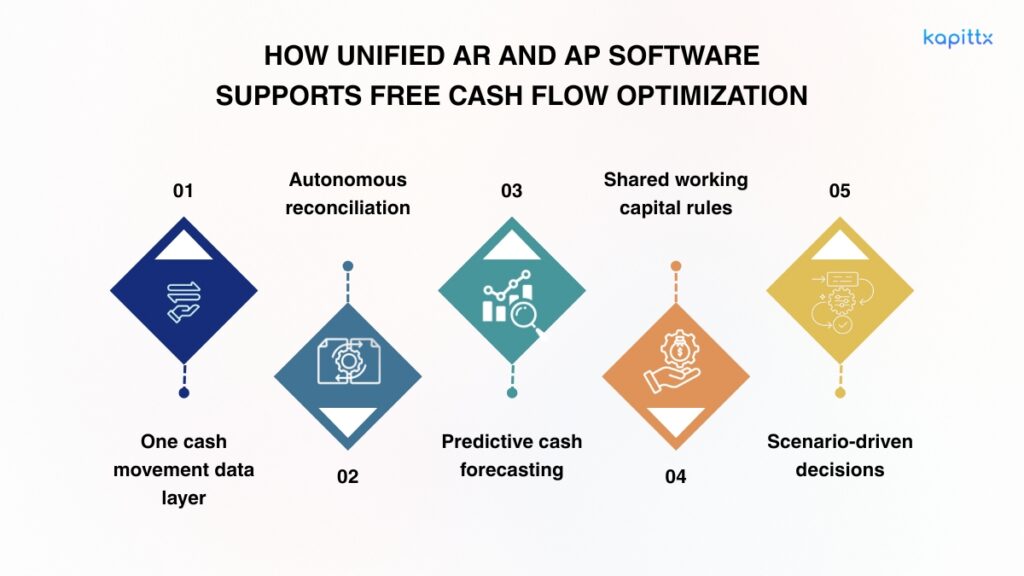
One cash movement data layer
Invoices, remittances, bank transactions, deductions, purchase orders, goods receipts, supplier invoices and payment commitments are connected within one operational model.
Autonomous reconciliation
AI agents match high-volume transactions, apply approved rules and route only meaningful exceptions for human review.
Predictive cash forecasting
Expected cash is calculated using historical behavior, promise-to-pay reliability, open disputes, vendor patterns, seasonality and current transaction status—not only contractual due dates.
Shared working capital rules
AR, AP and treasury decisions follow consistent policies for tolerances, approvals, write-offs, payment timing and escalation.
Scenario-driven decisions
CFOs and FP&A teams can assess how delayed collections, accelerated supplier payments, marketplace deductions or changing funding costs will affect liquidity.
The outcome is higher forecast confidence, better DSO and DPO alignment and faster capital velocity.
Why Traditional AR and AP Software Cannot Close the Loop
Traditional finance applications were generally built to automate functional workflows:
- AR software manages collections and incoming payments.
- AP software manages supplier invoices and approvals.
- Treasury software manages balances and funding.
- Planning tools model future financial performance.
Each platform can improve productivity within its own area. However, it may use different transaction definitions, update schedules, reconciliation logic and forecast assumptions.
A workflow tool can move an invoice from one approval stage to another. A connected cash intelligence platform must understand how the invoice affects liquidity, whether the expected amount is reliable and what financial action should follow.
This is why the next phase of finance automation is not simply about digitizing more departmental workflows. It is about connecting cash data, financial reasoning and governed execution.
How Kapittx Closes the Cash Conversion Loop
Kapittx connects AR, AP and cash intelligence through an ecosystem of governed AI agents.
Rather than replacing the ERP, Kapittx operates as an intelligent automation and reconciliation layer across invoice-to-cash and invoice-to-pay processes. It connects information from ERPs, banks, marketplaces, payment systems and finance communications.
The platform supports:
- AI-powered collections
- Remittance capture and cash application
- Bank and invoice reconciliation
- Short-payment and deduction handling
- Amazon, Walmart and PSP settlement reconciliation
- PO, GRN, contract and supplier-invoice matching
- Exception identification and routing
- ERP-grade journal posting
- Predictive cash flow forecasting
- Live working capital dashboards
Kapittx reconciliation agents can compare customer invoices with payments, match bank transactions with ERP records, reconcile goods received notes with purchase orders and supplier invoices, and identify missing or duplicate transactions.
By feeding validated AR and AP signals into one cash position, Kapittx helps finance teams move from disconnected automation to autonomous working capital operations.
A Six-Step Framework for CFOs
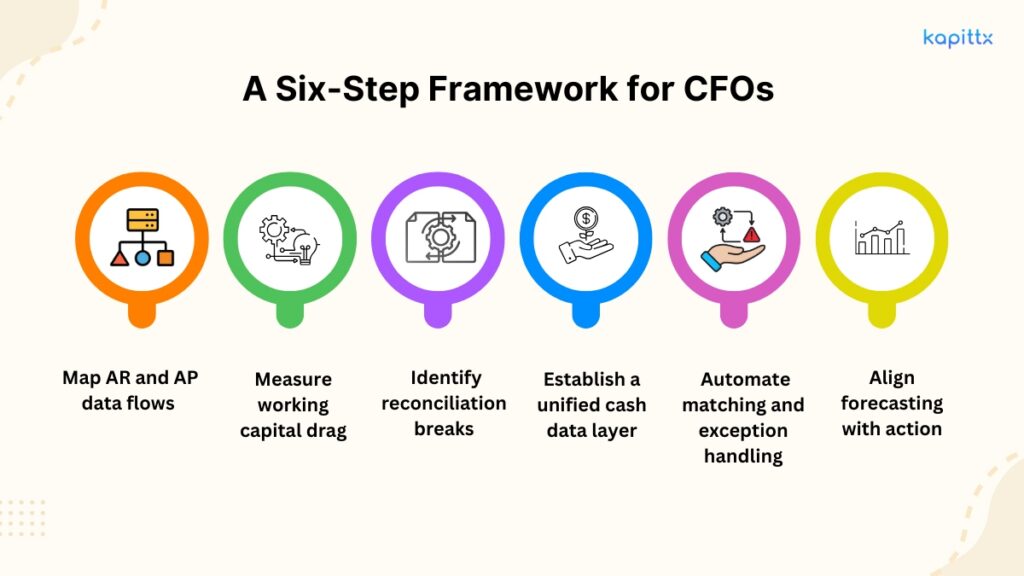
Step 1: Map AR and AP data flows
Identify every system and communication channel containing information about incoming or outgoing cash.
Step 2: Measure working capital drag
Quantify unapplied cash, blocked invoices, open deductions, delayed approvals, excess liquidity buffers and avoidable borrowing.
Step 3: Identify reconciliation breaks
Locate points where transactions cannot move forward because information is missing, inconsistent or unverified.
Step 4: Establish a unified cash data layer
Connect ERP, bank, marketplace, PSP, customer and supplier data using common transaction definitions.
Step 5: Automate matching and exception handling
Apply autonomous reconciliation to repeatable transactions while retaining approvals and human oversight for material exceptions.
Step 6: Align forecasting with action
Build dashboards that show expected inflows, committed outflows, forecast variance, risk and recommended working capital actions.
Closing Thoughts: Cash Flow Is a System Problem
AR and AP may be managed by different teams, but they operate within the same liquidity system.
Automating receivables without connecting upcoming obligations provides only half the cash picture. Automating payables without understanding the probability of incoming cash can result in poorly timed payments and unnecessary funding.
The objective is not merely to improve AR or AP productivity. It is to eliminate financial data silos, synchronize cash application with payables and turn every validated transaction into a better working capital decision.
CFOs that close this loop can reduce working capital drag, align DSO and DPO, improve capital velocity and achieve more sustainable free cash flow optimization.
