
TDS Receivables: Why TDS Reconciliation Is a Blind Spot for Accounts Receivable Teams
August 3, 2026Implementing AI-Powered AR Automation: The Complete Demo-to-Deployment Guide
August 3, 2026Summary
AI Cash Application is redefining how finance teams turn incoming payments into posted, reconciled cash. This guide compares AI Cash Application with traditional cash posting across speed, cost, accuracy, and scalability. You'll see how manual cash posting works, get a feature-by-feature comparison, a buyer's checklist for the software, and a clear answer on which ERP systems support it. The verdict is consistent: automation saves more time and more money for AR and finance operations teams.
The Cash Application Bottleneck That Slows Finance Teams
Cash application, matching incoming customer payments to open invoices and posting them to the ledger, is where working capital is either unlocked or left stuck. Yet it remains one of the most stubborn bottlenecks in the order-to-cash cycle. Cash application teams must reconcile funds arriving via ACH, wire, card, check, or lockbox with matching remittance details that arrive independently, if they arrive at all, through disparate formats like emails, PDFs, spreadsheets, and EDI.
The manual burden is striking. In one industry survey, 84% of finance leaders said their AR team still matches payments and remittance data manually at least some of the time, and 19% do it manually every time. Separate research found companies dedicate roughly 15% of AR staff to cash application and reconciliation. Every hour trapped in manual payment processing is an hour lost on high-value initiatives like credit risk evaluation, forecasting, and collections.
How Traditional Cash Posting Works
Traditional cash posting is a sequential, human-driven workflow. A clerk first pulls the day's bank deposits, lockbox files, and payment notifications. Next, they hunt for the matching remittance, often across multiple inboxes and shared drives, to learn which invoices a payment covers. Then comes the matching: reconciling one payment against one invoice, or, more painfully, a single lump-sum payment against dozens of invoices (40 to 50 is common in high-volume B2B). Discounts, short payments, deductions, and unreferenced wires each demand a judgment call. Finally, the clerk keys the applied amounts into the ERP and clears the account.
The entire workflow is bound by manual tasks, depending completely on staff to read documents, interpret details, and key in data. It works at low volume, but as invoice counts climb, cash posting turns slow, error-prone, and impossible to scale without adding headcount, exactly where cash posting automation earns its place.
Manual Cash Posting Quietly Drains Time and Money
The costs are both visible and hidden. Visibly, matching one lump-sum payment to many invoices can consume hours, and month-end becomes a scramble. Invisibly, errors compound: 82% of C-level executives in one survey said their company lost work due to miscommunications in the payment process. Misapplied cash flags paying customers as delinquent, triggers needless dunning, and erodes relationships.
There is a balance-sheet cost too. Unapplied and misapplied cash sits trapped, inflating Days Sales Outstanding (DSO) and blurring the view of who actually owes money. Industry benchmarks put average DSO near 39 days in 2025, while top performers operate closer to 28, a gap that often comes down to how fast cash is applied and cleared. Slow payment reconciliation is not a back-office nuisance; it is a working-capital problem.
What AI Cash Application Actually Does?
AI Cash Application replaces the read-interpret-type loop with intelligent automation. Instead of a person opening a PDF remittance, a finance AI model reads it, along with emails, spreadsheets, and bank files, extracts the payment references, and normalizes inconsistent formats automatically. It then performs two-way reconciliation (payment to invoice) and three-way reconciliation (invoice, remittance, and bank deposit) to confirm each match with high confidence.
Modern automation handles messy financial data, not just perfect payments. It flags short payments, disputes, and partial settlements, alerts the right team member to genuine exceptions with full context, and logs verified cash straight into the ERP with a complete audit history for every action. This is the shift from data entry to exception management, and it is the heart of invoice-to-cash automation.
AI Cash Application vs Traditional Cash Posting: Feature-by-Feature Comparison
Here is how the two approaches compare across the seven dimensions finance leaders weigh most:
|
Dimension |
Traditional Cash Posting |
AI Cash Application |
|
Remittance capture |
Manual retrieval from inboxes and portals |
Automatic ingestion and reading across email, PDF, spreadsheet, and bank files |
|
Matching logic |
One-by-one human matching |
Automated two- and three-way reconciliation at scale |
|
Speed |
Hours to days; worse at month-end |
Minutes, continuously |
|
Match rate |
Variable and staff-dependent |
90%+ straight-through; leaders near 95% |
|
Exceptions |
Buried in spreadsheets |
Auto-detected and routed with context |
|
Scalability |
Add headcount to add volume |
Absorbs volume spikes without new hires |
|
Auditability |
Manual notes |
Full, traceable audit log by default |
The pattern is consistent: AI cash application wins on every axis that touches time or money.
How AI Cash Application Saves Time, Reduces Costs, and Improves Cash Flow
Put numbers to it. Finance teams routinely spend 10 to 20 hours per week manually processing remittance advice. By eliminating at least 80% of manual tasks, AR automation frees up 8 to 16 hours per accountant weekly, allowing teams to refocus their efforts on collections and financial forecasting. Industry data shows automation can save up to six minutes per invoice, substantial once multiplied across thousands of transactions.
The money side is bigger than payroll. Faster, more accurate application compresses DSO, and every day of DSO reduction releases working capital tied up in receivables. Higher straight-through processing, top performers exceed 90% versus the 60–80% many companies live with, means fewer costly exceptions and less revenue leakage from unclaimed deductions. For most mid-market and enterprise AR teams, cash application automation pays for itself well inside a year.
What to Look for in AI Cash Application Software: A Buyer's Checklist
Not every tool labeled “AI” is equal. Evaluate any platform against these seven criteria:
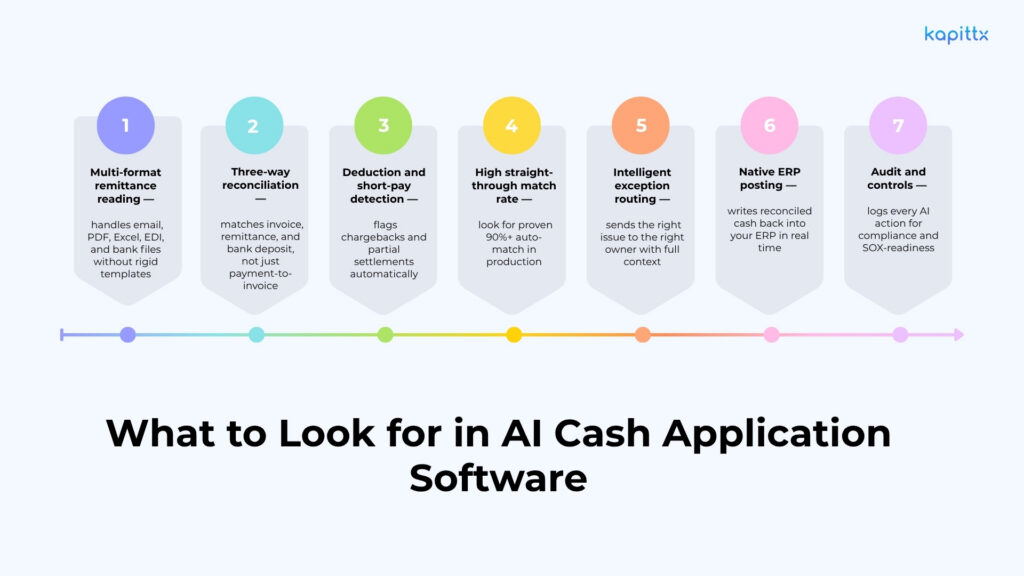
- Multi-format remittance reading : Handles email, PDF, Excel, EDI, and bank files without rigid templates.
- Three-way reconciliation : Matches invoice, remittance, and bank deposit, not just payment-to-invoice.
- Deduction and short-pay detection : Flags chargebacks and partial settlements automatically.
- High straight-through match rate : Look for proven 90%+ auto-match in production.
- Intelligent exception routing : Sends the right issue to the right owner with full context.
- Native ERP posting : Writes reconciled cash back into your ERP in real time.
- Audit and controls : Logs every AI action for compliance and SOX-readiness.
Prioritize proven accuracy and ERP fit over flashy dashboards; those two factors drive the real return.
Which ERP Systems Support AI Cash Application?
The best AI cash application platforms are ERP-agnostic, sitting on top of whatever system of record you already run. In the enterprise tier, that means SAP S/4HANA, SAP ECC, and SAP Business One, plus Oracle, Oracle NetSuite, and Microsoft Dynamics 365 Business Central (and legacy Navision).
Mid- market and high-growth teams commonly connect QuickBooks and Xero. For teams across India, support for Tally and Zoho Books is essential. Kapittx, for example, integrates across all of these, SAP, NetSuite, Dynamics 365, QuickBooks, Xero, Tally, and Zoho Books, so cash posts natively regardless of the underlying ERP. The buyer's takeaway: confirm real, bidirectional integration with your specific ERP before committing.
How AI Cash Application Benefits Different Industries
The payoff varies by payment pattern. SaaS teams face high-volume subscription card and ACH payments where speed and auto-match matter most. Manufacturing and CPG suppliers wrestle with heavy deductions, trade promotions, and lump-sum payments spanning many invoices. Logistics and distribution deal with fragmented remittance and lockbox files. Construction contends with retainage and milestone billing that complicate matching. In each case, AI cash application adapts to the remittance reality instead of forcing the team to.
Why Finance Leaders Are Adopting AI Cash Application
For CFOs, controllers, and AR leaders, the comparison is no longer close. Traditional cash posting is defensible only at low volume; beyond that, it costs hours, inflates DSO, and caps growth. AI cash application saves more time and more money while improving accuracy, control, and morale. The question is not whether to automate, but how fast.
How Kapittx Helps You Execute This
Kapittx puts a dedicated AI Cash Application agent to work inside your invoice-to-cash process. It automatically detects and reads remittance advice across emails, PDFs, spreadsheets, and bank files, even through a dedicated capture inbox, then normalizes inconsistent references and runs two- and three-way reconciliation across invoices, remittance, and bank deposits. Short payments, deductions, and chargebacks are flagged automatically, genuine exceptions route to the right team with full context, and reconciled cash posts in real time into SAP, NetSuite, Dynamics 365, QuickBooks, Xero, Tally, or Zoho Books, with a complete audit trail.
In practice, that means up to 95% auto-match across invoices, remittance, and bank receipts, more than 80% less manual effort, and 8 to 16 hours saved per accountant every week. The result: lower DSO, cleaner books, and a finance team focused on strategy instead of data entry. That is what modern cash posting automation looks like when it is done right.
Frequently Asked Questions
