
What Is an AI Collection Agent? How It Automates Debt Recovery
June 22, 2026AI Handles the Follow-Up. You handle the relationship. The Rise of the Human & AI Collections Team
June 29, 2026Every finance leader knows the feeling. The invoice went out on time. The product was delivered. The service was rendered. And yet the payment hasn't arrived. You send a reminder. Then another. Then an escalation. Weeks pass. Your cash flow forecast is starting to look unrealistic.
Late payments are no longer an exception in B2B commerce. They have become the norm. And in 2025–2026, the problem is accelerating in ways that should concern every CFO, Controller, and Finance Director running a mid-market business.
This blog explores why late payments are rising, what's driving the trend, the true financial and non-financial cost to your business, and critically what you can do about it today.
What the Data Reveals About the Scale of the Problem
The numbers tell an uncomfortable story.
According to the Atradius 2025 Payment Practices Barometer, 55% of all B2B invoiced sales in the United States are currently overdue. That is not a rounding error. More than half of every invoice your business sends is likely to be paid late.
Globally, working capital reached its highest level since 2008 in early 2025, rising to 78 days, meaning businesses are now waiting more than two and a half months, on average, to turn a sale into cash. For US companies, the average cash conversion cycle is even higher at 89 days.
The ripple effect is significant: 42% of US companies say late payments cause them to struggle to meet their own financial obligations, and 40% respond by delaying payments to their own suppliers, creating a chain reaction of delayed cash across entire industries.
The average annual cost of late payments per US company has been measured at $39,406, and for 10% of businesses, late payment-related expenses exceed $100,000 annually. This is not a back-office inconvenience. It is a strategic risk.
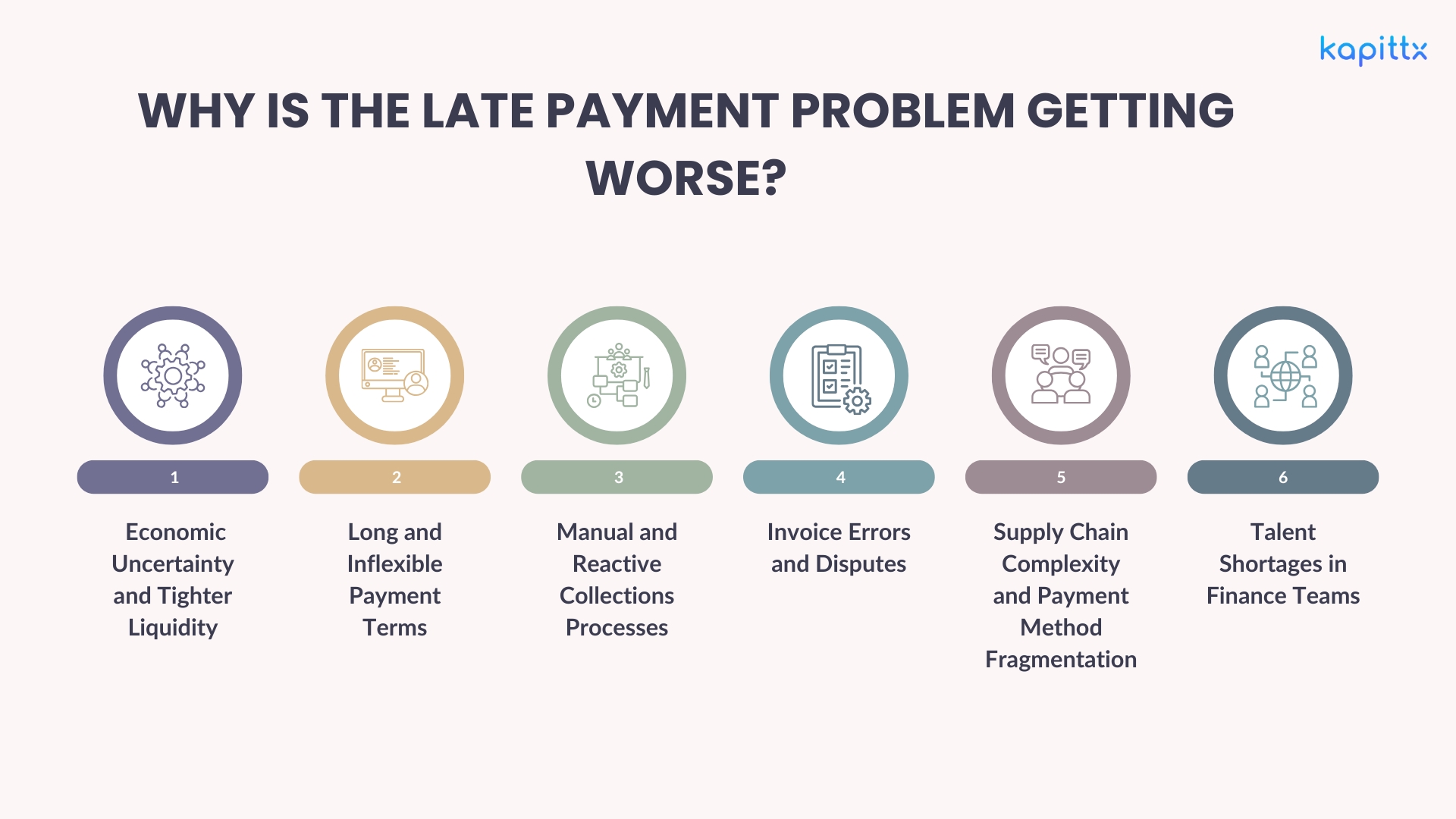
Why Is the Late Payment Problem Getting Worse?
Late payments have always existed in B2B commerce, but several structural and economic forces are amplifying the problem in 2025–2026.
1. Economic Uncertainty and Tighter Liquidity
Elevated interest rates and persistent economic volatility have squeezed corporate liquidity. Many businesses, particularly mid-market companies — are deliberately delaying outgoing payments to preserve their own working capital. What looks like late payment from your perspective is often intentional cash management from your customer's. The result: 34% of US businesses report that the average time it takes to get paid has increased over the past year.
2. Long and Inflexible Payment Terms
In industries like manufacturing, wholesale distribution, and logistics, NET-60 and NET-90 terms remain standard practice. These extended cycles were designed for a simpler era. When customers then pay against NET terms late, even by 10 or 15 days, the impact on your receivables ledger compounds quickly.
3. Manual and Reactive Collections Processes
Over 85% of mid-market companies in distribution, logistics, manufacturing, and technology services still rely on manual processes to manage receivables, according to Kapittx's own research. When your collections process depends on a team member remembering to send a reminder, checking a spreadsheet, and drafting a personalised follow-up, delays are built into the system by design.
4. Invoice Errors and Disputes
61% of late payments globally result from administrative errors, incorrect pricing, wrong purchase order references, missing tax codes, or invoices sent to the wrong contact. Every disputed invoice resets the payment clock. And without a structured dispute management workflow, resolution can take weeks.
5. Supply Chain Complexity and Payment Method Fragmentation
Modern B2B transactions flow through a complicated mix of checks, ACH, wire transfers, and virtual cards, often from buyers who aggregate multiple invoices into a single payment without remittance details. This creates cash application bottlenecks that delay posting and distort your real-time AR picture.
6. Talent Shortages in Finance Teams
Skilled AR professionals are increasingly difficult to hire and retain. Many mid-market businesses are running lean collections teams that simply cannot keep pace with growing invoice volumes. The result: aging receivables go uncontacted, disputes go unresolved, and cash sits uncollected.
The Financial Impact: What Late Payments Actually Cost
The most visible cost of late payment is the cash flow gap money you have earned but cannot yet spend. But the financial damage runs deeper than a temporary delay. Working capital drain. Every dollar sitting in your AR aging report is a dollar you cannot reinvest in inventory, payroll, equipment, or growth. With US companies collectively carrying $1.7 trillion in excess working capital, the opportunity cost of slow collections is enormous.
Bad debt write-offs. Kapittx's research shows that invoices older than six months carry a 70% probability of becoming uncollectible, rising to 90% after one year. US companies currently write off an average of 3–5% of B2B invoices as bad debts, a direct hit to the bottom line.
Higher cost of borrowing. When receivables are slow, businesses turn to credit lines, overdrafts, or invoice factoring to bridge the gap.
These carry real costs. Factoring fees, interest charges, and bank fees effectively tax you for cash you have already earned.
Revenue leakage. Manual AR processes are error-prone. Payments are misapplied. Invoices go unsent. Disputes drag on without resolution. Each of these represents revenue already generated that simply fails to be collected.
Forecast inaccuracy. When AR data is fragmented and manually maintained, cash flow forecasting becomes guesswork. 77.9% of CFOs identify improving the cash flow cycle as very or extremely important to their strategy, but this is impossible without accurate, real-time receivables visibility.
The Non-Financial Impact: The Hidden Costs Nobody Talks About
The damage from late payments extends well beyond the balance sheet.
Team morale and burnout. AR teams spending hours each day manually chasing overdue invoices, resolving disputes, and preparing aging reports experience significant burnout. Kapittx research shows collectors spend upwards of six hours a day on manual tasks, leaving little time for strategic, high-value work. This contributes to turnover in a function that is already hard to staff.
Customer relationship strain. Aggressive or poorly timed collections calls can damage relationships with customers who are genuinely good payers experiencing a temporary delay. Without data-driven prioritisation, AR teams often contact the wrong customers at the wrong time, creating friction where none is needed.
Leadership distraction. When cash flow becomes unpredictable, it pulls senior finance leaders into operational firefighting. CFOs find themselves in AR review meetings instead of strategic planning sessions. Controllers are reconciling AR reports instead of providing business insights.
Supplier relationship damage. When you cannot pay your own suppliers on time because customers have not paid you, the ripple effect extends upstream. 40% of US businesses slow payments to their own suppliers as a direct consequence of receiving late payments, creating reputational and operational risk throughout the supply chain.
Organisational confidence. Uncertain cash flow creates anxiety across the business. Sales teams are cautious about extending credit to new customers. Operations teams second-guess investment decisions. The entire organisation slows down when the finance engine is running on outdated information.
What CFOs Can Do: A Strategic Response to the Late Payment Crisis
The good news is that late payments are not inevitable. They are, to a significant degree, a process problem, and process problems have solutions. Here is what the most effective finance leaders are doing right now.
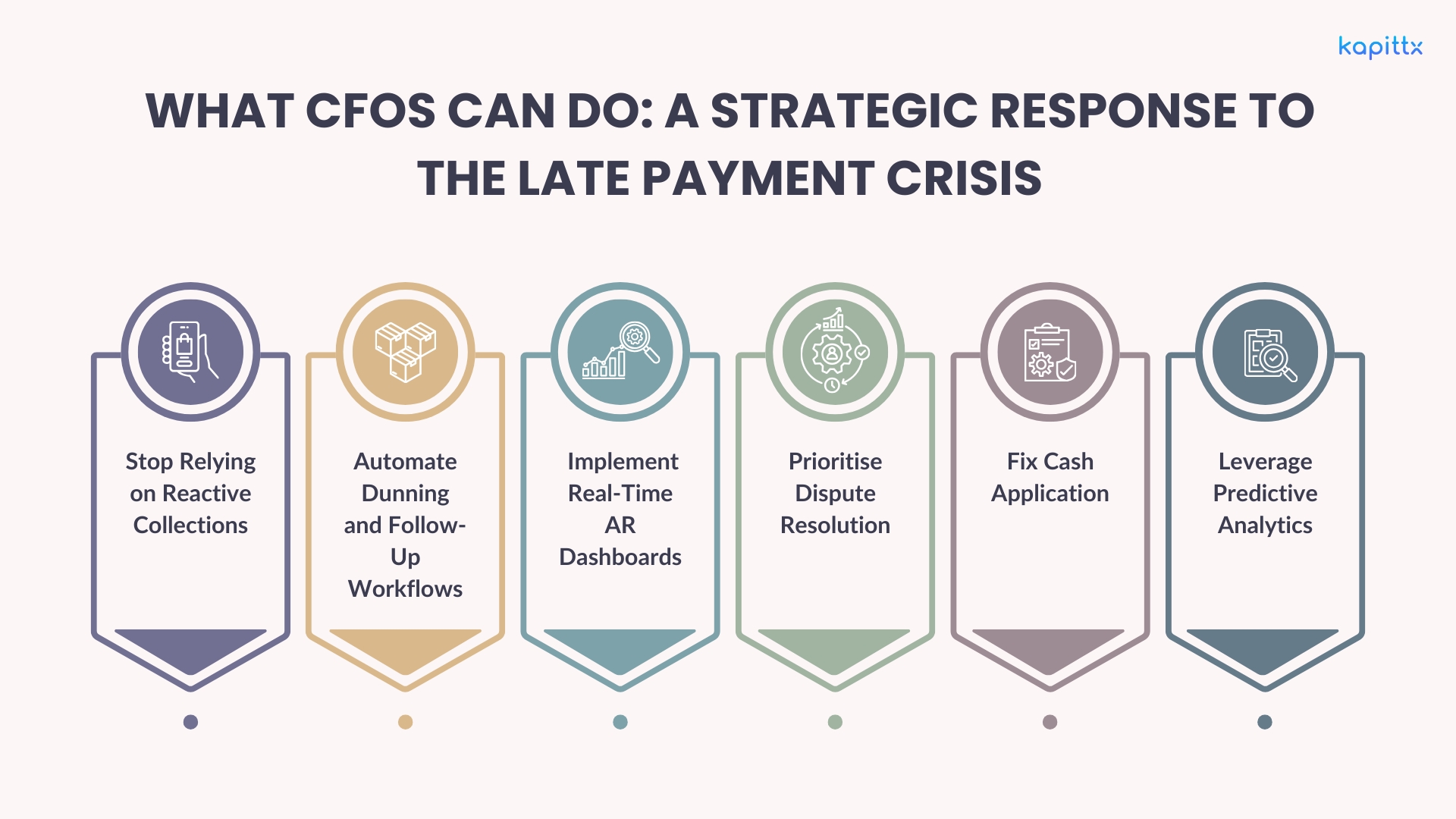
1. Stop Relying on Reactive Collections
The traditional model, send invoice, wait 30 days, send reminder, wait, escalate, is inherently reactive. By the time you are chasing an overdue invoice, you have already lost momentum. CFOs are shifting to proactive collections: using predictive analytics to identify which customers are at risk of paying late, and engaging them before the due date.
2. Automate Dunning and Follow-Up Workflows
Automated dunning: the structured, escalating sequence of payment reminders — removes the human bottleneck from collections. When configured well, automated reminders are personalised, timely, and consistent. They increase on-time payment rates without increasing headcount.
3. Implement Real-Time AR Dashboards
Cash flow forecasting is only as good as the AR data feeding it. Real-time dashboards that surface aging analysis, overdue accounts, dispute status, and payment trends give finance leaders the visibility they need to act, not react.
4. Prioritise Dispute Resolution
Unresolved disputes are the single biggest cause of avoidable payment delays. Building a structured dispute management workflow — where every dispute is logged, tracked, assigned, and resolved within defined SLAs- can dramatically reduce the AR ageing bucket.
5. Fix Cash Application
Unapplied cash is a hidden drag on AR efficiency. AI-powered cash application that matches payments to open invoices automatically — even without remittance data, eliminates the manual matching bottleneck and gives finance teams an accurate, real-time picture of what has been collected.
6. Leverage Predictive Analytics
Rather than treating all overdue accounts equally, use AI to segment customers by payment risk and behaviour. High-risk accounts should receive earlier, more intensive attention. Low-risk accounts, habitual slow payers who always pay eventually, should receive a different, less intensive follow-up track.
How Kapittx Helps You Get Paid Faster
Kapittx is a purpose-built, AI-powered accounts receivable automation platform designed for mid-market B2B businesses. It does not replace your ERP, it enhances it, sitting alongside SAP, NetSuite, Microsoft Dynamics, QuickBooks, and other systems to give your finance team capabilities they cannot get from their accounting software alone.
Here is what Kapittx delivers specifically to address the late payment challenge:
AI-Powered Collections Automation: Kapittx's AI agent sends personalised, scheduled payment reminders automatically, adapting communication style and timing based on each customer's payment history and behaviour. Your AR team stops spending six hours a day on manual follow-ups and starts focusing on exceptions and relationships.
Smart Dunning Workflows: Kapittx automates the entire dunning process, from first invoice delivery through escalation, with configurable workflows that reflect your business rules and customer segments. Reminders are consistent, persistent, and polite.
Predictive Analytics and Risk Flagging. Kapittx analyses historical payment patterns to forecast which customers are likely to pay late, empowering your team to intervene proactively, before an invoice becomes overdue. This is the shift from reactive to predictive collections that leading finance teams are making right now.
Intelligent Cash Application: Kapittx uses AI to match incoming payments to open invoices accurately, even when remittance information is incomplete. This eliminates the manual matching bottleneck and ensures your AR ledger reflects reality in real time.
Dispute Management. Every dispute is automatically identified, categorised, tracked, and escalated through a structured resolution workflow. Finance teams gain visibility into the dispute lifecycle and can resolve issues faster, which means invoices get paid faster.
Real-Time AR Dashboards: Kapittx provides configurable dashboards that surface AR ageing, overdue payment trends, customer behaviour patterns, and key KPIs, giving CFOs and Controllers the visibility they need to manage cash flow with confidence, not guesswork.
ERP Integration. Kapittx integrates seamlessly with the ERPs your team already uses, NetSuite, SAP, Dynamics, QuickBooks, and more, without disrupting existing workflows. You get more from your existing technology stack without a rip-and-replace project.
Businesses using Kapittx have reduced DSO by 20–35%, freed AR teams from hours of daily manual work, and achieved more predictable cash flow, all without adding headcount.
Conclusion: The Late Payment Problem Is Solvable
Late payments are painful. They drain working capital, stress finance teams, and create uncertainty that ripples through the entire business. But they are not inevitable.
The businesses navigating this environment most effectively are those that have stopped treating accounts receivable as a back-office function and started treating it as a strategic lever. They have moved from reactive to predictive collections, from manual follow-ups to intelligent automation, and from periodic AR reviews to real-time cash flow visibility.
Platforms like Kapittx make this transition accessible for mid-market businesses, without requiring a large technology project, without replacing your ERP, and without adding headcount.
If your business is still waiting on invoices that should have been paid weeks ago, the answer is not to hire more collectors. It is to build a smarter system.
Ready to reduce your DSO and take control of your cash flow? Visit Kapittx to learn more or Request a demo.
Frequently Asked Questions
