
Debt Collection: How Finance Teams Are Automating Payment Recovery with AI
June 6, 2026Bill-Wise Outstanding Accounting in Tally: Why It Matters for Faster Collections and Lower DSO
June 16, 2026As Accounts Receivable (AR) processes become more complex, finance leaders are being presented with a new question: should they continue investing in traditional AR software, or embrace AI agents for accounts receivable? The answer is not about choosing one over the other. The most successful finance organizations are combining both to create a foundation for autonomous finance.
The Shift from AR Automation to Agentic AI
For years, organizations have relied on Accounts Receivable software to standardize collections, manage disputes, automate reminders, apply cash, and maintain visibility into receivables performance. These platforms helped finance teams move away from spreadsheets, manual follow-ups, and disconnected processes.
Today, however, a new category of technology is emerging: AI agents for accounts receivable.
Unlike traditional automation that follows predefined workflows, AI agents can evaluate context, make intelligent decisions, and execute actions within approved governance controls. They don’t simply automate tasks. They determine what should happen next.
The result is a significant evolution in Accounts Receivable management, moving from workflow-driven automation toward agentic AI in accounts receivable and ultimately autonomous AR.
AR Software vs AI Agents: Understanding the Core Difference
The primary difference between AR software and AI agents lies in how decisions are made.
Traditional AR software operates through rules and workflows.
For example:
If an invoice becomes 7 days overdue, send Reminder A.
The system follows the process exactly as configured.
An AI agent, on the other hand, analyzes the context surrounding the invoice before deciding on the next step.
For instance:
This customer has historically responded after a single reminder, currently has an unresolved dispute on another invoice, recently committed to a payment date, and has increased credit exposure. Rather than sending another reminder, monitor the promise-to-pay and escalate only if the payment does not arrive.
In this scenario, the software executes a workflow.
The AI agent evaluates the situation and recommends the best action.
This distinction is what separates traditional AR automation from modern AI-powered receivables management.
What Traditional AR Software Does Well
Accounts Receivable software remains the foundation of an effective invoice-to-cash process. It provides the structure, controls, and visibility needed to manage receivables consistently.
Typical capabilities include:
- Invoice and customer management
- Collection workflows
- Automated payment reminders
- Aging analysis
- Dispute management
- Promise-to-pay tracking
- Cash application
- Payment reconciliation
- Credit management
- ERP integrations
- Reporting and dashboards
A typical AR workflow follows a predictable path:
Invoice Due → Reminder Sent → Escalation Triggered → Collector Assigned
This works extremely well when processes are standardized and customer behavior is relatively predictable.
However, real-world receivables environments are rarely that simple.
A strategic customer with a temporary deduction issue should not necessarily receive the same treatment as a chronically late payer. Yet traditional workflows often lack the ability to distinguish between these situations effectively.
This is where AI agents add significant value.
What Are AI Agents for Accounts Receivable?
An AI agent in accounts receivable is an intelligent software system that can:
- Observe data and business events
- Understand context
- Determine the most appropriate next action
- Execute or recommend that action
Instead of asking:
“What does the workflow require?”
AI agents ask:
“Given everything I know about this customer, invoice, payment history, and risk profile, what should happen next?”
To make these decisions, AI agents analyze signals such as:
- Customer payment behavior
- Invoice values
- Days past due
- Previous collection outcomes
- Promise-to-pay commitments
- Open disputes
- Credit exposure
- Deduction patterns
- Remittance details
- Historical communication performance
Based on this information, the agent can decide whether to:
- Send a reminder
- Prioritize an account
- Escalate a dispute
- Route an exception
- Recommend a credit action
- Match payments
- Request supporting documentation
- Trigger human review
This is the essence of agentic AI for accounts receivable: intelligent decision-making rather than simple task execution.
Why AR Teams Are Moving Toward Agentic AI
Most finance leaders are not struggling with workflow automation anymore.
The real challenge is managing complexity at scale.
As customer portfolios grow, transaction volumes increase, and payment data becomes fragmented across emails, PDFs, spreadsheets, ERP systems, and banking platforms, human effort shifts from executing tasks to investigating exceptions.
Collectors spend hours deciding:
- Which customers to prioritize
- Which accounts require escalation
- Which payment promises are trustworthy
- Which disputes are likely to impact cash flow
This decision-making burden creates bottlenecks that traditional rules-based systems struggle to solve.
AI agents help eliminate this burden by analyzing multiple variables simultaneously and recommending the next-best action based on current conditions.
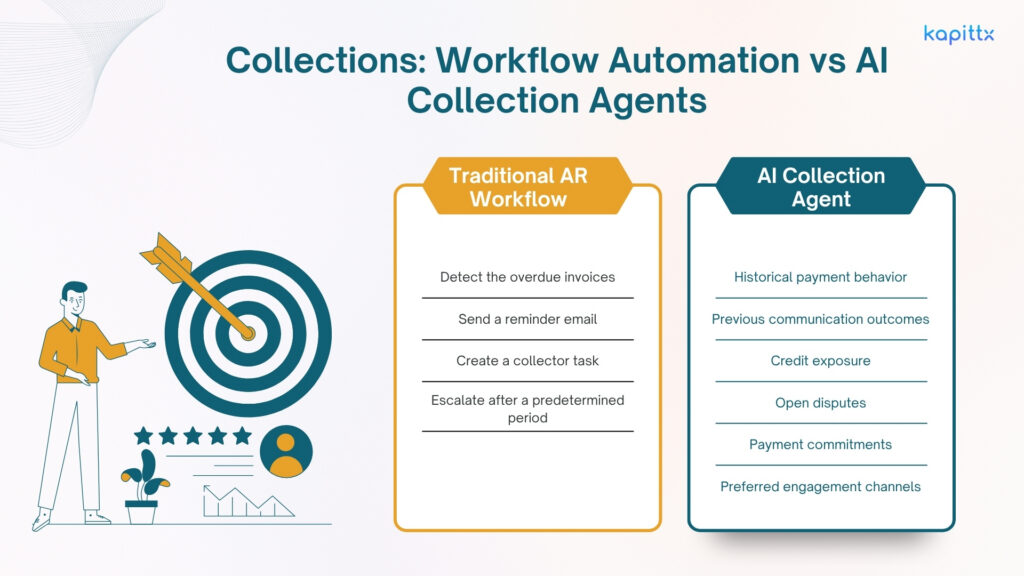
Collections: Workflow Automation vs AI Collection Agents
Consider a customer with a $250,000 invoice that is 12 days overdue.
Traditional AR Workflow
A typical collections workflow may:
- Detect the overdue invoice
- Send a reminder email
- Create a collector task
- Escalate after a predetermined period
The process is consistent, but it treats all situations similarly.
AI Collection Agent
An AI Collection Agent evaluates factors such as:
- Historical payment behavior
- Previous communication outcomes
- Credit exposure
- Open disputes
- Payment commitments
- Preferred engagement channels
Instead of sending another generic reminder, it may determine:
“The customer has already committed to payment this Friday. Monitor the promise-to-pay and escalate only if the commitment is missed.”
This approach reduces unnecessary communications while helping collectors focus on accounts that truly require intervention.
Cash Application: Where AI Delivers the Biggest Impact
Cash application is one of the most complex areas within accounts receivable.
Rules-based systems perform well when remittance details are clean and complete.
Unfortunately, that is rarely the reality in B2B environments.
Organizations frequently encounter:
- Consolidated payments
- Partial settlements
- Missing remittance details
- Customer deductions
- Multiple invoices paid together
- Inconsistent payment references
This creates a significant amount of unapplied cash and manual investigation.
AI-powered cash application agents analyze:
- ERP invoice data
- Customer remittances
- Bank transaction information
- Historical payment patterns
- Deductions and short-payments
Rather than searching for exact matches, they evaluate multiple pieces of evidence simultaneously to determine the most likely reconciliation outcome.
This enables faster cash allocation, reduced unapplied cash, and greater visibility into working capital.
How AI Improves Dispute Management
Disputes are another area where AI agents outperform rigid workflows.
Traditional AR software can:
- Create disputes
- Assign owners
- Track status
- Measure SLA compliance
AI agents take this further by understanding the dispute itself.
For example, if a customer submits a freight deduction, the AI agent can:
- Identify the short payment
- Compare it against the invoice
- Categorize the deduction
- Gather supporting documentation
- Review historical customer behavior
- Route the exception to the correct team
- Recommend the next course of action
Finance leaders retain control through approvals while reducing significant amounts of manual investigation work.
Do You Need AI Agents If You Already Have AR Software?
Not necessarily.
The better question is:
Where is your team still spending time making manual decisions?
AR software may be sufficient if:
- Customer behavior is predictable
- Transaction volumes are manageable
- Exceptions are limited
- Rules address most scenarios
- The organization is still standardizing processes
AI agents become more relevant when:
- Collectors spend substantial time prioritizing accounts
- Payment data is fragmented
- Deductions and disputes are common
- Remittances arrive in multiple formats
- Exception handling dominates AR workloads
- Growth is outpacing team capacity
In these environments, AI agents provide a powerful layer of intelligence on top of existing AR infrastructure.
The Importance of Human Governance
One common misconception about autonomous finance is that humans disappear from the process.
In reality, the most successful implementations use a human-in-the-loop model.
Low-Risk Activities
AI agents can act autonomously on:
- Payment reminders
- Routine follow-ups
- Remittance extraction
- Payment matching
- Task creation
Medium-Risk Activities
AI can recommend and execute according to policy:
- Collection prioritization
- Dispute routing
- Escalation management
- Credit-risk alerts
High-Risk Activities
Human approval remains essential for:
- Write-offs
- Credit memos
- Settlement decisions
- Credit limit modifications
- Strategic customer escalations
This structure allows organizations to increase automation while maintaining strong financial controls.
The Future of Accounts Receivable Is Not Software or AI. It Is Both.
The most effective receivables organizations are not replacing AR software with AI agents.
They are combining:
- AR software for workflows, controls, ERP connectivity, reporting, and auditability
- AI agents for contextual reasoning, prioritization, recommendations, and execution
- Human oversight for governance, judgment, and strategic decision-making
This combination creates a scalable framework for autonomous accounts receivable and, ultimately, autonomous finance.
How Kapittx Enables Agentic Accounts Receivable
Kapittx brings together a robust AR operating platform with specialized AI agents across the invoice-to-cash lifecycle.
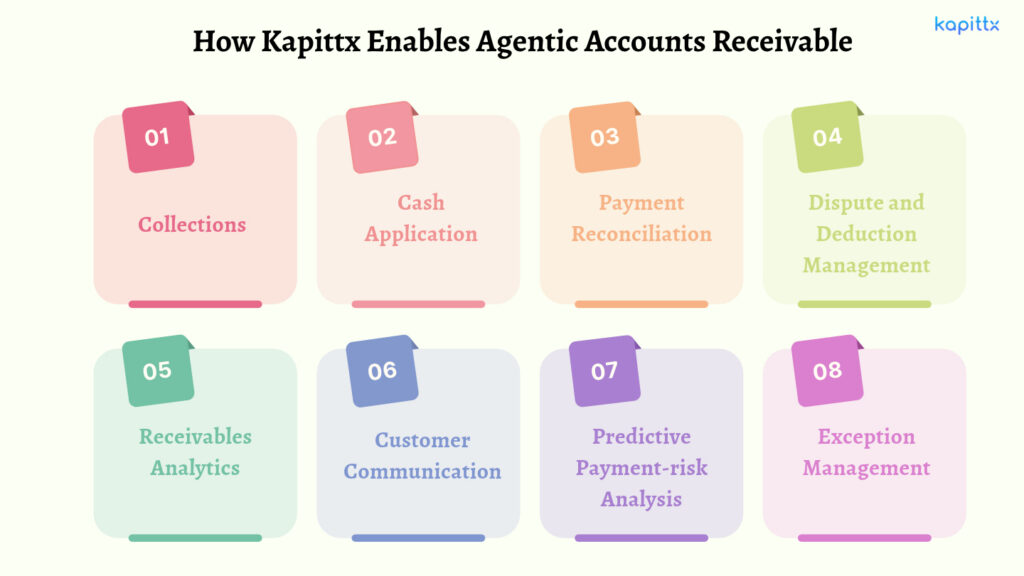
The platform supports AI-powered capabilities across:
- Collections
- Cash application
- Payment reconciliation
- Dispute and deduction management
- Receivables analytics
- Customer communication
- Predictive payment-risk analysis
- Exception management
Rather than requiring finance teams to manually investigate every payment, deduction, or overdue invoice, Kapittx enables AI agents to analyze context, prioritize actions, and execute routine tasks while keeping humans in control of critical financial decisions.
The outcome is a more efficient Accounts Receivable function that spends less time on repetitive administration and more time improving cash flow, customer relationships, and financial performance.
Final Thoughts
The debate should not be AR software vs AI agents.
The real question is how finance leaders can combine both to build a smarter, more scalable receivables operation.
AR software provides the operational foundation. AI agents provide intelligence, adaptability, and execution. Together, they enable finance teams to move beyond basic automation toward a future where routine receivables decisions happen autonomously and human expertise is focused where it creates the greatest value.
For organizations looking to reduce manual effort, accelerate cash flow, and prepare for the next era of finance operations, the journey is clear:
Manual AR → Automated AR → AI-Assisted AR → Agentic AR → Autonomous Finance.
FAqs
Accounts Receivable Software helps organizations manage invoicing, collections, cash application, disputes, and customer payments through structured workflows and automation.
AI Agents are intelligent systems that can analyze data, make recommendations, and execute collection-related tasks autonomously
AR Automation follows predefined workflows, while AI Agents can make context-aware decisions and adapt based on outcomes.
No. AI Agents typically require an underlying Accounts Receivable Software platform for data, workflows, governance, and execution.
Autonomous AR refers to receivable processes that use AI and automation to manage collections, prioritization, dispute resolution, and cash forecasting with minimal human intervention.
By automating follow-ups, prioritizing accounts, accelerating dispute resolution, and improving payment visibility.
AI Agents analyze customer behavior and recommend or execute the most effective collection strategies to accelerate payment recovery
The future lies in combining Accounts Receivable Software, AI Agents, and Autonomous Finance capabilities to create intelligent, self-optimizing receivable operations.
Yes. AI agents can help reduce DSO by prioritizing high-risk invoices, identifying customers likely to delay payments, recommending proactive collection actions, and ensuring collectors focus on accounts with the greatest impact on cash flow. By improving collection efficiency and reducing follow-up delays, organizations can accelerate cash conversion cycles.
Modern AI-powered AR platforms integrate directly with ERP systems such as SAP, Oracle, Microsoft Dynamics, NetSuite, Infor, and Sage. AI agents use ERP data as the system of record while analyzing payment behavior, remittances, disputes, and customer interactions to support collections, cash application, and reconciliation processes.
Yes, when implemented with appropriate governance controls. Most enterprise AI agents operate within predefined approval workflows, access controls, audit trails, and compliance policies. Organizations can define which activities are fully automated and which require human approval before execution.
AI agents can support multiple invoice-to-cash activities, including:
Collections prioritization
Payment reminders
Cash application
Bank reconciliation
Remittance extraction
Customer communication
Dispute routing
Deduction management
Credit-risk monitoring
Receivables analytics
The level of automation depends on an organization’s policies, data quality, and risk tolerance.
AI agents can identify short payments, categorize deductions, retrieve supporting documents, detect recurring dispute patterns, and route issues to the correct teams. Instead of manually investigating every exception, finance teams receive recommended actions and prioritized resolution paths.
No. AI is designed to augment AR professionals, not replace them. AI agents handle repetitive analysis, transaction processing, and routine decision-making, while finance professionals focus on customer relationships, exception management, strategic planning, negotiation, and policy decisions.
An autonomous AR function combines AR software, AI agents, and human oversight. Routine tasks such as payment matching, reminder generation, exception categorization, and collections prioritization happen automatically. Finance teams focus on governance, customer engagement, dispute resolution, and high-value financial decisions. The result is faster cash flow, improved productivity, and greater operational scalability.
