
Bill-Wise Outstanding Accounting in Tally: Why It Matters for Faster Collections and Lower DSO
June 16, 2026The Late Payment Crisis: Why B2B Businesses Are Getting Paid Slower And What CFOs Can Do About It
June 29, 2026Summary
As businesses grow, managing customer collections manually becomes increasingly difficult. Finance teams often spend significant time chasing payments, sending reminders, tracking promises to pay, and updating collection records. An AI Collection Agent transforms this process by automating debt recovery activities, prioritizing accounts, personalizing customer communication, and continuously following up until payment is received. This blog explains what an AI Collection Agent is, how it works, key ROI metrics, and why companies are adopting AI-powered collection automation software to improve cash flow, reduce bad debt, and lower Days Sales Outstanding (DSO).
What Is an AI Collection Agent?
An AI Collection Agent is an intelligent software agent that automates accounts receivable collections and debt recovery activities using artificial intelligence, machine learning, workflow automation, and conversational AI.
Unlike traditional collection tools that simply send predefined reminders, an AI Collection Agent can:
- Analyze customer payment behavior
- Prioritize accounts requiring immediate attention
- Generate personalized collection communications
- Conduct autonomous follow-ups
- Track promises-to-pay
- Escalate high-risk accounts
- Recommend collection actions
- Continuously learn from collection outcomes
Think of an AI Collection Agent as a digital collections specialist working alongside your finance team 24/7.
The goal is not to replace finance professionals but to eliminate repetitive collection tasks so teams can focus on strategic customer conversations and dispute resolution.
For organizations managing hundreds or thousands of invoices every month, AI debt recovery solutions can significantly improve collection efficiency while reducing operational costs.
Why Traditional Debt Recovery Processes Are No Longer Enough
Many organizations still rely on spreadsheets, email reminders, ERP reports, and manual collection activities.
While these approaches may work at a small scale, they create major challenges as businesses grow:
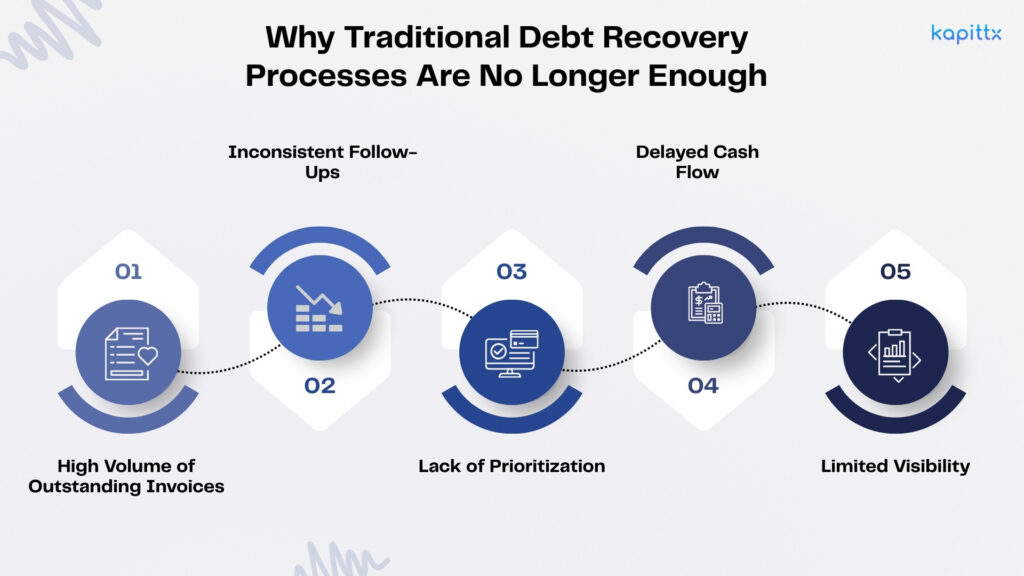
High Volume of Outstanding Invoices
Finance teams often struggle to monitor thousands of open invoices across multiple customers.
Inconsistent Follow-Ups
Collectors may miss follow-up dates due to workload or competing priorities.
Lack of Prioritization
Not all overdue accounts present the same risk. Manual processes often fail to identify which customers require immediate attention.
Delayed Cash Flow
Late payments directly impact working capital and increase DSO.
Limited Visibility
Management teams often lack real-time insights into collection performance and collection effectiveness.
As a result, organizations experience:
- Higher DSO
- Increased bad debt risk
- Poor collector productivity
- Revenue leakage
- Reduced working capital availability
This is where an AI Collection Agent delivers significant value.
How AI Collection Agents Work
An AI Collection Agent combines multiple technologies including AI, predictive analytics, workflow automation, and customer engagement tools.
The process generally follows these steps
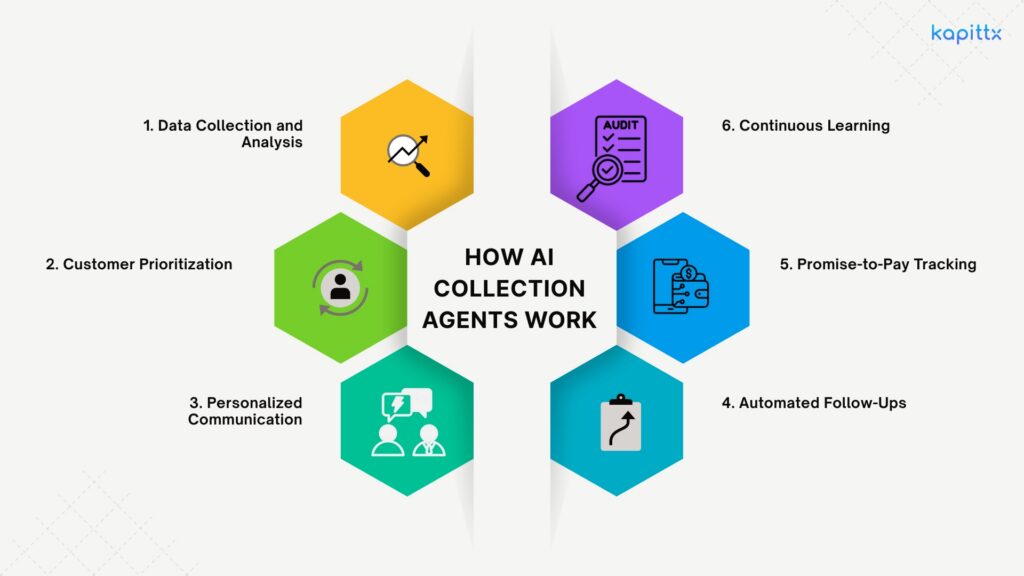
1. Data Collection and Analysis
The AI agent connects with ERP systems, accounting software, CRM platforms, and accounts receivable data sources.
It analyzes:
- Invoice aging
- Payment history
- Customer behavior
- Collection notes
- Dispute records
- Credit risk indicators
- Previous communication outcomes
This creates a comprehensive risk profile for every customer.
2. Customer Prioritization
Rather than treating every overdue invoice equally, the AI agent ranks accounts based on:
- Probability of payment
- Risk of default
- Invoice value
- Customer importance
- Days overdue
- Historical collection performance
This ensures collectors focus on the accounts that will have the biggest impact on cash flow.
3. Personalized Communication
Traditional collection emails are generic.
An AI Collection Agent creates contextual communication based on:
- Customer payment history
- Outstanding amount
- Industry
- Previous interactions
- Current payment behavior
Examples include:
- Payment reminders
- Overdue notices
- Promise-to-pay follow-ups
- Escalation messages
- Payment link notifications
The communication feels more personalized and relevant to the customer.
4. Automated Follow-Ups
One of the biggest reasons invoices remain unpaid is lack of consistent follow-up.
AI agents automatically:
- Send reminders
- Schedule follow-up emails
- Trigger SMS notifications
- Escalate overdue accounts
- Track customer responses
This ensures no invoice is forgotten.
5. Promise-to-Pay Tracking
When customers commit to payment, the AI agent monitors whether payment arrives as promised.
If payment is missed:
- Follow-up communication is automatically triggered
- Collection workflows continue
- Finance teams receive alerts
This significantly improves collection discipline.
6. Continuous Learning
Modern AI agents learn from collection outcomes.
They identify:
- Which messages perform best
- Which customers respond to specific communication channels
- Which collection strategies improve recovery rates
Over time, collection effectiveness continues to improve.
Key Benefits of an AI Collection Agent
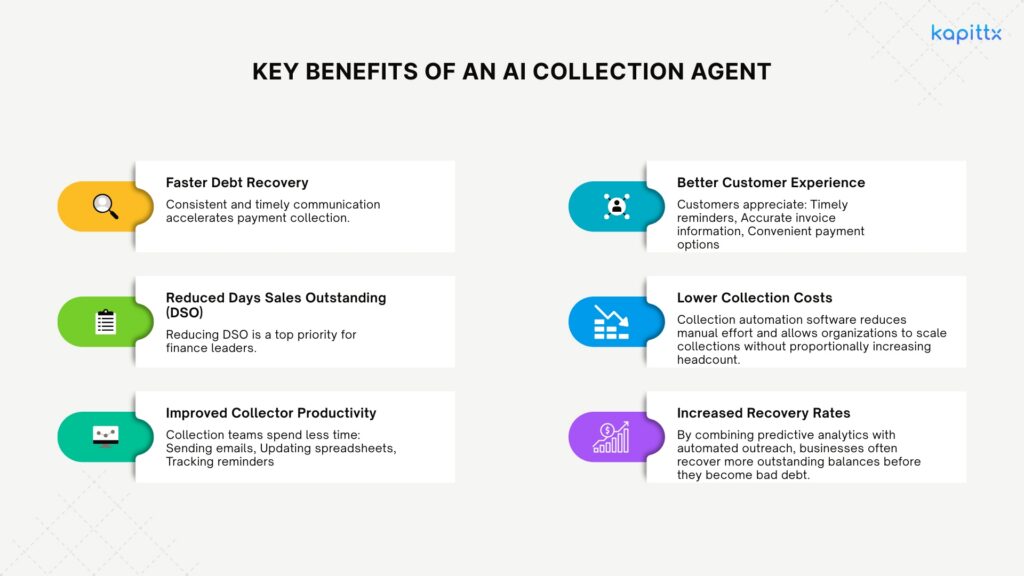
Faster Debt Recovery
Consistent and timely communication accelerates payment collection.
Rather than waiting for monthly collection cycles, AI agents engage customers continuously.
This shortens payment cycles and improves cash flow.
Reduced Days Sales Outstanding (DSO)
Reducing DSO is a top priority for finance leaders.
By prioritizing high-risk accounts and ensuring systematic follow-up, AI Collection Agents help organizations collect payments faster.
Even a small DSO reduction can unlock substantial working capital.
Improved Collector Productivity
Collection teams spend less time:
- Sending emails
- Updating spreadsheets
- Tracking reminders
- Searching for customer information
Instead, they focus on:
- Strategic accounts
- Customer negotiations
- Dispute resolution
- Escalations
This dramatically improves productivity.
Better Customer Experience
Customers appreciate:
- Timely reminders
- Accurate invoice information
- Convenient payment options
- Consistent communication
AI-powered collections improve customer engagement while maintaining professionalism.
Lower Collection Costs
Collection automation software reduces manual effort and allows organizations to scale collections without proportionally increasing headcount.
This lowers the cost of debt recovery.
Increased Recovery Rates
By combining predictive analytics with automated outreach, businesses often recover more outstanding balances before they become bad debt.
Key ROI Metrics of AI Debt Recovery Solutions
Finance leaders evaluating AI debt recovery platforms typically focus on measurable business outcomes.
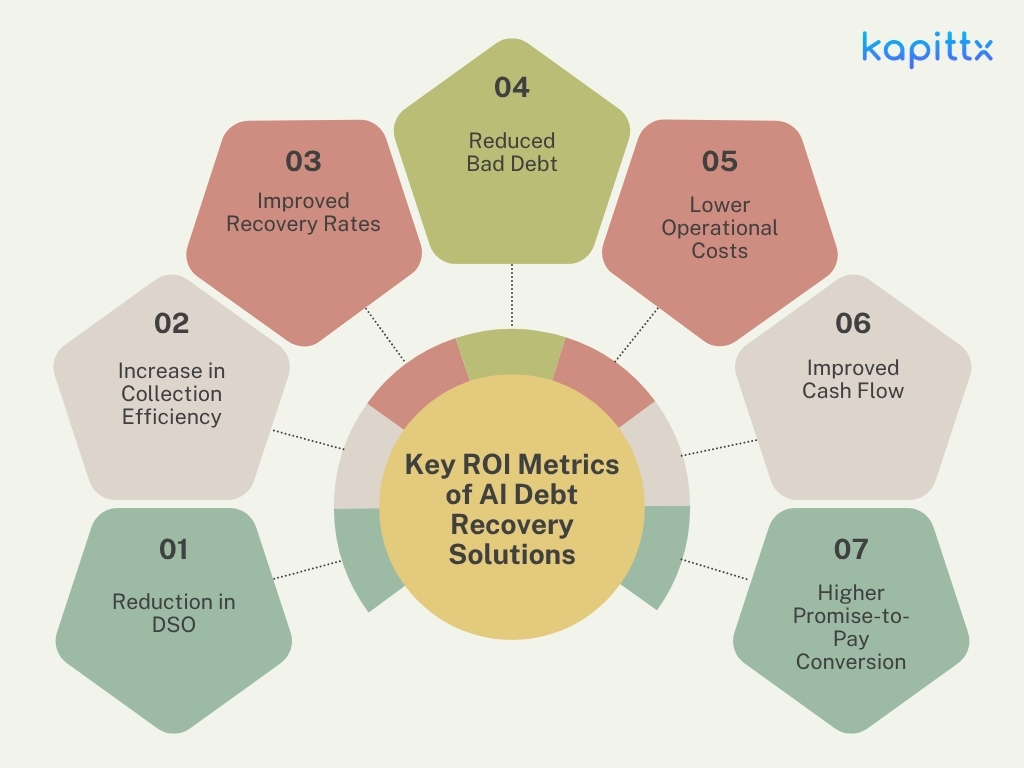
Finance leaders evaluating AI debt recovery platforms typically focus on measurable business outcomes.
1. Reduction in DSO
One of the most important metrics.
Organizations commonly achieve meaningful reductions in DSO through proactive collections.
2. Increase in Collection Efficiency
Collectors manage significantly more accounts because repetitive tasks are automated.
3. Improved Recovery Rates
More overdue invoices are collected before becoming write-offs.
4. Reduced Bad Debt
Early intervention helps prevent customer accounts from progressing into severe delinquency.
5. Lower Operational Costs
Automation reduces dependence on manual collection processes.
6. Improved Cash Flow
Faster collections directly improve liquidity and working capital availability.
7. Higher Promise-to-Pay Conversion
AI-driven follow-up improves the percentage of commitments that convert into actual payments.
AI Collection Agent vs Human Collectors: Performance Comparison
A common question among finance leaders is whether AI can replace collection professionals.
The reality is that AI works best when augmenting human teams.
| Capability | Human Collector | AI Collection Agent |
|---|---|---|
| 24/7 Availability | Limited | Yes |
| Follow-Up Consistency | Variable | Excellent |
| Processing Large Volumes | Limited | Excellent |
| Personal Judgment | Strong | Moderate |
| Emotional Intelligence | Strong | Limited |
| Data Analysis | Moderate | Excellent |
| Prioritization | Time Consuming | Instant |
| Scalability | Limited by Headcount | Highly Scalable |
| Cost Efficiency | Lower at Scale | Higher at Scale |
| Learning from Data | Limited | Continuous |
The optimal model combines AI automation with human expertise.
AI handles repetitive tasks while finance professionals manage complex conversations and strategic customer relationships.
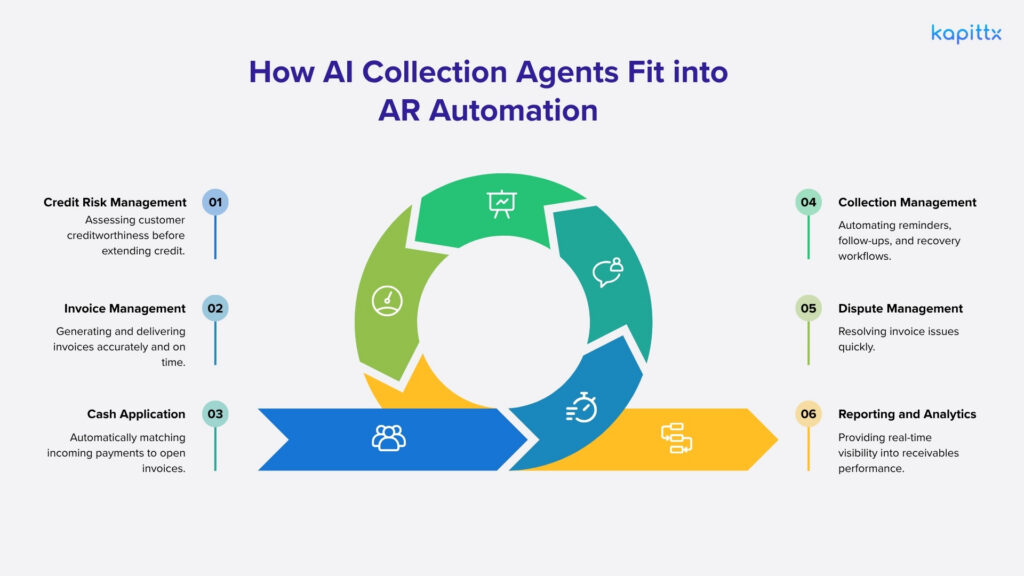
How AI Collection Agents Fit into AR Automation
An AI Collection Agent is often part of a broader AR Automation strategy.
Modern accounts receivable processes include:
An AI Collection Agent is often part of a broader AR Automation strategy.
Modern accounts receivable processes include:
Credit Risk Management
Assessing customer creditworthiness before extending credit.
Invoice Management
Generating and delivering invoices accurately and on time.
Cash Application
Automatically matching incoming payments to open invoices.
Collection Management
Automating reminders, follow-ups, and recovery workflows.
Dispute Management
Resolving invoice issues quickly.
Reporting and Analytics
Providing real-time visibility into receivables performance.
When integrated together, these capabilities create a highly efficient Order-to-Cash process.
Why Businesses Are Adopting AI Collection Agents
Several market trends are driving adoption:
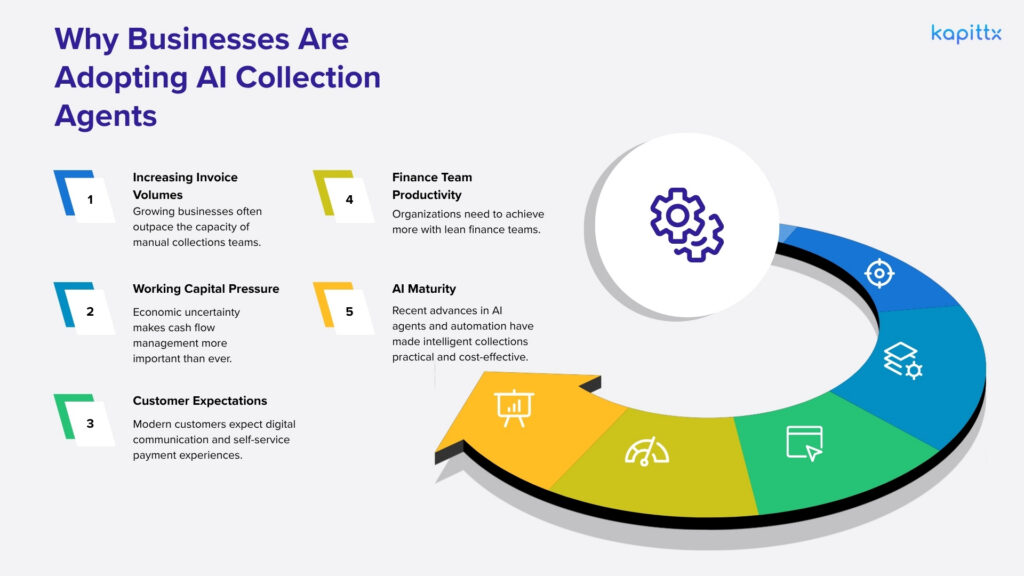
Increasing Invoice Volumes
Growing businesses often outpace the capacity of manual collections teams.
Working Capital Pressure
Economic uncertainty makes cash flow management more important than ever.
Customer Expectations
Modern customers expect digital communication and self-service payment experiences.
Finance Team Productivity
Organizations need to achieve more with lean finance teams.
AI Maturity
Recent advances in AI agents and automation have made intelligent collections practical and cost-effective.
How Kapittx AI Collection Agent Helps Finance Teams
Kapittx’s AI Collection Agent is designed specifically for B2B accounts receivable teams seeking to automate debt recovery and improve collection performance.
The platform combines:
- AI-powered collections workflows
- Automated customer communication
- Intelligent account prioritization
- Promise-to-pay tracking
- Collection analytics
- ERP integration
- Accounts receivable automation
Instead of relying on manual follow-ups and spreadsheets, finance teams can leverage Kapittx to create a scalable collection operation that continuously drives faster payment recovery.
By integrating collections within a broader AR automation framework, Kapittx helps organizations:
- Reduce DSO
- Improve working capital
- Increase collector productivity
- Minimize bad debt risk
- Strengthen customer relationships
As businesses scale, the ability to automate debt recovery becomes a competitive advantage rather than simply an operational improvement.
The Future of AI Debt Recovery
The future of collections will be increasingly autonomous.
AI Collection Agents are evolving beyond simple reminder systems into intelligent digital workers capable of:
- Understanding customer intent
- Predicting payment behavior
- Recommending collection strategies
- Conducting personalized conversations
- Identifying dispute risks
- Optimizing collection workflows automatically
Organizations that adopt AI-driven collection automation software today will be better positioned to manage growth, improve cash flow, and maintain healthy customer relationships.
The question is no longer whether AI will transform debt recovery—it is how quickly businesses can leverage AI Collection Agents to modernize their accounts receivable operations.
FAQs
1. What is an AI Collection Agent?
An AI Collection Agent is an intelligent software solution that automates debt recovery activities such as payment reminders, customer follow-ups, account prioritization, and collections workflow management.
2. How does an AI Collection Agent work?
It analyzes accounts receivable data, identifies collection priorities, sends personalized communications, tracks responses, and automates follow-up actions until payment is received.
3. Can AI Collection Agents reduce DSO?
Yes. By ensuring timely and consistent collection activities, AI Collection Agents help businesses collect payments faster and reduce Days Sales Outstanding (DSO).
4. What is AI debt recovery?
AI debt recovery uses artificial intelligence, automation, and predictive analytics to improve collection efficiency and increase payment recovery rates.
5. Do AI Collection Agents replace human collectors?
No. They automate repetitive collection tasks while allowing finance professionals to focus on customer relationships, negotiations, and dispute resolution.
6. What industries benefit from AI collection automation software?
Manufacturing, distribution, SaaS, logistics, wholesale, healthcare, professional services, and any B2B organization managing customer credit and receivables.
7. What ROI can businesses expect from AI Collection Agents?
Typical benefits include reduced DSO, improved recovery rates, increased collector productivity, lower collection costs, and stronger cash flow.
8. How does an AI agent prioritize overdue accounts?
It evaluates factors such as invoice age, payment history, customer risk, outstanding balance, and likelihood of payment to rank accounts by collection priority.
9. How does an AI Collection Agent support AR Automation?
It automates collections while integrating with invoice management, cash application, dispute management, and credit risk processes within the accounts receivable function.
10. What should businesses look for in an AI Collection Agent?
Key capabilities include ERP integration, automated workflows, predictive analytics, personalized communication, promise-to-pay tracking, reporting dashboards, and scalability.
