
Benefits of Implementing AI in Accounts Receivable
June 2, 2026Accounts Receivable Software vs AI Agents for Accounts Receivable: Transforming AR Automation into Autonomous Execution
June 16, 2026Summary
AI for debt collection is rapidly transforming how businesses recover payments, improve cash flow, and optimize accounts receivable performance. AI for debt collection uses artificial intelligence, automation, and machine learning to streamline payment recovery, automate customer communications, prioritize overdue accounts, manage disputes, and improve accounts receivable collections. Businesses use AI debt collection software to reduce DSO, improve cash flow, lower collection costs, and increase collection team productivity. By combining AI agents, workflow automation, and real-time analytics, organizations can accelerate collections, reduce bad debt, and build a more efficient, scalable, and data-driven debt collection process.
Debt Collection is rapidly becoming a priority for CFOs seeking faster payment recovery, lower collection costs, and improved cash flow visibility. As economic uncertainty, rising working capital pressure, and advances in AI transform finance operations, organisations are adopting AI-powered debt collection automation to improve accounts receivable recovery, reduce bad debt, and accelerate collections.
Modern collection management systems now combine AI agents, workflow automation, and real-time analytics to help finance teams recover payments faster while improving customer relationships.
The CFO Perspective Has Changed Dramatically in 2026
The way CFOs view debt collection in 2026 is fundamentally different from how they viewed it just a year ago.
What changed? Almost everything.
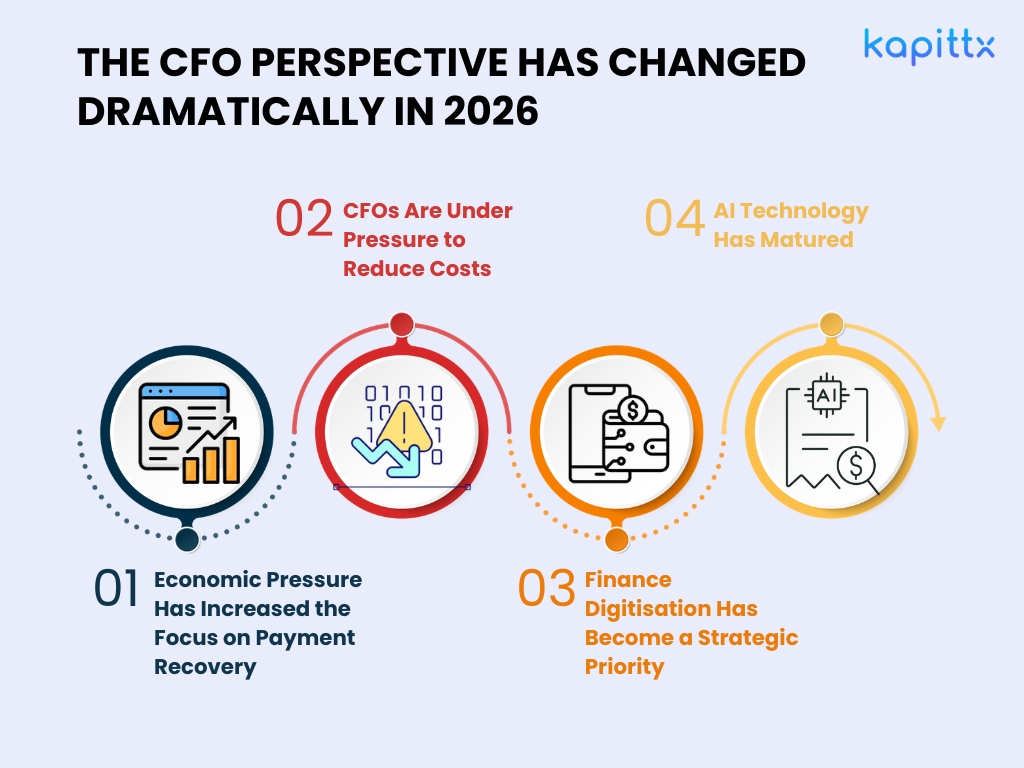
1. Economic Pressure Has Increased the Focus on Payment Recovery
Global economic uncertainty, supply chain disruptions, and tighter liquidity have increased
the importance of cash flow management. Companies can no longer afford to let outstanding
receivables remain unmanaged.
Every unpaid invoice represents working capital trapped on the balance sheet.
2. CFOs Are Under Pressure to Reduce Costs
Finance leaders are being asked to do more with fewer resources. At the same time, AI has created expectations that finance operations can become significantly more efficient through automation.
Manual debt collection processes that require large teams, spreadsheets, and repetitive Follow-ups are increasingly difficult to justify.
3. Finance Digitisation Has Become a Strategic Priority
Organisations that delayed digital transformation are now accelerating investments in
automation technologies. CFOs understand that manual collection processes create
operational risk, limit scalability, and reduce visibility into customer payment behaviour.
4. AI Technology Has Matured
Perhaps the biggest shift is that AI is no longer experimental. Modern AI debt collection software can integrate with existing ERP systems, automate repetitive collection activities, prioritise collection efforts, and provide actionable insights with significantly lower implementation risk than previous generations of technology. Platforms such as Kapittx are helping organisations automate collections, cash application, reconciliation, and accounts receivable workflows through AI-powered automation.
Today, many CFOs are actively evaluating AI solutions across:
- AI debt collection software
- Accounts receivable recovery automation
- Cash application automation
- Payment reconciliation
- Vendor portal automation
- Financial close acceleration
- Working capital optimisation
Among these initiatives, AI debt collection often represents the fastest path to measurable ROI.
Why AI Debt Collection Is a Low-Hanging Fruit for CFOs
Unlike large ERP transformation projects, AI debt collection software can typically be deployed with minimal disruption. The impact can be immediate:
- Faster payment recovery
- Reduced Days Sales Outstanding (DSO)
- Lower collection costs
- Improved collector productivity
- Better customer communication
- Reduced bad debt write-offs
- Enhanced cash flow forecasting
The key question is:
Where Should You Start?
Before evaluating any AI collection management system, CFOs should map their existing debt collection process.
A Practical Framework for Evaluating Your Debt Collection Process
Kapittx recommends reviewing five critical stages of the receivables lifecycle.
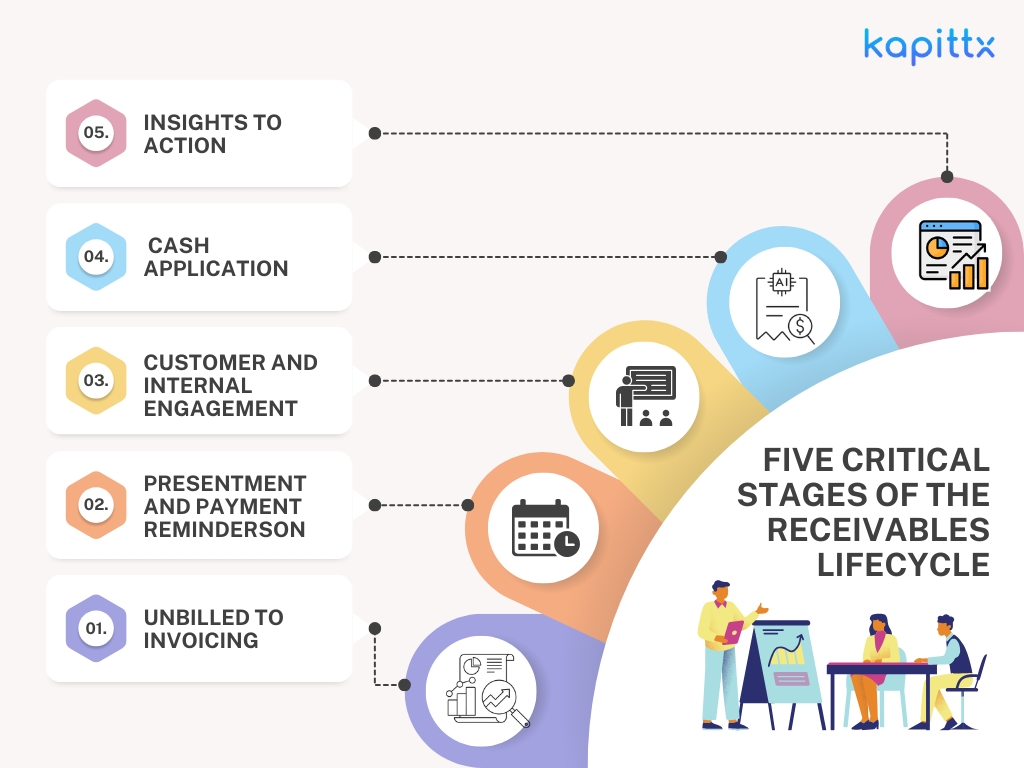
1. Unbilled to Invoicing
Debt collection starts long before an invoice becomes overdue. Many organizations lose cash flow simply because transactions are not invoiced on time.
Questions to ask:
- How much revenue remains unbilled?
- Are invoices generated promptly?
- Are supporting documents attached correctly?
- Are customer-specific invoicing requirements followed?
Even a perfect collection team cannot collect an invoice that was never sent.
2. Presentment and Payment Reminders
Kapittx research indicates that 65% of customers pay on time because they were reminded on time and payment reminders can play a significant role in payment behaviour. The objective is not just sending invoices but ensuring customers receive them and remain aware of upcoming due dates.
Evaluate:
- Invoice delivery processes
- Invoice acknowledgement tracking
- Payment reminder schedules
- Statement generation
- Dunning notice management
- Multi-channel communication
Modern debt collection automation platforms like Kapittx can automate reminders while maintaining personalised communication. Automated payment reminders are among the most effective ways to improve collection efficiency and reduce overdue accounts.
3. Customer and Internal Engagement
As per Kapittx research, 70% of payment delays are not caused by customer unwillingness to pay. Instead, they result from operational issues:
- Invoice disputes
- Missing documentation
- Pricing disagreements
- Internal approval bottlenecks
- Delivery-related concerns
Accounts receivable recovery is often a reflection of overall operational effectiveness. A strong collection management system enables collaboration between:
- Finance teams
- Sales teams
- Customer service
- Operations
- Customer stakeholders
The ability to manage disputes efficiently can dramatically improve payment recovery rates. AI-powered workflow automation helps organisations coordinate internal and external stakeholders more effectively.
4. Cash Application
Collecting money is only part of the process. The payment must also be accurately reconciled and applied.
Key metrics include:
- Unapplied cash percentage
- Reconciliation cycle time
- Deposit creation time
- Payment matching accuracy
- Month-end close efficiency
Manual cash application creates delays, reconciliation gaps, and working capital visibility issues. AI-powered cash application solutions can automatically extract remittance information, reconcile payments, detect short payments, and post transactions directly into ERP systems.
5. Insights to Action
Most companies have data. Few have actionable insights.
Finance teams often spend hours preparing collection reports instead of taking action.
Evaluate:
- How long does reporting take?
- Are collection priorities clear?
- Can collectors identify high-risk accounts quickly?
- Are collection strategies data-driven?
AI can convert receivable data into prioritised actions, helping teams focus on accounts with the highest impact on DSO reduction and payment recovery.
AI Agents for Debt Collection
After process mapping is complete, organisations can begin evaluating technology. Interestingly, the framework above does not start with ERP systems.
Why?
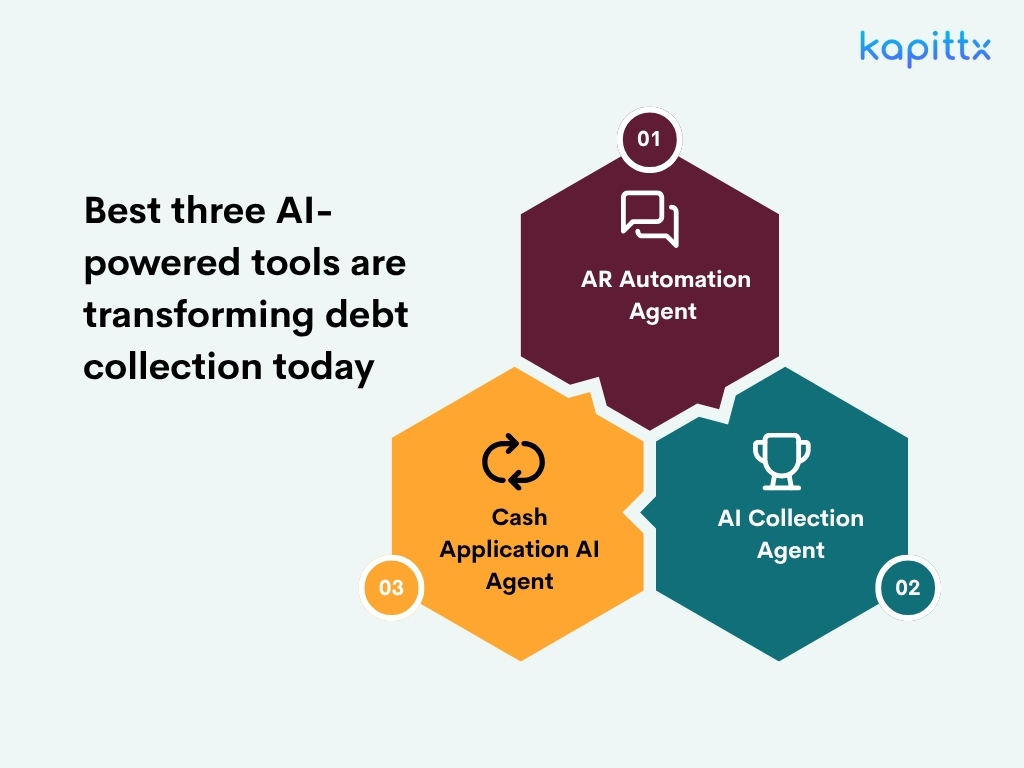
Because modern AI solutions integrate with existing ERPs rather than replacing them. Three AI-powered tools are transforming debt collection today.
1. AR Automation Agent : An AR Automation Agent acts as the operational engine for receivables management.
It automates:
- Invoice delivery
- Payment reminders
- Customer communications
- Workflow management
- Dispute tracking
- Task assignment
- Collection prioritisation
Instead of collectors manually tracking hundreds or thousands of invoices, AI automates Repetitive tasks and enables teams to focus on exceptions and customer engagement.
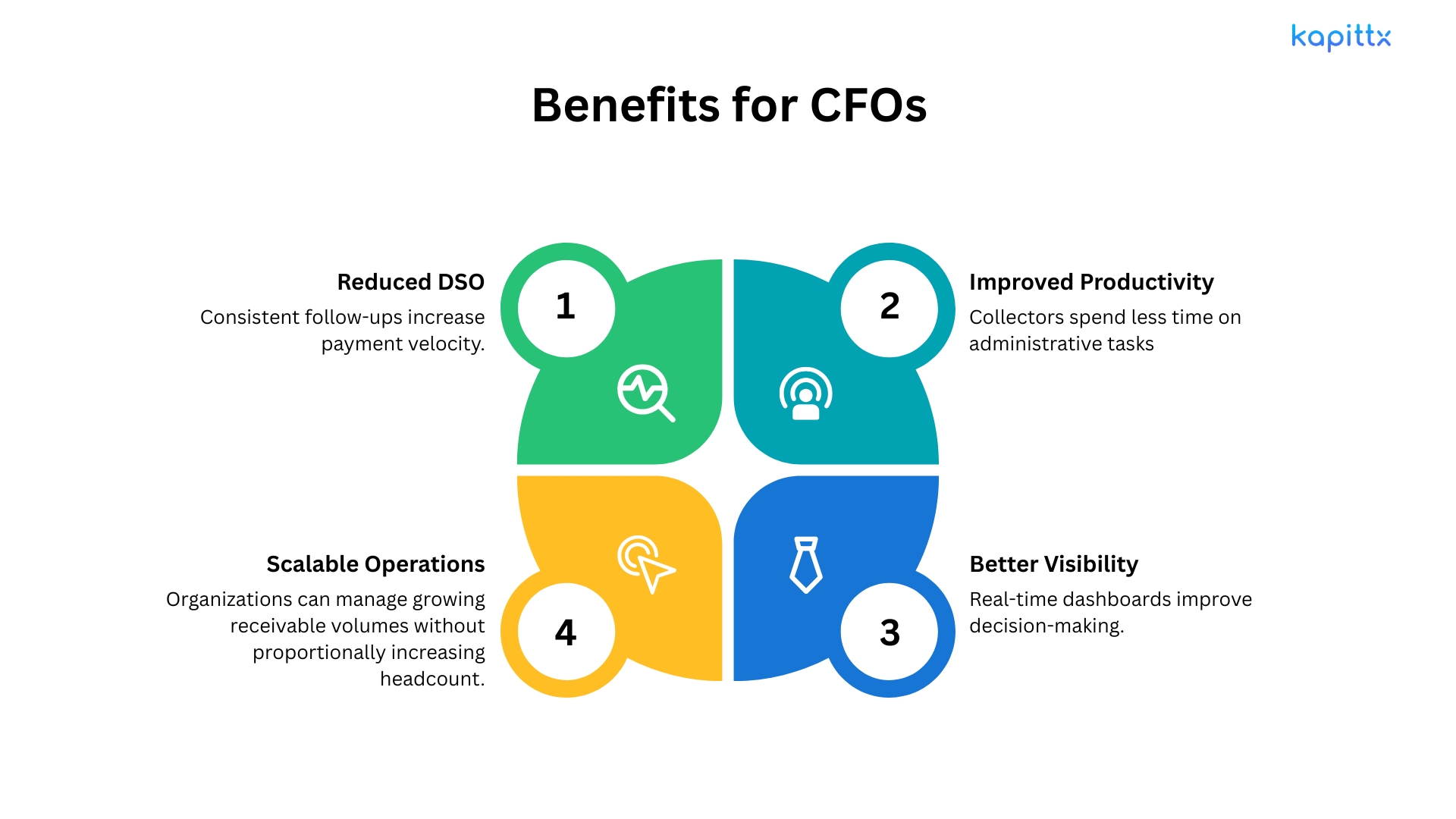
- Reduced DSO : Consistent follow-ups increase payment velocity.
- Improved Productivity: Collectors spend less time on administrative tasks.
- Better Visibility: Real-time dashboards improve decision-making.
- Scalable Operations: Organisations can manage growing receivable volumes without proportionally increasing headcount.
AR automation platforms help organisations streamline invoice-to-cash processes while improving collection efficiency and cash flow performance.
2. AI Collection Agent
The AI Collection Agent is where debt collection automation becomes truly intelligent.
Traditional collection teams often apply the same strategy to every customer. AI does not.
Instead, it analyses:
- Payment behaviour
- Historical collections
- Customer responses
- Dispute patterns
- Collection effectiveness
The AI collection agent can:
- Prioritise High-Risk Accounts
- Focus the collector's attention where it matters most.
- Personalise Payment Recovery
- Tailor communication based on customer personal behaviour.
- Recommend Next Best Actions
- Suggest collection strategies likely to produce results.
- Automate Follow-Ups
- Ensure no account is forgotten.
- Improve Bad Debt Recovery
- Identify accounts requiring early intervention before they become write-offs.
For CFOs, this means a more proactive and predictive approach to debt collection rather
than reactive chasing of overdue invoices.
3. Cash Application AI Agent
Many organisations underestimate the impact of cash application on working capital. The Cash Application Agent automates the reconciliation process from payment receipt to ERP posting.
According to Kapittx, AI-powered cash application can automate:
- Remittance Processing: Extract data from emails, PDFs, spreadsheets, and bank files.
- Invoice Matching on: Automatically identify deductions, chargebacks, and discrepancies.
- Exception Handling: Route reconciliation issues to the appropriate teams.
- Real-Time ERP Updates: Post reconciled transactions instantly.
Organisations implementing AI cash application often achieve significant reductions in manual effort while improving reconciliation accuracy and financial visibility.
For CFOs, the benefits include:
- Faster financial close
- Improved audit readiness
- Better cash visibility
- Reduced unapplied cash
- Stronger working capital management
The Future of AI Debt Collection
The future of debt collection is not about replacing finance teams. It is about augmenting them.
The most successful organisations will combine:
- Human judgment
- AI automation
- Real-time insights
- Intelligent workflows
As CFOs continue investing in finance transformation, AI debt collection software is emerging as one of the most practical and highest-impact starting points. Organisations that automate payment recovery today will be better positioned to:
- Reduce DSO
- Improve cash flow
- Increase collector productivity
- Reduce bad debt
- Enhance customer experience
- Improve working capital performance
In a world where cash flow is increasingly strategic, AI-powered debt collection is rapidly becoming a competitive advantage rather than a technology experiment. Ready to transform your debt collection process with AI? Book a demo to see how Kapittx helps automate payment recovery, reduce DSO, and improve cash flow.
Frequently Asked Questions
