
Real-Time SAP S/4HANA GL Sync: How AI Closes the Manual Write-Off Gap
July 13, 2026Accounts Receivable Dispute Management: How Faster Dispute Resolution Improves Daily Cash Position
July 21, 2026Every Uncollected Invoice Is Working Capital Locked Away
A sale is complete only when payment reaches your bank account. Yet, for many B2B organizations, collecting payments remains one of the most manual and inconsistent processes in finance.
Finance teams spend hours sending emails, making phone calls, updating spreadsheets, preparing aging reports, and following up with customers. As businesses grow, manual collection efforts simply cannot scale.
Customers expect timely communication, personalized interactions, and quick resolution of disputes, rather than repetitive reminder emails that ignore their circumstances.
This is where invoice follow up automation becomes a strategic advantage rather than just an operational improvement.
Modern AI-powered receivables platforms automate repetitive follow-up activities while intelligently adapting communication based on customer behavior, payment history, invoice disputes, and business rules. The result is faster collections, lower Days Sales Outstanding (DSO), improved customer relationships, and significantly higher productivity for collection teams. Kapittx's AI-powered AR platform enables organizations to automate payment reminders, prioritize collections, manage disputes, and improve receivables visibility without changing their existing ERP.
Why Invoice Follow-Up Is Critical in B2B Collections
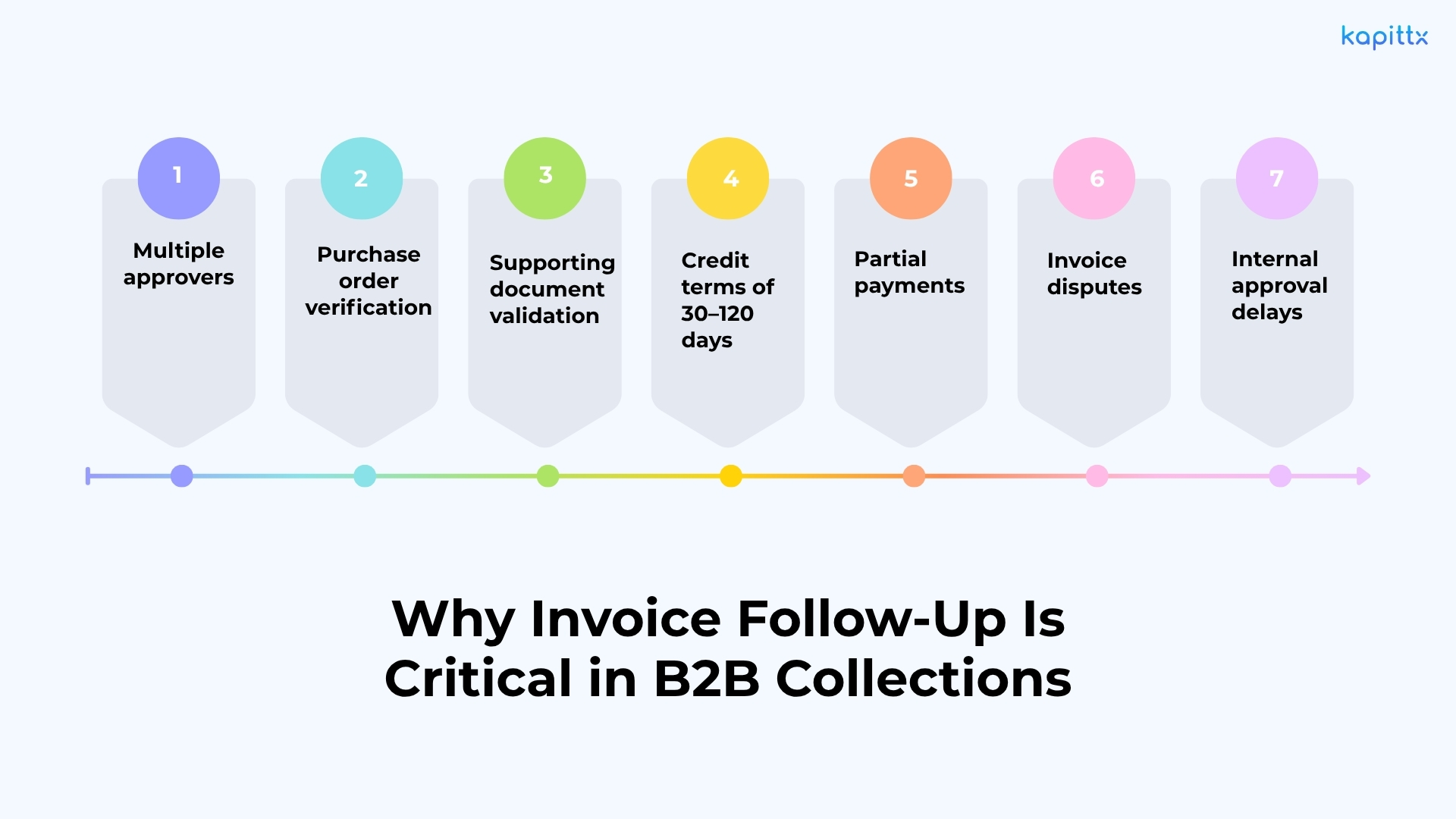
Unlike B2C payments, B2B invoices often involve:
- Multiple approvers
- Purchase order verification
- Supporting document validation
- Credit terms of 30–120 days
- Partial payments
- Invoice disputes
- Internal approval delays
Without consistent follow-up from suppliers, invoices easily slip through the customer's payment cycle.
Industry research consistently shows that delayed collections increase working capital requirements and force companies to rely more heavily on short-term borrowing. Even small improvements in DSO can release significant cash for business growth.
- invoices remain visible
- customers receive timely reminders
- disputes are identified early
- collections stay predictable
- relationships remain professional
Traditional collections usually depend on collectors remembering whom to contact and when.
Typical activities include:
- Sending an invoice payment reminder
- Calling customers
- Updating Excel trackers
- Escalating overdue invoices
- Coordinating with sales teams
- Tracking disputes manually
Kapittx estimates that finance teams spend several hours each day on repetitive collection activities that can be automated using AI-powered workflows.
Follow-up strategies must vary from customer to customer.
Standardizing reminder schedules for all customers is a major organizational mistake.
Successful invoice follow up automation starts with understanding your receivables portfolio.
Step 1: Analyze Your Receivables Portfolio
Every organization has customers with different characteristics:
- Government
- Private companies
- Public listed companies
- Domestic
- International
- Different time zones
- Distributor
- Dealer
- Enterprise customer
- End customer
- Open Account
- Letter of Credit
- Cash Against Delivery
- Excellent payment history
- Medium risk
- High-risk customers
- Manufacturing
- Services
- Distribution
- Retail
Some strategic accounts require sales involvement before escalation.
Portfolio segmentation allows finance teams to build intelligent follow-up strategies instead of generic reminder campaigns.
After segmentation, organizations should design a structured automation framework.
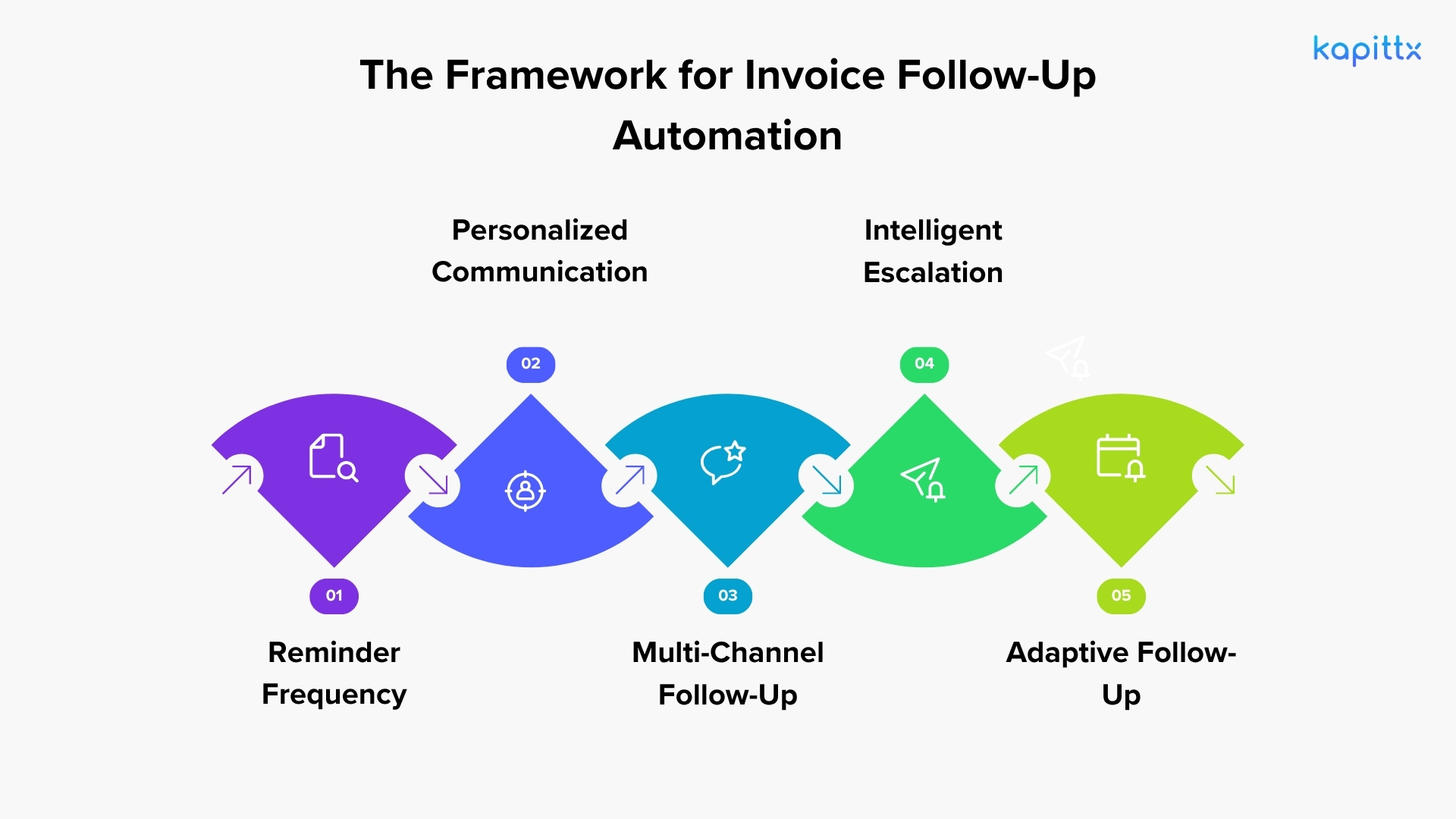
Different customer segments need different reminder frequencies.
Example:
Low-risk customer
- 5 days before due date
- Due date
- 5 days overdue
- 7 days before due date
- Due date
- Every 3 days after due date
- Weekly proactive calls
- Frequent reminders
- Faster management escalation
Every reminder should include:
- Customer name
- Invoice number
- Due date
- Outstanding amount
- Supporting documents
- Payment link
- Collector contact
Kapittx enables customized reminder templates by customer, business unit, and collection policy to ensure communications remain consistent, persistent, and polite.
Collections no longer rely only on email.
- Modern automation combines:
- Voice reminders
- SMS
- Customer portals
- Task notifications
4. Intelligent Escalation
Automation should know when to escalate.
Example:
Invoice overdue by 15 days
→ Reminder email
30 days overdue
→ Collector notified
45 days overdue
→ Sales manager informed
60 days overdue
→ Finance head escalation
This structured AR follow up automation eliminates dependence on manual monitoring.
5. Adaptive Follow-Up
Not every overdue invoice should continue receiving payment reminders.
AI must understand customer responses.
For example:
Customer replies:
"Invoice is under approval."
The system pauses aggressive reminders.
Customer replies:
"Goods were damaged."
Automation creates a dispute workflow.
Customer replies:
"Payment scheduled next Friday."
Future reminders adjust automatically.
This intelligence dramatically improves customer experience while reducing unnecessary communication.
Traditional automation follows predefined rules. AI goes much further.
It continuously learns from:
- customer payment behavior
- previous email conversations
- collector actions
- payment promises
- dispute history
- ERP data
Prioritize invoices most likely to become overdue.
Recommend Best Action
Should the collector:
- email?
- call?
- escalate?
- wait?
Understand Customer Emails
- payment committed
- dispute raised
- invoice missing
- duplicate invoice
- request for documents
Automate Task Assignment
- If supporting documents are requested: Assign Accounts team.
- If pricing dispute arises: Assign Sales.
- If delivery issue exists: Assign Logistics.
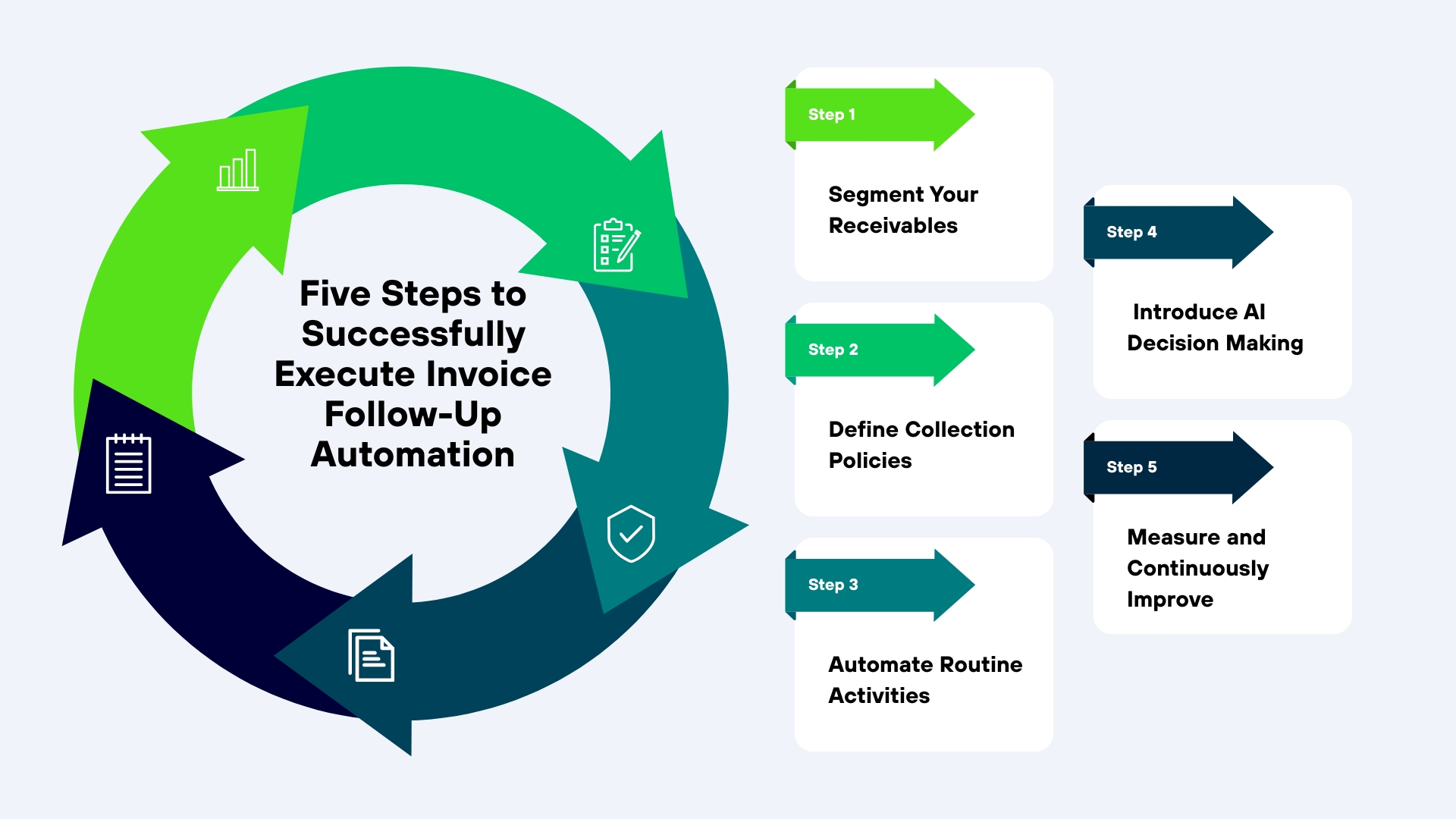
Different customers require different collection strategies.
Never automate every customer the same way.
Document:
- reminder frequency
- escalation matrix
- communication templates
- approval hierarchy
- customer-specific exceptions
Automate:
- invoice reminders
- follow-up emails
- call scheduling
- reminder workflows
- aging alerts
- dispute routing
Allow AI to:
- prioritize invoices
- recommend next actions
- predict payment delays
- classify customer responses
- personalize communication
Monitor KPIs such as:
- DSO
- Collection Effectiveness Index (CEI)
- Promise-to-pay conversion
- Reminder response rate
- Collector productivity
- Dispute resolution time
Organizations implementing invoice follow up automation typically experience:
- Faster collections
- Reduced DSO
- Higher collector productivity
- Lower manual effort
- Better cash-flow visibility
- Consistent customer communication
- Improved audit trail
- Faster dispute resolution
- Better customer experience
- Improved working capital
With Kapittx, organizations can:
- Automate invoice payment reminder emails using customer-specific templates.
- Configure intelligent payment reminder automation workflows based on risk, geography, customer type, and payment behavior.
- Automatically interpret customer email responses using AI and launch the appropriate workflow.
- Track disputes and assign ownership across finance, sales, logistics, and customer service.
- Prioritize high-risk invoices using AI-driven receivables insights.
- Maintain a complete audit trail of customer communication.
- Integrate seamlessly with existing ERP systems without disrupting current finance operations.
- Gain real-time dashboards for collections, cash flow forecasting, and receivables visibility.
Frequently Asked Questions
