
AI Handles the Follow-Up. You handle the relationship. The Rise of the Human & AI Collections Team
June 29, 2026How Can You Reduce DSO in NetSuite with AI?
June 30, 2026
NetSuite is one of the best things to happen to the modern finance function. It unified the ledger, retired a dozen disconnected spreadsheets, and gave controllers a single source of truth for what every customer owes. So this is not a takedown. It is a clarification, one that matters
more than most NetSuite conversations admit: NetSuite was built to record accounts receivable, not to optimise collections. Those are two different jobs. Recording AR means accurately capturing every invoice, payment, credit, and aging bucket, all tied cleanly back to the general ledger. Optimising collections means getting the cash in faster, orchestrating follow-ups, predicting who will pay late, routing disputes to the right owner, and applying incoming cash at scale. NetSuite is excellent at the first. It was never engineered to be great at the second. That gap carries a real price. The median company collects its receivables in roughly 56 days, and most B2B sellers sit somewhere between 45 and 60. More than half of B2B invoices are now paid late, and finance teams burn a striking amount of time chasing them; surveys routinely find collectors losing double-digit hours every week to manual follow-up. Every extra day of DSO is working capital sitting in someone else's bank account instead of yours. This article gives an honest read on what NetSuite accounts receivable does well, the five AR gaps it structurally cannot close, and what NetSuite CFOs are actually doing about them.
What NetSuite AR Does Well
Give NetSuite its due. As the system of record for receivables, it is genuinely strong, and any honest evaluation of NetSuite AR automation should start there:
- Order-to-invoice and billing. NetSuite converts sales orders into invoices automatically as orders are fulfilled, and handles multi-entity, multi-currency, and multi-subsidiary billing cleanly.
- A clean AR subledger. Every invoice, payment, credit memo, and write-off ties back to the GL with a defensible, auditable trail, exactly what you want from a system of record.
- Aging visibility. Real-time AR aging reports, customer balance summaries, and dashboards that drill from the portfolio level down to a single invoice.
- Baseline dunning. The Dunning Letters SuiteApp and SuiteFlow can issue reminder letters on a schedule across aging brackets.
- Native payment capture and reconciliation for straightforward, one-to-one cases.
If your question is "What do our customers owe us, and is it tied out correctly?"
NetSuite answers it well. The friction begins the moment the question becomes "how do we get paid faster?"
The 5 AR Gaps NetSuite Cannot Close
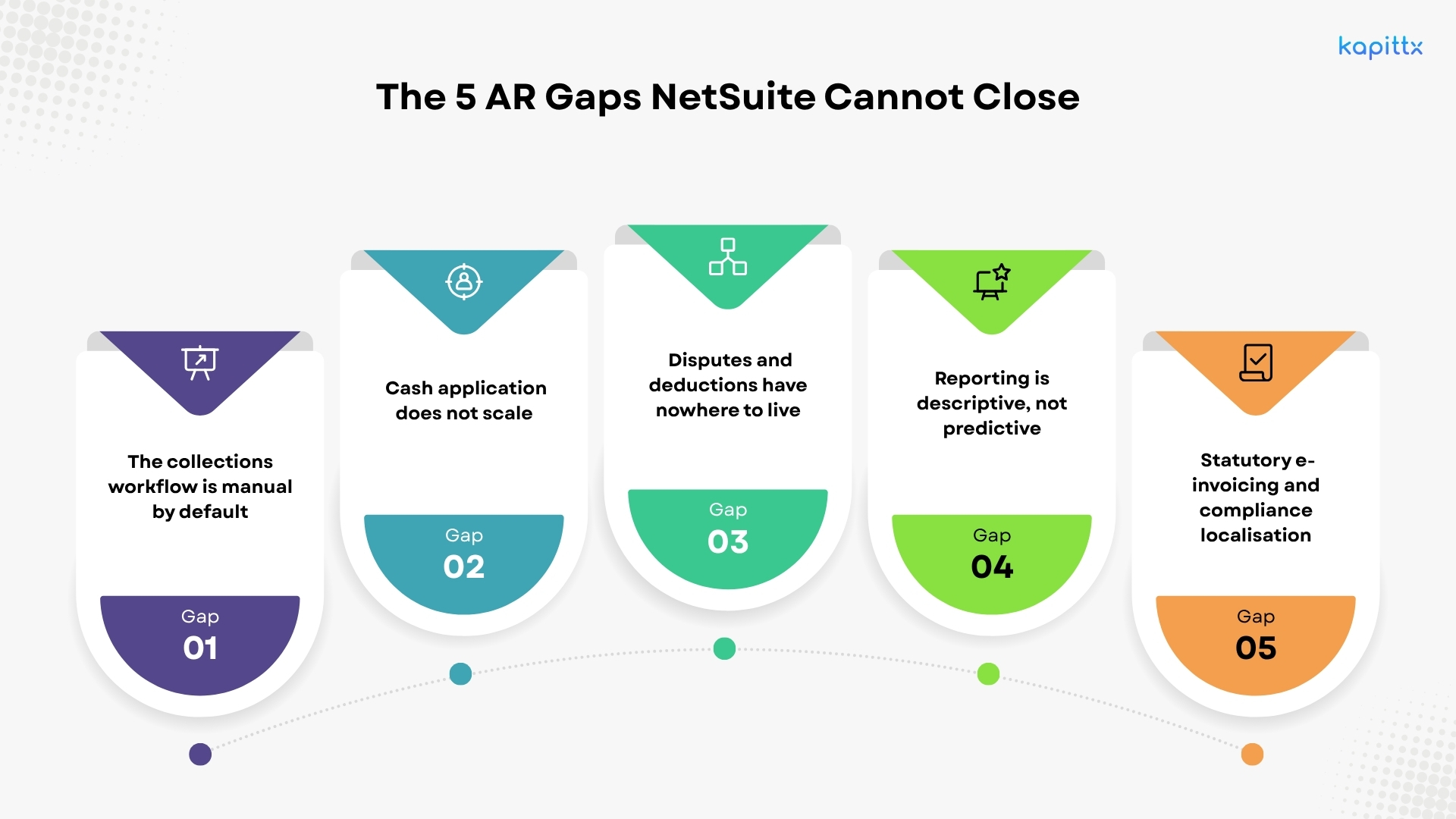
These are not bugs or oversights. They are the predictable edges of a platform designed to record receivables rather than actively collect them. Recognising them is the first step in any serious NetSuite AR limitations assessment.
Gap 1 — The collections workflow is manual by default
NetSuite tells you who is overdue; it does not run the chase for you. Out of the box, there is no intelligent worklist that tells each collector exactly who to contact today, in what order, through which channel, with what message, and what to do next. Teams build that logic in SuiteFlow
which means custom workflow projects, ongoing administrator time, and rework every time the process changes. Native dunning has hard ceilings, too: a dunning procedure tops out at 15 levels, batch print and email jobs are capped at roughly 100 letters at a time, and the Dunning
Letters Suite App cannot even detect a bounced email, so a reminder that never arrived looks identical to one that did. Most teams quietly drift back into spreadsheets to track who needs a follow-up and when. A truly automated NetSuite collections workflow is simply not something
the core platform provides.
Gap 2 — Cash application does not scale
Matching incoming payments to open invoices is where AR teams lose hours every single day. NetSuite handles the clean cases: one payment, one invoice, exact amount. Real B2B cash is messier than that: lump-sum payments spread across dozens of invoices, short pays, deductions, missing remittance detail, and funds arriving by ACH, wire, card, and lockbox in different formats. NetSuite carries little native intelligence to interpret that complexity, so specialists match it by hand. Modern AI cash-application engines now achieve straight-through match rates above 90%. The difference is stark: cash posted today versus cash sitting unapplied for a week, which inflates DSO on receivables you have, in fact, already been paid for.
Gap 3 — Disputes and deductions have nowhere to live
A disputed invoice is a collections problem wearing a customer-service costume. In NetSuite there is no native, structured way to log a dispute, attach the supporting proof, route it to the person who can actually resolve it- sales, billing, or logistics- track it to closure, and keep collections activity in sync the whole time. So disputes get tracked in inboxes and side spreadsheets, age silently, and too often harden into write-offs. The cash was collectable; the process let it slip.
Gap 4 — Reporting is descriptive, not predictive
NetSuite's AR reporting tells you what already happened: current ageing, balances, turnover. What it does not tell you is what is about to happen, which open invoices are likely to pay late, which customers' behaviour is quietly deteriorating, and what next month's collections will realistically be. Predictive payment-behaviour scoring and forecast-grade cash projection are not part of the core platform. CFOs who want them end up exporting to spreadsheets or BI tools and modelling by hand, which is slow and stale by the time it is done.
Gap 5 — Statutory e-invoicing and compliance localisation
Tax authorities around the world are moving AR onto real-time, government-cleared rails. In a fast-growing number of jurisdictions, a B2B invoice is not legally valid until it has been registered with a tax-authority portal and stamped with a validation reference and QR code, and there are tight reporting windows and meaningful penalties for getting it wrong. NetSuite's native localisation for these continuous, clearance-model mandates often lags the regulation or requires a separate bolt-on per market. For finance teams running receivables across multiple
jurisdictions, staying compliant, and keeping that compliance connected to live collections rather than siloed in a tax tool, is a real and widening gap.
What CFOs on NetSuite Are Actually Doing About the Gap
There are two roads, and most NetSuite finance leaders have now walked at least part of the first before choosing the second.
Road one: Extend NetSuite natively. Build collections workflows in SuiteFlow, license additional SuiteApps, and commission custom scripts for cash matching and reporting. Keeping everything inside one platform is appealing — but it turns the finance team into a software-development shop. SuiteFlow customisations are slow to build, brittle to change, dependent on a NetSuite specialist, and rarely deliver true AI matching or predictive scoring no matter how much you invest. You are asking a system of record to moonlight as a collections engine.
Road two: Add an intelligent collections layer on top. Keep NetSuite as the system of record and bolt a dedicated, AI-native AR layer onto it. The ERP stays the source of truth; the AR layer handles the work NetSuite was never built for, automated multi-channel follow-ups, AI cash application, structured dispute resolution, predictive analytics, and customer self-service. The two sync in real time, so the ledger stays pristine while collections get materially faster. This is not replacing NetSuite. It is finishing the job NetSuite starts.
The decision usually reduces to a single test. If your AR team's biggest constraint is recording receivables, stay native. If the constraint is collecting them, DSO that will not budge, specialists buried in cash matching, disputes aging into write-offs, a purpose-built AR automation layer for NetSuite tends to pay for itself in recovered working capital, often within a quarter or two.
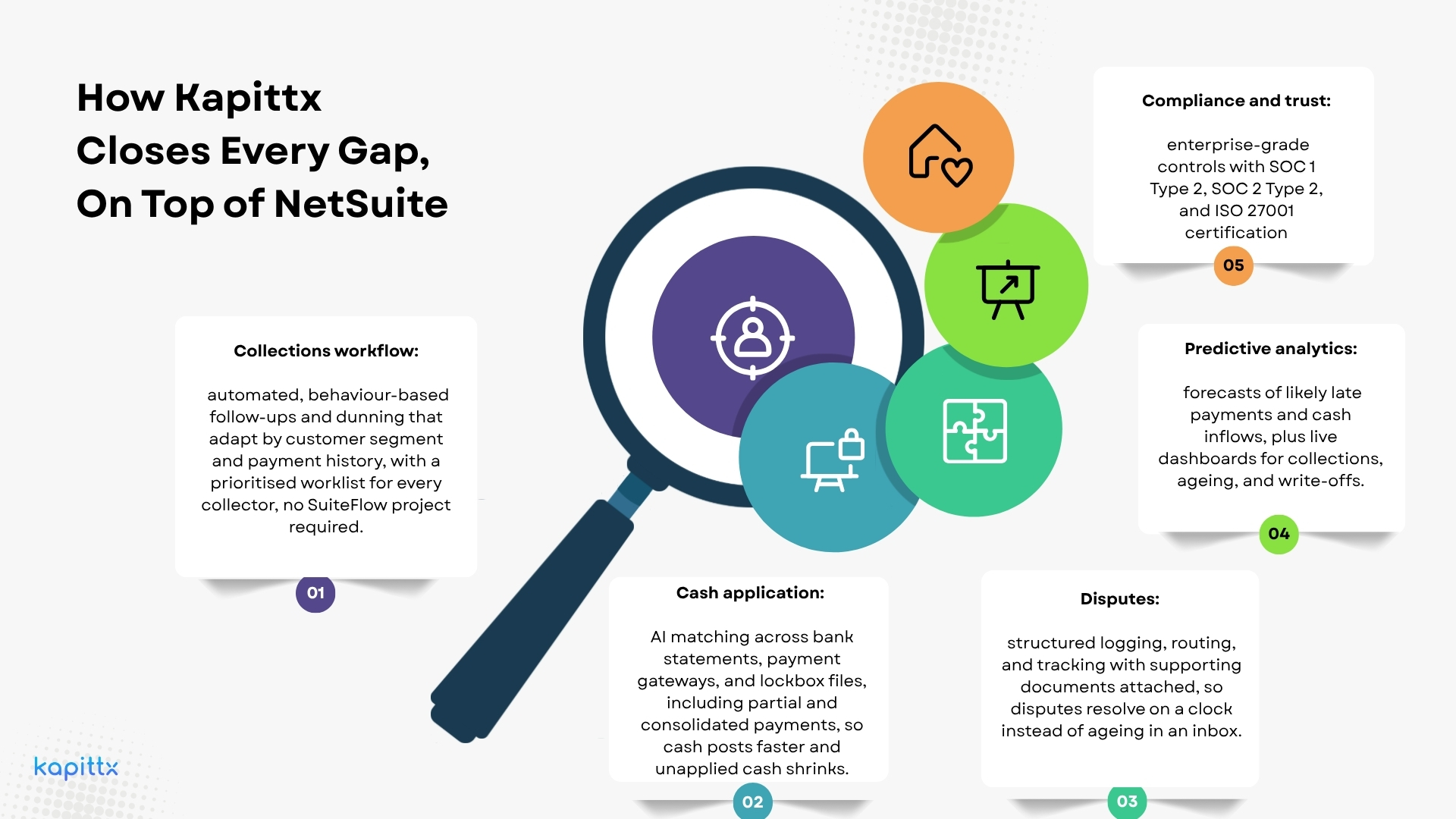
How Kapittx Closes Every Gap, On Top of NetSuite
Kapittx is built for exactly this role: an AI-native accounts receivable platform that sits on top of NetSuite as an intelligent collections layer, never a replacement. The Kapittx NetSuite integration connects through secure APIs, syncs invoice, payment, and customer data in real time, and lets your team keep working the way they already do. Mapped directly to the five gaps:
- Collections workflow: automated, behaviour-based follow-ups and dunning that adapt by customer segment and payment history, with a prioritised worklist for every collector, no SuiteFlow project required.
- Cash application: AI matching across bank statements, payment gateways, and lockbox files, including partial and consolidated payments, so cash posts faster and unapplied cash shrinks.
- Disputes: structured logging, routing, and tracking with supporting documents attached, so disputes resolve on a clock instead of ageing in an inbox.
- Predictive analytics: forecasts of likely late payments and cash inflows, plus live dashboards for collections, ageing, and write-offs.
- Compliance and trust: enterprise-grade controls with SOC 1 Type 2, SOC 2 Type 2, and ISO 27001 certification, plus a customer self-service portal that speeds payment and cuts inbound queries.
See how Kapittx layers onto NetSuite to close the AR gap, and what it could take off your DSO. Book a demo at Kapittx.
Frequently Asked Questions
