
MSMED Amendment Act 2026: A Blueprint for MSMEs, Enterprise Buyers & Financial Infrastructure
August 13, 2026Closing the Cash Conversion Loop: Why Siloed AR and AP Software Is Stalling Your Free Cash Flow
August 24, 2026
Executive Summary: The New Reality of Cash Planning
AR AP integration gives finance leaders a unified view of incoming and outgoing cash, replacing fragmented spreadsheets with reliable, real-time intelligence. By connecting receivables, payables, ERP, banking, and payment data, businesses can forecast liquidity more accurately, anticipate cash gaps, and make better funding decisions. Unified cash management also enables automated reconciliation, scenario planning, and proactive working-capital control, turning cash planning from a stressful month-end exercise into a continuous, confident management process for growing organizations worldwide.
Accounts Receivable and Accounts Payable Operate in Silos
Accounts receivable and accounts payable influence the same outcome: how much cash a business will have and when it will be available. Yet most companies manage them as separate processes.
AR teams focus on customer invoices, collections, disputes, and cash application. AP teams manage supplier invoices, approvals, payment schedules, and vendor relationships. Treasury then attempts to combine information from both functions to forecast liquidity.
This separation creates four common problems:
- AR forecasts may assume customers will pay on contractual due dates, even when their payment history indicates otherwise.
- AP schedules may omit invoices waiting for approval or vendor disputes.
- Bank balances show cash already received or paid but not future commitments.
- Treasury teams consolidate these incomplete data sets manually, often using spreadsheets.
The result is a forecast that appears precise but rests on weak assumptions. A delayed customer payment, an unexpected supplier run, or a large deduction can suddenly turn an expected surplus into a liquidity gap.
This is why cash management and forecasting remain major finance priorities. According to the Association for Financial Professionals, 73% of treasury professionals identify cash management and forecasting as a top priority. AFP also reports that 62% consider cash and liquidity forecasting their most challenging treasury task.
What Happens When You Connect AR and AP for Better Cash Flow?
AR AP integration creates a shared financial timeline covering expected collections, approved payments, actual bank transactions, and forecast exceptions.
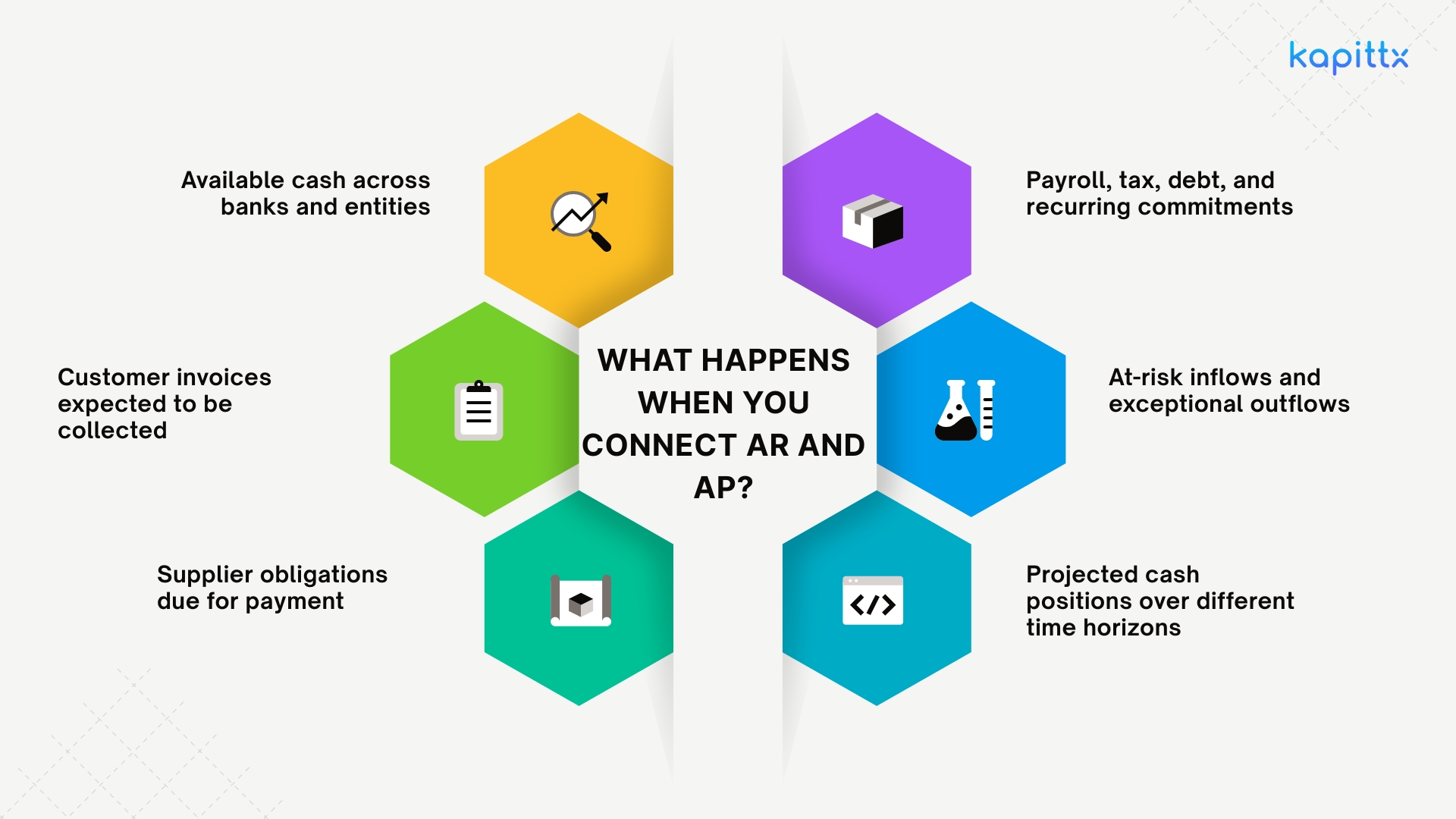
Instead of asking AR, AP, and treasury for separate reports, the CFO gains one view of:
- Available cash across banks and entities
- Customer invoices expected to be collected
- Supplier obligations due for payment
- Payroll, tax, debt, and recurring commitments
- At-risk inflows and exceptional outflows
- Projected cash positions over different time horizons
This is more than data consolidation. Effective unified cash management connects operational events with their probable cash impact.
For example, a ₹50 lakh or $60,000 customer invoice due next week should not automatically enter the forecast as cash available on the due date. The system should consider the customer’s payment behavior, open disputes, promise-to-pay commitments, and historical delays.
Similarly, an approved supplier invoice may be scheduled according to its due date, early-payment discount, vendor criticality, and available liquidity. Connecting both sides reveals whether anticipated collections can support planned payments without creating unnecessary borrowing or supplier risk.
The Role of a Finance Automation Platform
A modern finance automation platform creates a common intelligence layer across AR, AP, treasury, ERP systems, banks, and payment service providers.
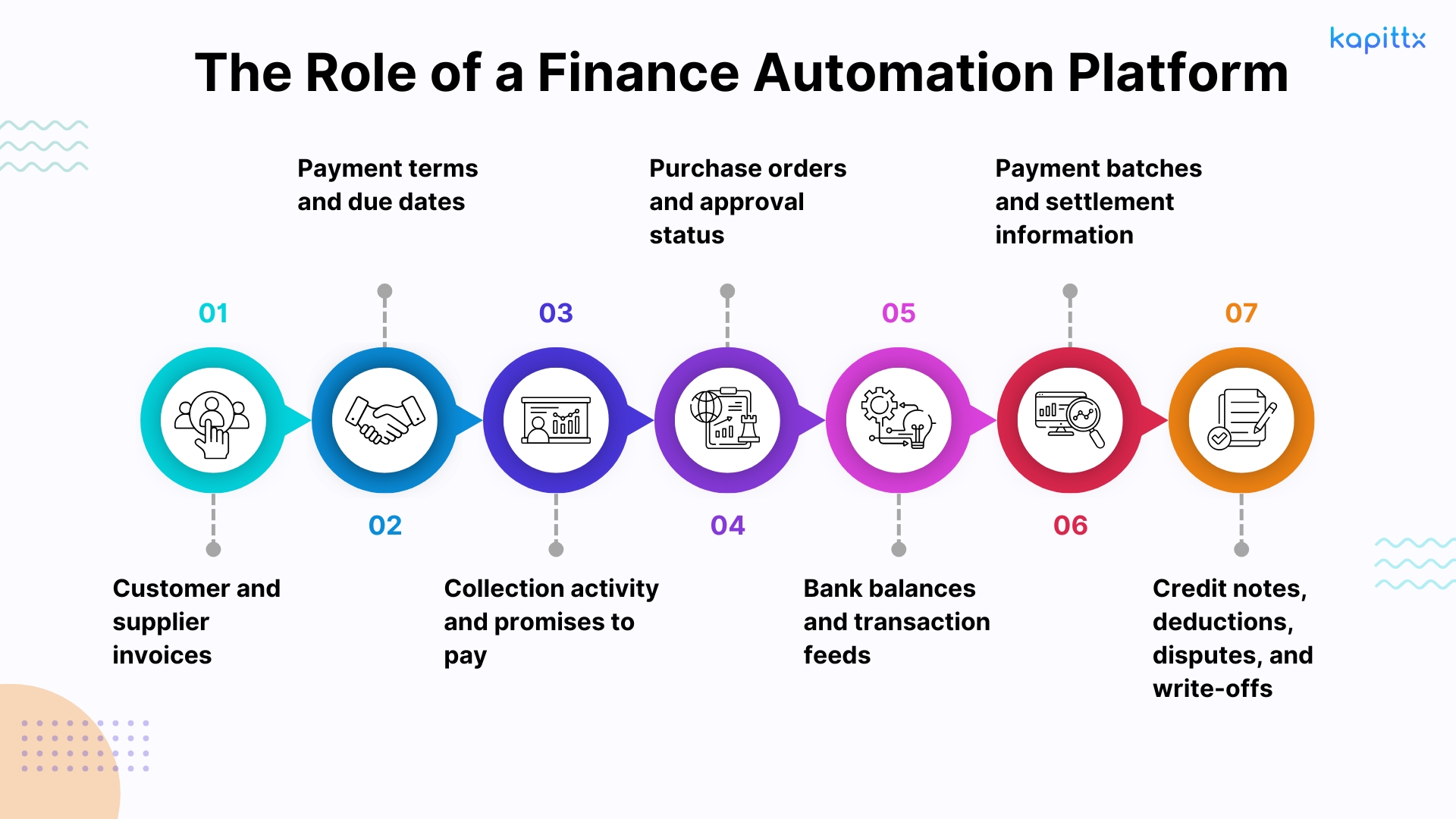
It can continuously collect and normalize data such as:
- Customer and supplier invoices
- Payment terms and due dates
- Collection activity and promises to pay
- Purchase orders and approval status
- Bank balances and transaction feeds
- Payment batches and settlement information
- Credit notes, deductions, disputes, and write-offs
Automation then converts this information into workflows and decisions. Collection agents can prioritize overdue accounts. Cash application agents can match receipts with open invoices. Reconciliation agents can identify discrepancies. AP workflows can schedule approved payments within organizational policies.
AI adds another layer by identifying payment patterns, forecasting likely receipt dates, detecting anomalies, and flagging exceptions requiring human judgment.
This approach supports treasury planning without necessarily replacing the ERP or treasury management system. The automation platform connects operational finance data and makes it timely, usable, and predictive.
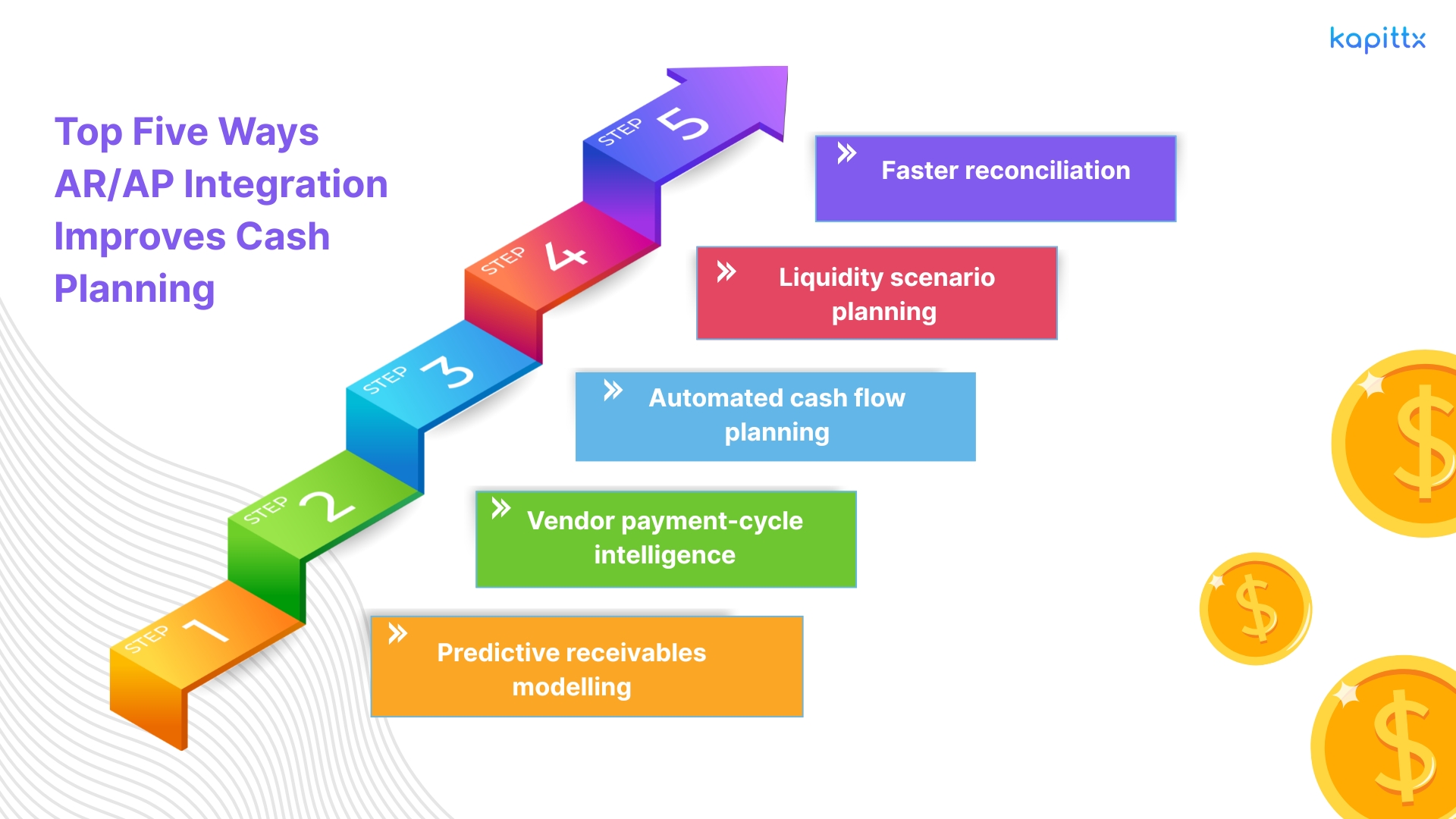
Top Five Ways AR/AP Integration Improves Cash Planning
Trusted Results Across Automotive Accounts Receivable
1. Predictive receivables modelling
Contractual due dates are not always reliable cash dates. Predictive models can examine customer payment history, invoice value, disputes, seasonality, and collection engagement to estimate when an invoice is likely to be paid. This produces a more realistic inflow forecast than simply extracting an aging report.
2. Vendor payment-cycle intelligence
Integrated AP data shows which invoices are approved, disputed, blocked, or eligible for discounts. Finance teams can distinguish mandatory payments from those that can be rescheduled within agreed terms. The objective is not to delay suppliers indiscriminately. It is to optimize payment timing while protecting critical vendor relationships.
3. Automated cash flow planning
Automated cash flow planning for businesses continuously updates forecasts when an invoice is paid, a customer breaks a promise, a supplier invoice is approved, or a bank transaction is posted. Finance teams spend less time rebuilding models and more time interpreting changes.
4. Liquidity scenario planning
Connecting inflows and outflows enables meaningful scenarios:
- What happens if the ten largest customers pay seven days late?
- Can the business fund a major supplier run without using its credit facility?
- What is the effect of offering early-payment discounts?
- How would a 10% sales decline affect cash over the next 13 weeks?
These simulations turn cash planning into an active decision tool.
5. Faster reconciliation
Automated matching connects customer receipts, supplier payments, invoices, remittances, and bank transactions. This reduces unidentified cash and prevents already-settled items from distorting the forecast.
Real-Time Cash Positioning: The Heart of Stress-Free Planning
Cash positioning answers a deceptively simple question: how much usable cash does the company have today? For a growing business, the answer may be distributed across entities, banks, currencies, payment gateways, and restricted accounts. A consolidated bank balance alone is insufficient because it excludes operational commitments and expected receipts.
Real-time cash positioning combines:
- Opening bank balances
- Confirmed intraday transactions
- Expected near-term customer receipts
- Approved or scheduled payments
- Funding movements
- Currency and entity-level restrictions
Intelligent alerts can then notify finance leaders when projected balances fall below a threshold, surplus cash becomes available, a major receipt is delayed, or payments exceed the approved plan. The AFP’s guidance on liquidity management notes that integrating data from bank, ERP, and financial application gives organizations a more complete view of liquidity. That connected view is the foundation of stress-free B2B cash forecasting.
Connecting AR and AP Workflows: A Practical Guide
Businesses do not need to replace every finance system to connect payables and receivables. They need a reliable integration and data-governance model.
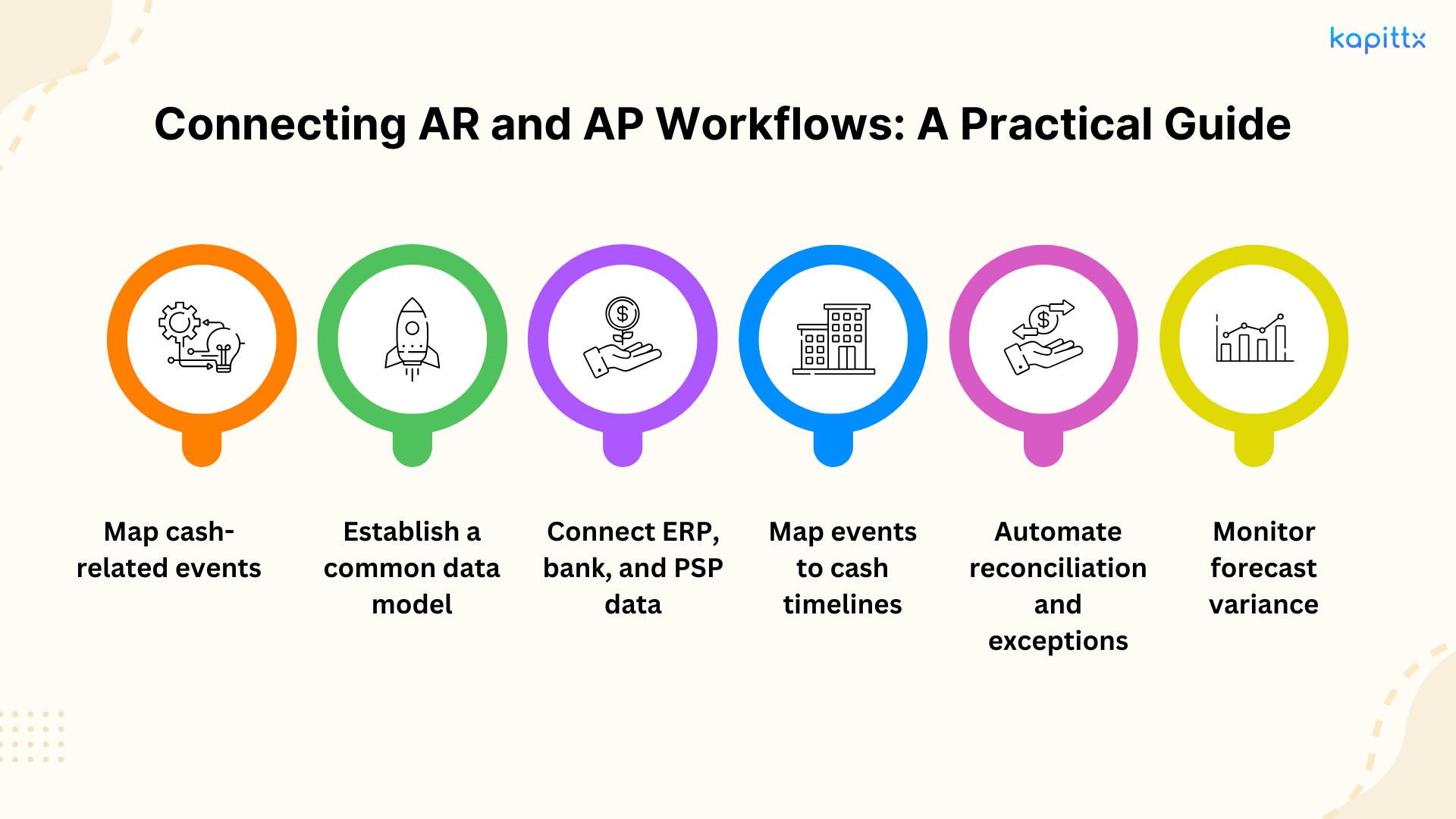
Step 1: Map cash-related events
Identify the events that change the cash forecast: invoice creation, due-date changes, disputes, promises to pay, AP approvals, payment runs, bank settlements, and reconciliations.
Step 2: Establish a common data model
Standardize customer, supplier, entity, currency, bank-account, invoice, and payment identifiers. Without consistent master data, integration can reproduce existing confusion faster.
Step 3: Connect ERP, bank, and PSP data
Use APIs, or AI secure bank data, scheduled file exchanges, or system connectors. Define which platform is the system of record for each field and how frequently information should refresh.
Step 4: Map events to cash timelines
Translate operational statuses into expected cash dates. A disputed receivable should carry a different probability from a confirmed promise to pay. An unapproved supplier invoice should not be treated like a scheduled payment.
Step 5: Automate reconciliation and exceptions
Apply rules and AI-assisted matching to routine transactions. Route low-confidence matches, unusual values, duplicate payments, and policy exceptions to finance users.
Step 6: Monitor forecast variance
Compare forecast dates and amounts with actual results. Variance analysis helps teams identify weak data, unreliable assumptions, and customer or vendor behaviour that requires attention.
Implementation Roadmap for Finance Leaders
A practical rollout can be completed in four phases.
- Phase one: Diagnose. Document current AR, AP, cash-positioning, and reconciliation processes. Measure forecast variance, manual effort, unapplied cash, overdue receivables, and payment exceptions.
- Phase two: Connect. Integrate the primary ERP, bank accounts, and payment service providers. Begin with the entities and cash flows representing the greatest financial exposure.
- Phase three: Automate. Introduce collections prioritization, cash application, reconciliation, AP scheduling, and exception workflows. Maintain approval controls and audit trails.
- Phase four: Predict. Add behavioural forecasting, liquidity scenarios, threshold alerts, and executive dashboards. Review forecast accuracy regularly and refine the model.
- Change management is essential throughout. AR, AP, treasury, and controllership teams must agree on data ownership, exception responsibilities, approval policies, and common working-capital objectives.
Stress-Free Cash Planning in Action
Consider three illustrative examples.
A SaaS company connects subscription invoices, customer payment behaviour, renewals, AP commitments, and bank feeds. Instead of assuming every invoice will be collected on its due date, finance creates probability-weighted forecasts and identifies renewal-related collection risks earlier.
A manufacturer combines distributor receivables with raw-material purchases and supplier payment schedules. When a major customer delays payment, treasury can assess the liquidity effect before approving a non-critical payment run.
A retail or CPG company reconciles high-volume customer receipts, deductions, payment-gateway settlements, and supplier obligations. Automated exception handling reduces spreadsheet work and improves daily visibility during seasonal peaks.
The Future: Unified Cash Management as a Strategic Advantage
Cash planning is moving from periodic reporting to continuous cash intelligence.
AI-driven treasury planning will not merely project balances. It will explain why liquidity is changing, identify the transactions driving forecast risk, and recommend policy-compliant actions.
Autonomous AR and AP workflows will coordinate collection priorities, receipt matching, supplier schedules, and reconciliation. CFO dashboards will show not only current cash but also forecast confidence, exposure concentration, and recommended interventions.
J.P. Morgan’s analysis of AI-driven cash flow forecasting highlights how machine learning, real-time analysis, and simulations can improve the strategic value of forecasting. However, AI is only as useful as the connected operational data supporting it.
Conclusion: AR/AP Integration Is No Longer Optional
Connecting AR and AP gives CFOs a dependable view of the relationship between money expected and money committed. It improves forecasting accuracy, accelerates reconciliation, strengthens working-capital decisions, and reduces liquidity surprises.
For finance leaders asking how to connect payables and receivables, the answer begins with shared data, synchronized events, automated controls, and cross-functional ownership. AR AP integration transforms cash planning from a stressful reconstruction of the past into a proactive view of what comes next.
How Kapittx Helps You Execute This
Kapittx provides an AI-native environment for connecting invoice-to-cash and invoice-to-pay activity through a coordinated ecosystem of finance agents.
Its AI Collection Agent helps prioritize receivables, interpret customer responses, track promises to pay, and initiate policy-based follow-ups. The AI Cash Application Agent reads remittance information and matches receipts with open invoices. Reconciliation agents identify mismatches across invoices, payments, and financial records.
By integrating with ERP, banking, payment, and operational data, Kapittx helps finance teams create real-time visibility into incoming and outgoing cash. CFOs can move toward unified cash management while retaining governance, approval controls, exception routing, and auditability.
The outcome is clearer cash positioning, more reliable forecasting, reduced manual effort, and better coordination across AR, AP, treasury, and finance operations.
Frequently Asked Questions
