
How Can You Reduce DSO in NetSuite with AI?
June 30, 2026Accounts Receivable Automation in India: Why Your ERP Cannot Solve Collections Alone
July 7, 2026Summary
NetSuite is an exceptional ERP, but it was built to record accounts receivable, not to optimise collections. For Indian businesses, the gap is wider: GST reconciliation, TDS deductions, IRN e-invoicing, and UPI payment matching create compliance and operational challenges that native NetSuite cannot solve. This article explains the five structural gaps CFOs on NetSuite face, why they matter more in India, and how AI-powered AR automation from Kapittx closes every one, without replacing the ERP you already rely on.
Introduction: NetSuite Is Excellent, But Incomplete
NetSuite is one of the finest ERP platforms available to mid-market and enterprise businesses. It unifies the general ledger, retires disconnected spreadsheets, and gives finance teams a single source of truth for every invoice, credit, and payment. This article is not a takedown of NetSuite. It is a clarification, one that matters especially to Indian finance leaders.
The clarification is this: NetSuite was built to record accounts receivable, not to optimise collections. Those are two fundamentally different jobs.
Recording AR means accurately capturing every invoice, payment, and aging bucket, tied cleanly to the general ledger. Optimising collections means getting cash in faster, automating follow-ups, predicting which customers will pay late, routing disputes intelligently, applying incoming cash at scale, and doing all of this within India's complex compliance framework of GST, TDS, and IRN e-invoicing mandates.
NetSuite is excellent at first. It was never engineered for the second. And in India's B2B market, where extended credit cycles, compliance obligations, and manual AR processes are the norm, that gap carries a high and measurable financial cost.
- Why Indian Businesses Struggle with Accounts Receivable
India's B2B payment landscape is structurally challenging. The average Days Sales Outstanding (DSO) for mid-market Indian companies sits between 60 and 90 days, well above the 47-day global average reported by PwC in its 2025 Working Capital Survey. The Reserve Bank of India's MSME Payment Index confirms that delayed payments remain one of the top three financial stressors for Indian businesses, affecting cash flow, supplier relationships, and growth plans simultaneously.
Several forces drive this. Extended NET-60 to NET-90 credit terms are culturally normalised across manufacturing, distribution, and services, particularly in relationships between larger enterprises and their mid-market vendors. GST reconciliation adds a layer of complexity that most ERP systems, including NetSuite, were not designed to manage natively. TDS deductions on outgoing payments routinely reduce remittances below invoice values, requiring invoice-by-invoice reconciliation that consumes AR team hours. And the rapid growth of UPI-based B2B payments, while transformative, creates new cash application challenges when payments arrive without structured remittance data.
According to McKinsey's 2025 Global Payments Report, India is one of the fastest-growing B2B payments markets in the world, but transaction complexity is growing faster than the tools most finance teams use to manage it.
- Why ERP Alone Is Not Enough
ERPs, including NetSuite, are designed to be systems of record. They capture and store financial data with precision, accuracy, and auditability. That is what they were built for, and they do it well.
What ERPs were not built for is the active orchestration of collections: deciding which customers to contact today, through which channel, with what message, escalating disputes to the right owner, or predicting next month's cash inflows from current payment behaviour. These are operational execution problems, not record-keeping problems, and they require a different class of tool.
Gartner's 2025 Finance Technology Report notes that over 70% of mid-market companies still rely primarily on their ERP for AR management, yet fewer than 20% report satisfaction with their collections effectiveness. The gap between recording receivables and collecting them efficiently is one of the most consistent and costly inefficiencies in modern finance operations.
For Indian businesses on NetSuite, the challenge is compounded by compliance requirements that native NetSuite localisation does not fully address: GSTR-2B reconciliation, IRN generation under e-invoicing mandates, and TDS certificate management across vendor and customer relationships. These obligations sit at the intersection of AR management and tax compliance, a space that ERP systems handle partially and AR automation platforms built for India can handle completely.
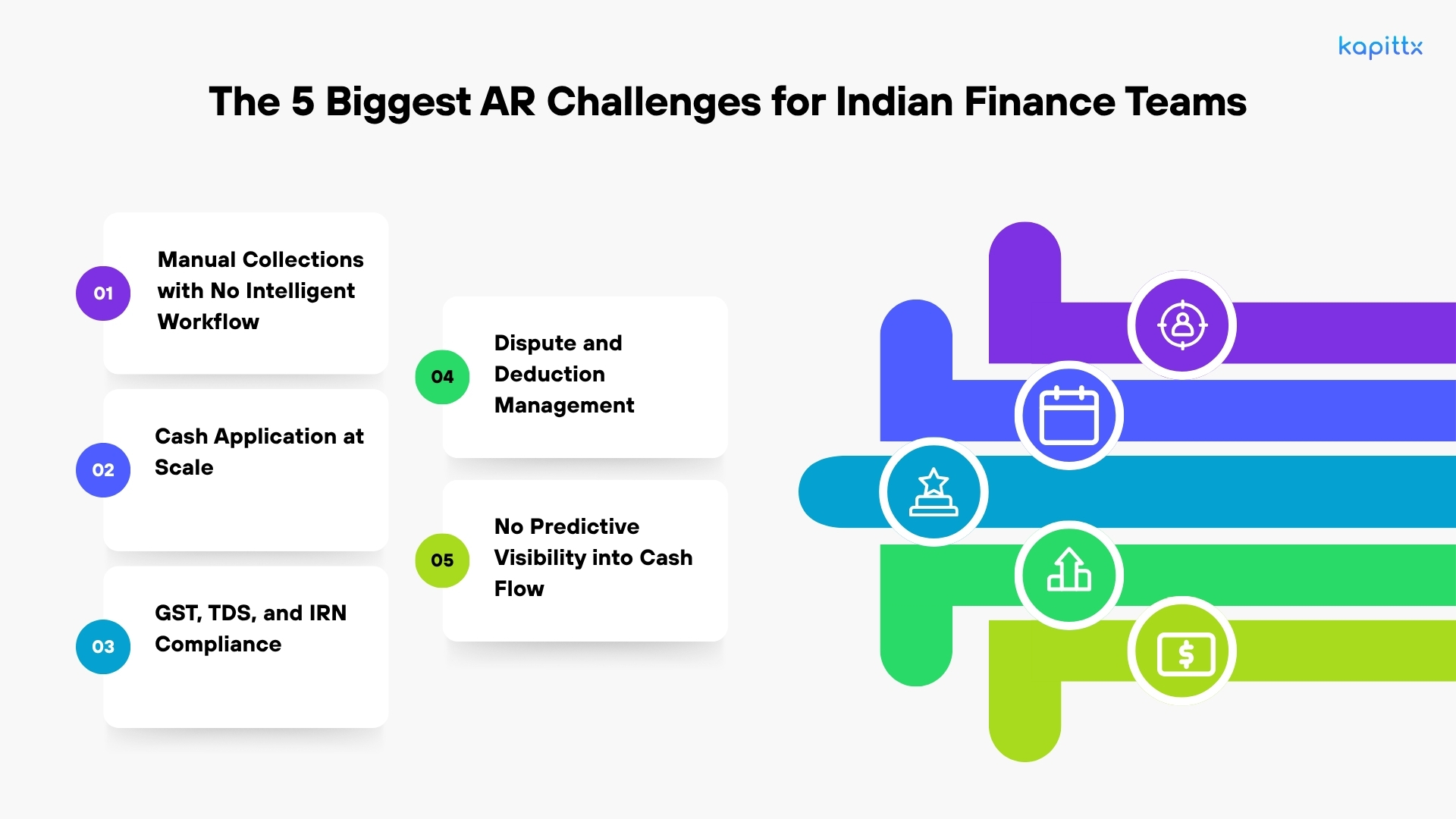
4.1 Manual Collections with No Intelligent Workflow
NetSuite surfaces who is overdue, but does not orchestrate what happens next. Out of the box, there is no intelligent worklist that tells each collector which accounts to prioritise today, in what order, through which channel- email, WhatsApp, phone, or customer portal- and with what escalation path.
Teams build workarounds in SuiteFlow, which requires developer resources and constant maintenance. NetSuite's native dunning has documented hard limits: a maximum of 15 dunning levels per procedure, batch jobs capped at approximately 100 letters per run, and no capabilities to detect a bounced email, so a reminder that never arrived looks identical to the one that did.
Industry Data: Deloitte's 2025 Finance Operations Survey found that AR teams at mid-market companies spend an average of 62% of their working time on manual, repetitive tasks, follow-up emails, ageing reports, and payment reconciliation. For a five-person AR team, this represents approximately 2,480 hours per year of recoverable capacity.
Indian businesses face an additional dimension: collections in India rely more heavily on relationship management than automated pressure. A platform that can personalise outreach by customer segment, pause collections when a relationship-level conversation is underway, and adapt cadence based on payment history is not a luxury; it is a collections requirement.
Cash application, matching incoming payments to open invoices, is where Indian AR teams lose significant time every day. NetSuite handles clean, one-to-one cases reliably. Real B2B cash in India is rarely that clean.
A single payment from a large distributor may cover 40 invoices across three business units, with TDS deducted, GST adjusted, and a short payment on a disputed line. UPI transactions arrive without structured remittance data. Cheques require manual deposit and reconciliation against the bank statement. NEFT and RTGS transfers come with reference numbers that must be manually cross-referenced to invoice records.
According to PwC's India CFO Survey 2025, over 58% of Indian finance teams cite cash application accuracy as their most time-consuming AR task, with unapplied cash balances inflating reported DSO by an average of 8–12 days.
Modern AI cash application platforms achieve straight-through match rates above 90%, even for complex, partial, and multi-invoice remittances. The difference is stark: cash posted today versus cash sitting unapplied in a suspense account for a week, which overstates DSO on receivables that have, in fact, already been collected.
4.3 GST, TDS, and IRN Compliance
This is the AR challenge that is most uniquely Indian, and most distinctly underserved by global ERP platforms, including NetSuite.
India's GST framework requires that outward supplies are reconciled against GSTR-2B data from the GSTN portal, and that input tax credit claims are validated against supplier filings. For AR teams, this means that invoice posting and collections activity cannot be managed in isolation from GST reconciliation; a mismatch between what you have invoiced and what appears in your customer's GSTR-2B can delay payment while the customer waits to confirm ITC eligibility.
E-invoicing under the IRN mandate, which now applies to businesses with turnover above ₹5 crore, requires that every B2B invoice be registered with the Invoice Registration Portal before it is issued to the customer. An invoice without a valid IRN and QR code is not legally valid for the customer's GST purposes, and customers increasingly reject non-compliant invoices at the point of receipt, resetting the payment clock.
TDS deductions under various sections of the Income Tax Act mean that payments routinely arrive at values below the invoice amount. Reconciling these deductions, matching Form 16A or Form 26AS data to specific invoices, tracking TDS certificates, and adjusting AR balances accordingly, adds a compliance layer that NetSuite's native AR module does not automate for the Indian market.
Regulatory Context: As of April 2024, India's e-invoicing mandate covers all registered businesses with aggregate turnover exceeding ₹5 crore. The GSTN estimates that over 1.4 million businesses are now subject to IRN compliance, the majority of whom are mid-market companies in manufacturing, distribution, and services sectors.
4.4 Dispute and Deduction Management
A disputed invoice is a collection problem dressed as a customer service issue. In NetSuite, there is no native, structured mechanism to log a dispute, attach supporting documentation, route it to the appropriate internal owner- billing, logistics, or sales- track it through to resolution, and keep collections activity synchronised throughout the process.
Disputes in Indian B2B commerce are particularly common in manufacturing and distribution, where quantity short-ships, quality deductions, and pricing discrepancies are routine. Without a structured dispute management workflow, these items age silently in email inboxes, accumulate in ageing reports, and frequently convert to bad debt write-offs, not because the cash was uncollectable, but because the resolution process was unmanaged.
McKinsey's Accounts Receivable Benchmark Study (2024) found that companies with structured dispute management workflows resolve disputes 3.4 times faster than those relying on email and manual tracking, and write off 40% less AR as bad debt.
4.5 No Predictive Visibility into Cash Flow
NetSuite's AR reporting tells CFOs what has already happened: current aging, overdue balances, payment history. What it does not tell them is what is about to happen — which open invoices are likely to pay late this month, which customer relationships are showing early deterioration signals, and what next quarter's cash inflows will realistically be based on current payment behaviour patterns.
For Indian CFOs managing working capital against growth plans, treasury obligations, and supplier payment cycles, this backwards-looking reporting is a material constraint. Cash flow forecasting built on aging reports is inherently stale — and in a market where payment timing can be the difference between meeting payroll and missing it, that staleness carries real operational risk.
Gartner's CFO Survey 2025 found that 77% of CFOs in high-growth markets cite improving cash flow predictability as a top strategic priority, yet fewer than 25% have real-time, AI-powered forecasting tools connected to their AR data.
- How AI-Powered AR Automation Solves These Challenges
The solution is not to replace NetSuite. It is to add an intelligent collections layer on top of it, one that keeps NetSuite as the system of record while building the active, AI-driven collections capability the ERP was never designed to provide.
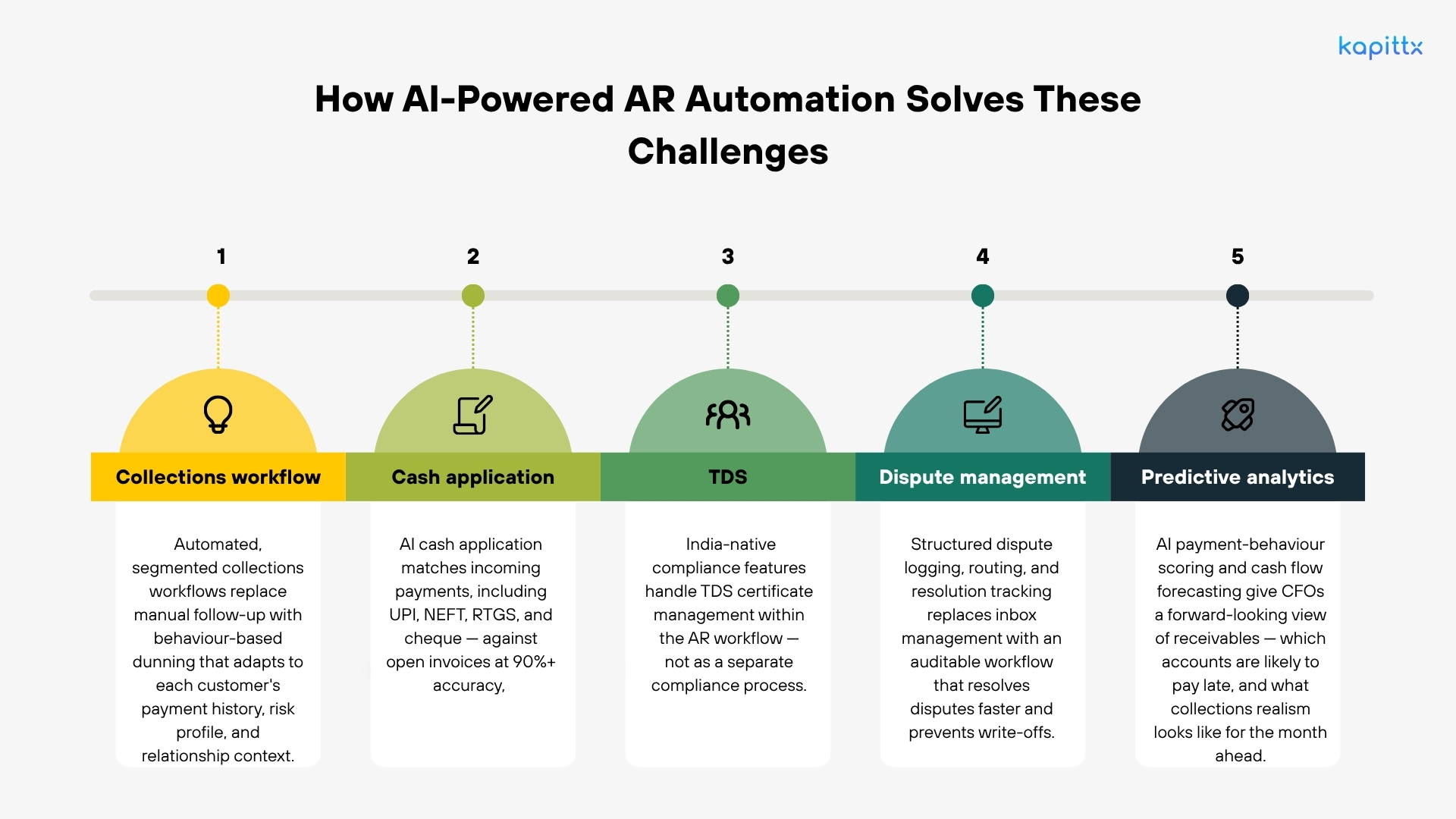
An AI-powered AR automation platform integrated with NetSuite closes each of the five gaps described above:
- Collections workflow: Automated, segmented collections workflows replace manual follow-up with behaviour-based dunning that adapts to each customer's payment history, risk profile, and relationship context.
- Cash application: AI cash application matches incoming payments, including UPI, NEFT, RTGS, and cheque, against open invoices at 90%+ accuracy, posting cash faster and eliminating unapplied balance backlogs.
- TDS: India-native compliance features handle TDS certificate management within the AR workflow, not as a separate compliance process.
- Dispute management: Structured dispute logging, routing, and resolution tracking replaces inbox management with an auditable workflow that resolves disputes faster and prevents write-offs.
- Predictive analytics: AI payment-behaviour scoring and cash flow forecasting give CFOs a forward-looking view of receivables, which accounts are likely to pay late, and what collections realism looks like for the month ahead.
Companies deploying AI-powered AR automation alongside their ERP report average DSO reductions of 15–25 days, AR team productivity improvements of 40–60%, and meaningful reductions in bad debt write-offs, according to Deloitte's 2025 Finance Automation Benchmarking Report.
- Why Kapittx Is Built for Indian Enterprises
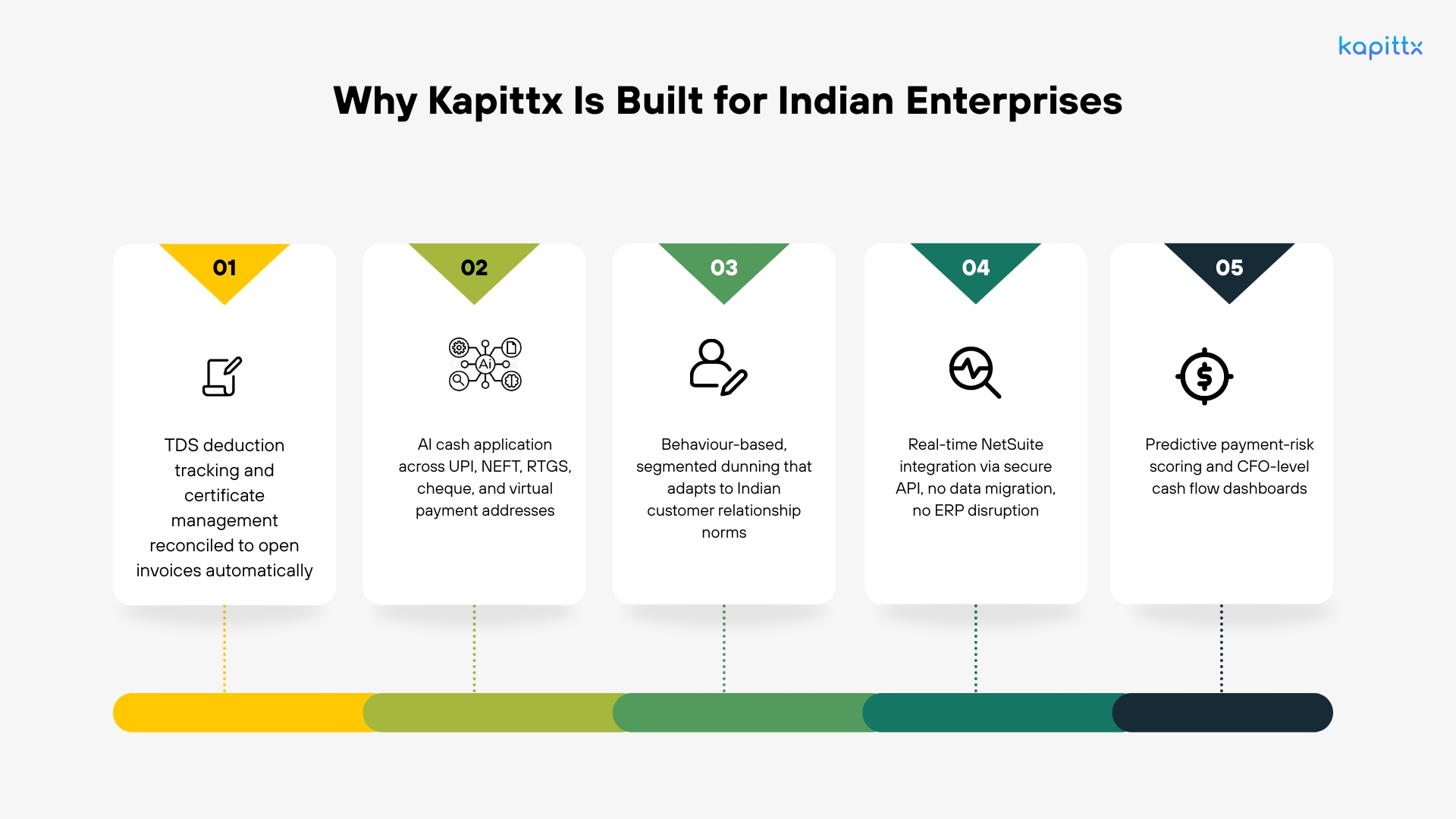
Kapittx is an AI-powered accounts receivable automation platform designed specifically for mid-market and enterprise B2B businesses in India and the United States. Unlike global AR automation tools that treat India as an afterthought, Kapittx is built from the ground up for the Indian compliance environment and the Indian B2B collections culture.
- TDS deduction tracking and certificate management reconciled to open invoices automatically
- AI cash application across UPI, NEFT, RTGS, cheque, and virtual payment addresses
- Behaviour-based, segmented dunning that adapts to Indian customer relationship norms
- Real-time NetSuite integration via secure API, no data migration, no ERP disruption
- Predictive payment-risk scoring and CFO-level cash flow dashboards
Kapittx integrates with NetSuite, SAP, Microsoft Dynamics, QuickBooks, Tally, and Zoho, making it accessible to Indian businesses at every stage of ERP maturity.
- Conclusion
NetSuite is an exceptional ERP. It is not an exceptional collections platform, particularly for the compliance complexity and extended credit cycles of the Indian B2B market. The five gaps described in this article are structural, not configuration problems. They require a purpose-built solution.
Finance leaders who close these gaps with AI-powered AR automation report faster cash collection, lower DSO, and finance teams that spend their time on strategic work rather than manual follow-up. The working capital recovered from a 15-day DSO improvement on a ₹100 crore revenue business is approximately ₹4 crore, capital that can fund growth, reduce borrowing, or improve supplier terms.
Ready to see Kapittx in action? Book a free 20-minute demo and see how Kapittx integrates with your NetSuite environment to reduce DSO, automate collections, and manage Indian compliance, without replacing the ERP your team already knows. Visit Kapittx
Frequently Asked Questions
