
Best Practices for Efficient Cash Application: Leveraging AI for Superior Results
November 25, 2024The Challenges and Limitations of Using Spreadsheets to Manage Accounts Receivable and Build AR Analytics
December 3, 2024Efficient Accounts Receivable (AR) is an essential component of any organization’s financial health. Effective management of AR ensures that the company maintains a healthy cash flow, minimizes the risk of bad debt, and fosters strong customer relationships. One of the most powerful tools at a company’s disposal to enhance AR processes is analytics. By leveraging AR analytics, businesses can gain actionable insights into payment behaviors and collection effectiveness. This blog explores how AR analytics can be used to optimize financial operations.
Understanding AR Analytics
AR analytics involves the systematic use of data and statistical analysis to understand and improve accounts receivable processes. This includes tracking payment patterns, predicting future payment behaviors, identifying potential risks, and measuring the effectiveness of collection strategies.
By implementing AR analytics, businesses can transition from reactive to proactive management of their accounts receivable. Instead of waiting for payment issues to arise, companies can anticipate potential problems and take preemptive measures to address them.
Key Metrics in AR Analytics
Several key metrics are crucial for gaining actionable insights through AR analytics:
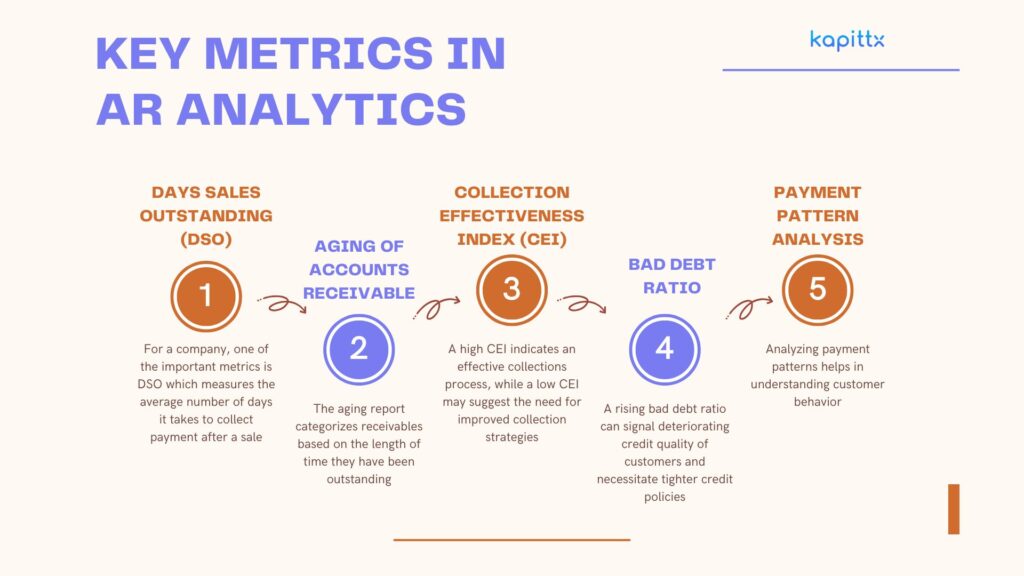
- Days Sales Outstanding (DSO): For a company, one of the important metrics is DSO which measures the average number of days it takes to collect payment after a sale. A lower DSO indicates faster collection of receivables and better liquidity. Monitoring DSO trends can help identify inefficiencies in the collection process and prompt corrective actions.
- Aging of Accounts Receivable: The aging report categorizes receivables based on the length of time they have been outstanding. This allows for the identification of overdue accounts and prioritizes collection efforts. By analyzing aging trends, businesses can also uncover patterns that may indicate underlying issues with certain customers or products.
- Collection Effectiveness Index (CEI): The Collection Effectiveness Index (CEI) gauges the efficiency of the collections process by calculating the percentage of receivables collected within a specific timeframe. A high CEI indicates an effective collections process, while a low CEI may suggest the need for improved collection strategies.
- Bad Debt Ratio: This ratio compares the amount of bad debt to total sales. A rising bad debt ratio can signal deteriorating credit quality of customers and necessitate tighter credit policies.
- Payment Pattern Analysis: Analyzing payment patterns helps in understanding customer behavior. By identifying customers who consistently pay late, businesses can implement targeted strategies to encourage timely payments, such as offering early payment discounts or setting stricter credit terms.
Leveraging Predictive Analytics
Predictive analytics, an advanced form of AR analytics, leverages historical data and statistical algorithms to anticipate future payment behaviors. By leveraging predictive analytics, businesses can:
- Identify At-Risk Accounts: Predictive models can flag accounts that are likely to become delinquent, allowing companies to proactively engage with these customers and negotiate payment plans before issues escalate.
- Optimize Credit Policies: By understanding the factors that contribute to late payments, businesses can refine their credit policies to mitigate risks. For example, adjusting credit limits based on predictive insights can help balance sales growth with credit risk.
- Enhance Cash Flow Forecasting: Accurate cash flow forecasting is essential for financial planning. Predictive analytics can improve the accuracy of these forecasts by accounting for anticipated payment delays and bad debts.
Enhancing Collection Strategies
AR analytics also plays a vital role in enhancing collection strategies. By analyzing the effectiveness of different collection methods, businesses can optimize their approach to maximize recovery. Key considerations include:
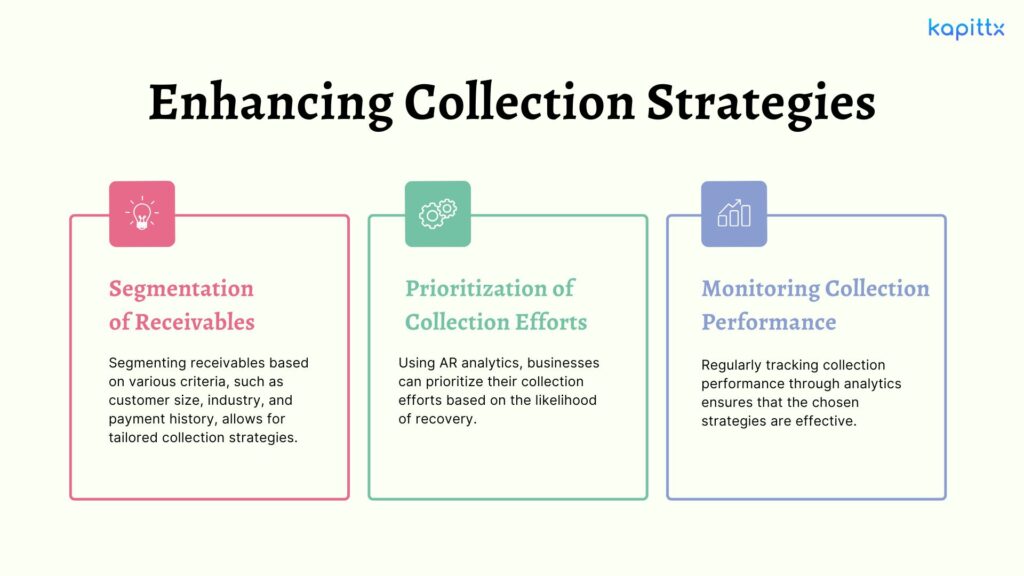
- Segmentation of Receivables: Segmenting receivables based on various criteria, such as customer size, industry, and payment history, allows for tailored collection strategies. For instance, high-value customers with good payment records may be handled differently from smaller accounts with inconsistent payment patterns.
- Prioritization of Collection Efforts: Using AR analytics, businesses can prioritize their collection efforts based on the likelihood of recovery. Accounts with a high probability of payment can be targeted for softer collection tactics, while accounts with lower probabilities may require more intensive follow-up.
- Monitoring Collection Performance: Regularly tracking collection performance through analytics ensures that the chosen strategies are effective. By comparing the success rates of different methods, businesses can continually refine their approach.
Case Study: AR Analytics in Action
Consider a mid-sized manufacturing company that implemented AR analytics to improve its cash flow management. Prior to leveraging analytics, the company struggled with high DSO and a significant amount of overdue receivables.
By deploying AR analytics, the company was able to:
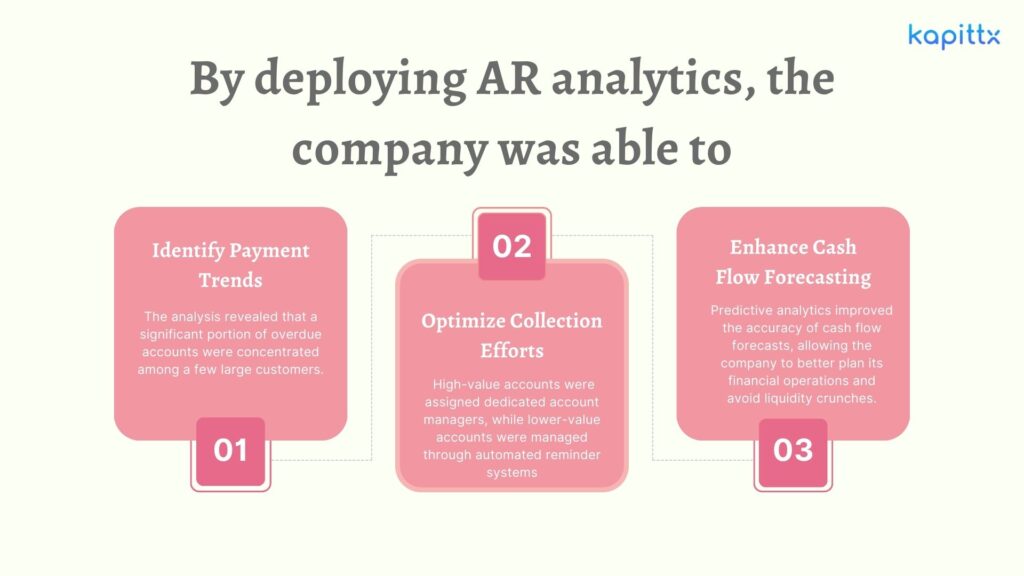
- Identify Payment Trends: The analysis revealed that a significant portion of overdue accounts were concentrated among a few large customers. By addressing these accounts directly, the company was able to negotiate more favorable payment terms and reduce its DSO.
- Optimize Collection Efforts: The company segmented its receivables and tailored its collection strategies accordingly. High-value accounts were assigned dedicated account managers, while lower-value accounts were managed through automated reminder systems. This resulted in a 20% improvement in the CEI.
- Enhance Cash Flow Forecasting: Predictive analytics improved the accuracy of cash flow forecasts, allowing the company to better plan its financial operations and avoid liquidity crunches.
Conclusion
In today’s competitive business environment, leveraging AR analytics is no longer optional—it is a necessity. By gaining actionable insights into payment behaviors and collection effectiveness, businesses can significantly enhance their accounts receivable processes. This enhances cash flow, lowers the risk of bad debt, fortifies customer relationships, and promotes overall financial health.
Implementing AR analytics requires a commitment to data-driven decision-making and continuous improvement. With the right tools and strategies in place, businesses can transform their AR operations and achieve sustainable growth.
What are the key points of accounts receivable?
Accounts receivable is one of the most critical functions in finance, because it’s the process that converts revenue into actual cash. Yet, despite its importance, many businesses still treat AR as a routine back-office task. In reality, AR is a strategic lever that directly impacts cash flow, customer experience, and profitability.
AR Is Measurable – and That Makes It Powerful
Unlike many other finance functions, AR can be tracked using clear, quantifiable metrics. This makes it easier to assess performance, identify inefficiencies, and drive improvements. Some of the most important metrics include:
- Days Sales Outstanding (DSO): Measures the average number of days it takes to collect payment after a sale. As per Kapittx research, the average DSO across industries is around 68 days, but in sectors like logistics, distribution, and technology services, it can exceed 120 days.
- Average Payment Days: Tracks how long customers typically take to pay invoices.
- Accounts Receivable Turnover Ratio: Indicates how efficiently a company collects its receivables.
- Collection Forecast vs. Actuals: Helps finance teams predict cash inflows and manage liquidity.
These metrics aren’t just numbers—they’re indicators of business health. A high DSO or low turnover ratio can signal cash flow issues, poor customer engagement, or inefficiencies in the collection process.
AR Is Where Finance Meets Customer Experience
AR is one of the few finance functions that directly interacts with customers. Every invoice, reminder, and follow-up email shapes the customer’s perception of your business. A smooth, professional AR process can enhance trust and loyalty. On the flip side, errors or delays can damage relationships and lead to disputes.
Kapittx emphasizes the importance of aligning AR operations with customer behavior. Their platform uses AI to segment customers based on payment history—such as Prompt Payers, Irregular Payers, or High-Risk Accounts—and applies tailored collection strategies to each group.
AR Is a Strategic Asset, Not Just a Ledger
Traditional AR processes rely on aging reports and manual tracking through spreadsheets or ERP systems. These tools offer limited visibility and don’t account for the complexity of B2B payment behavior. Kapittx redefines AR by treating receivables as a financial portfolio, much like an investment manager would. This approach allows businesses to:
- Monitor credit exposure in real time
- Adjust collection strategies dynamically
- Forecast cash flow with greater accuracy
- Free up working capital for growth initiatives
Automation Is the Future of AR
To truly unlock the potential of AR, businesses must embrace automation. Kapittx’s platform automates key tasks like invoice delivery, payment reminders, email response handling, and dispute resolution. This not only improves efficiency but also empowers finance teams to focus on strategic decisions rather than repetitive tasks.
In summary, accounts receivable is far more than a transactional process. It’s a measurable, customer-facing, and strategically vital function. With tools like Kapittx, businesses can transform AR into a growth engine – reducing DSO, improving cash flow, and enhancing customer relationships
What is the AR aging metric?
Accounts Receivable ( AR ) aging is one of the most fundamental metrics in financial management, and yet, it’s often misunderstood or underutilized. At its core, AR aging is a snapshot of how long invoices have been outstanding. It categorizes receivables based on the number of days they’ve remained unpaid after the credit period, typically segmented into buckets like 0–15 days, 16- 30 days, 31–60 days, 61–90 days, and 90+ days.
AR aging isn’t just a static report, it’s a dynamic indicator that reveals the health of your receivables, the behavior of your customers, and the efficiency of your collections process.
Why AR Aging Matters
AR aging helps finance teams answer critical questions:
- Which customers are consistently late?
- How much cash is locked up in overdue invoices?
- Are collection efforts aligned with payment behavior?
By analyzing aging data, businesses can identify risk early, prioritize follow-ups, and reduce the likelihood of bad debt. Kapittx’s platform takes this a step further by integrating aging metrics into a broader portfolio strategy, treating receivables like financial assets segmented by risk and behavior.
From Static Buckets to Behavioral Insights
Traditional aging reports offer a surface-level view. They show how long invoices have been outstanding, but they don’t explain why. Kapittx transforms aging analysis by applying AI-driven behavioral segmentation. Customers are grouped into profiles such as:
- Prompt Payers
- Irregular Payers
- High-Risk Accounts
These segments are updated in real time, allowing finance teams to tailor collection strategies based on actual payment behavior—not just aging buckets.
Key Metrics That Complement Aging
While aging is foundational, it’s most powerful when used alongside other AR metrics:
- Days Sales Outstanding (DSO): One of the universal measurement that indicates the average time to collect your receivables. Kapittx research shows the average DSO across industries is around 68 days, but in some sectors, it can exceed 120 days.
- Average Days Delinquent (ADD): Indicates how late payments are, on average. This complements aging by showing the severity of delays.
- Collection Forecast vs. Actuals: Helps predict cash inflows and assess the accuracy of collection efforts.
Kapittx’s platform integrates these metrics into a unified dashboard, giving finance leaders a real-time view of receivables health and collection performance.
By reimagining AR aging as part of a data-driven portfolio strategy, Kapittx empowers finance teams to move from reactive tracking to proactive management.
In summary, AR aging is more than a compliance tool, it’s a window into customer behavior, cash flow risk, and operational efficiency. With platforms like Kapittx, aging becomes a strategic asset that drives smarter decisions and stronger financial outcomes.
What are the best account receivable analysis techniques?
Accounts receivable (AR) is more than just tracking unpaid invoices – it’s a strategic function that directly impacts cash flow, customer relationships, and financial health. With accounts receivable analytics, businesses can move from reactive collections to proactive cash management. Kapittx, a leader in AR automation, emphasizes that effective AR analysis is key to unlocking faster collections and smarter decisions.
Here are the top 10 most effective accounts receivable analysis techniques every business should use :
1. Days Sales Outstanding (DSO)
The average number of days to collect payment is measured by DSO. As per Kapittx research, the average DSO across industries is around 68 days, but in sectors like logistics or tech services, it can exceed 120 days. A rising DSO signals inefficiencies in collections and potential cash flow issues.
2. Collection Effectiveness Index (CEI)
CEI evaluates how efficiently receivables are collected within a given period. A high CEI means your collection strategy is working; a low CEI suggests delays or gaps in follow-up processes.
3. Accounts Receivable Turnover Ratio
This ratio shows how often receivables are collected during a period. A higher turnover indicates faster collections and better liquidity. It’s a key metric for assessing the overall health of your AR process.
4. Aging Analysis
Aging reports categorize receivables by how long they’ve been outstanding—0–30 days, 31–60 days, etc. Kapittx enhances this by layering behavioral segmentation, identifying Prompt Payers, Irregular Payers, and High-Risk Accounts for targeted strategies.
5. Dispute Reason Analysis
Understanding why invoices are disputed helps reduce future delays. Kapittx tracks dispute reasons and assigns resolution workflows, helping teams resolve issues faster and improve customer experience.
6. Customer Payment Patterns
Analyzing payment behavior over time reveals which customers consistently pay late. Kapittx uses AI to segment customers and automate follow-ups based on their payment history, improving collection timing and reducing manual effort.
7. Average Invoice Payment Days
This metric tracks how long it takes customers to pay invoices on average. It complements DSO and helps identify trends across customer segments or industries.
8. Credit Analysis
Monitoring credit exposure is essential to managing risk. Kapittx provides real-time visibility into credit limits and outstanding balances, allowing finance teams to adjust terms and prevent overextension.
9. Invoice Submission Time and supporting documents that your customer requires
Delays in sending invoices, along with supporting documents, can lead to delayed payments. Tracking how quickly invoices are generated and delivered helps streamline the billing process and improve cash flow. It is also critical to time the invoice submission with your customers’ accounts payable cycle. Missing the accounts payable cycle could push your payment to the next cycle, increasing the DSO. As per Kapittx’s research, 28% of the customers come back with feedback that they haven’t received the invoice or need relevant supporting documents.
10. Bad Debt Ratio
This ratio compares bad debts to total sales. A rising bad debt ratio signals deteriorating customer credit quality and the need for tighter credit controls. Kapittx helps monitor this in real time to minimize losses.
From Static Reports to Strategic Insights
Kapittx transforms AR analysis from spreadsheet-driven reporting to intelligent, portfolio-style management. By combining these techniques with automation and predictive analytics, businesses can reduce DSO, improve cash flow, and empower finance teams to make data-driven decisions.
What are the key accounts receivable collection strategies?
Efficient accounts receivable collection strategies are no longer optional, they’re essential. Late payments, disputes, and manual follow-ups can choke cash flow and strain customer relationships. That’s why platforms like Kapittx are revolutionizing AR management with intelligent, automated strategies that drive results.
Here are the most effective AR collection strategies businesses should adopt:
1. Automated Communication Workflows
With the power of AI and automation to keep customers engaged, scheduled payment reminders, past-due alerts, and personalized follow-ups reduce manual effort and ensure consistent communication. This proactive approach minimizes late payments and improves customer accountability.
2. Behavioral Segmentation of Customers
Not all customers behave the same. AR software like Kapittx uses AI to segment customers into categories like Prompt Payers, Irregular Payers, and High-Risk Accounts. Each segment receives a tailored collection strategy—aggressive follow-ups for high-risk accounts, and flexible terms for reliable payers.
3. Portfolio-Based Receivables Management
Kapittx treats receivables like financial assets. Their portfolio model allows finance teams to manage AR with the same precision as investment portfolios—balancing risk, liquidity, and performance. This strategic view replaces static aging reports with dynamic, real-time insights.
4. Real-Time Credit Exposure Tracking
Knowing how much credit is extended—and to whom—is vital. Kapittx enables finance leaders to monitor credit exposure by customer, region, or industry. This helps adjust credit limits, prioritize collections, and avoid overextension.
5. Dispute Resolution Workflows
Disputes are a major cause of delayed payments. Kapittx tracks dispute reasons and automates resolution workflows, ensuring faster turnaround and fewer repeat issues. This improves customer satisfaction and accelerates collections.
6. Invoice Submission Optimization
Timely invoicing is the first step to timely payment. Kapittx streamlines invoice generation and delivery, reducing delays and improving billing accuracy. Faster invoicing means faster collections.
7. Predictive Cash Flow Modeling
By analyzing customer payment behavior, Kapittx helps businesses forecast collection timing. This predictive insight allows better liquidity planning and reduces the risk of cash shortfalls.
8. Dedicated Collection Workflows by Segment
Each customer segment has a designated collection strategy. High-risk accounts may receive automated escalation paths, while prompt payers get gentle reminders. This targeted approach improves efficiency and reduces friction.
9. Data-Driven Decision Making
Kapittx centralizes AR data, enabling finance teams to make informed decisions. Whether it’s adjusting terms, reallocating resources, or identifying trends, data becomes the backbone of strategy.
10. Cost Reduction Through Automation
Manual collections are resource-intensive. Kapittx reduces costs by automating repetitive tasks, like follow-ups, dispute tracking, and reporting—freeing up teams to focus on strategic activities.
From Chaos to Control
Kapittx’s approach transforms AR from a reactive function to a strategic asset. By combining automation, segmentation, and real-time analytics, businesses can improve cash flow, reduce risk, and build stronger customer relationships.
How to find average accounts receivable on the balance sheet?
Accounts receivable (AR) is a vital financial asset for any business offering credit sales, it reflects outstanding customer payments and plays a direct role in shaping cash flow, liquidity, and overall financial strategy. But to truly understand AR performance, especially when calculating metrics like Days Sales Outstanding (DSO) or AR Turnover Ratio, you need to know how to find the average accounts receivable.
Where to Find AR on the Balance Sheet
Accounts receivable is listed under current assets on the balance sheet. To calculate the average:
- Step 1: Locate the AR balance at the beginning of the period (e.g., January 1).
- Step 2: Locate the AR balance at the end of the period (e.g., December 31).
- Step 3: Apply the formula above.
If you’re using quarterly data, repeat the process for each quarter and average those values
What is the ideal receivable collection period?
In the world of B2B finance, timing is everything, especially when it comes to collecting payments. The receivable collection period serves as a vital performance metric, indicating the efficiency with which a business recovers cash from its credit sales. But what’s considered “ideal”? And how can companies optimize it?
Let’s explore the concept, its impact, and how platforms like Kapittx are redefining what “ideal” really means.
The receivable collection period represents the average number of days a company takes to collect customer payments following a credit sale. It’s calculated using:
A shorter collection period means faster cash inflow, while a longer one can signal inefficiencies or customer payment delays.
There’s no one-size-fits-all answer to the question What is the ideal receivable collection period? The ideal period depends on:
- Industry norms: Manufacturing may tolerate 60–90 days, while SaaS or services aim for 30–45 days.
- Customer behavior: Some clients consistently pay late, others early.
- Credit policy: Stricter terms lead to faster collections but may reduce sales volume.
However, Kapittx suggests that 45 days is a healthy benchmark for most mid-market B2B firms. Beyond 60 days, businesses risk liquidity strain and increased bad debt exposure.
Why It Matters
A lengthy collection period can:
- Delay cash flow
- Increase reliance on external financing
- Inflate working capital needs
- Signal poor credit control or invoicing inefficiencies
Kapittx’s data shows that companies with optimized collection periods experience 20–30% faster cash conversion cycles, reducing their need for short-term borrowing.
How Kapittx Optimizes Collection Periods
Kapittx doesn’t just track the collection period—it transforms it. Here’s how:
1. Automated Reminders
Kapittx sends consistent, polite, and personalized reminders, reducing manual effort and improving on-time payments. Timely nudges result in 60% of customers paying on time.
2. Behavioral Segmentation
Customers are grouped into Prompt Payers, Irregular Payers, and High-Risk Accounts. Each segment gets a tailored collection strategy, improving efficiency and reducing delays.
3. Portfolio-Based Management
Receivables are treated like financial assets. Kapittx’s strategic portfolio model allows finance teams to manage AR with precision—balancing risk, liquidity, and performance.
4. Real-Time Credit Exposure
Finance leaders can monitor credit limits and outstanding balances by customer or region, helping adjust terms and prioritize collections.
5. Predictive Cash Flow Modeling
Kapittx uses AI to forecast when payments will arrive, helping businesses plan liquidity and avoid shortfalls.
Final Thoughts
The ideal receivable collection period isn’t just a number, it’s a reflection of your credit policy, customer relationships, and operational efficiency. With Kapittx, businesses can move from reactive collections to proactive cash flow management, shortening the collection cycle and strengthening financial health.
